

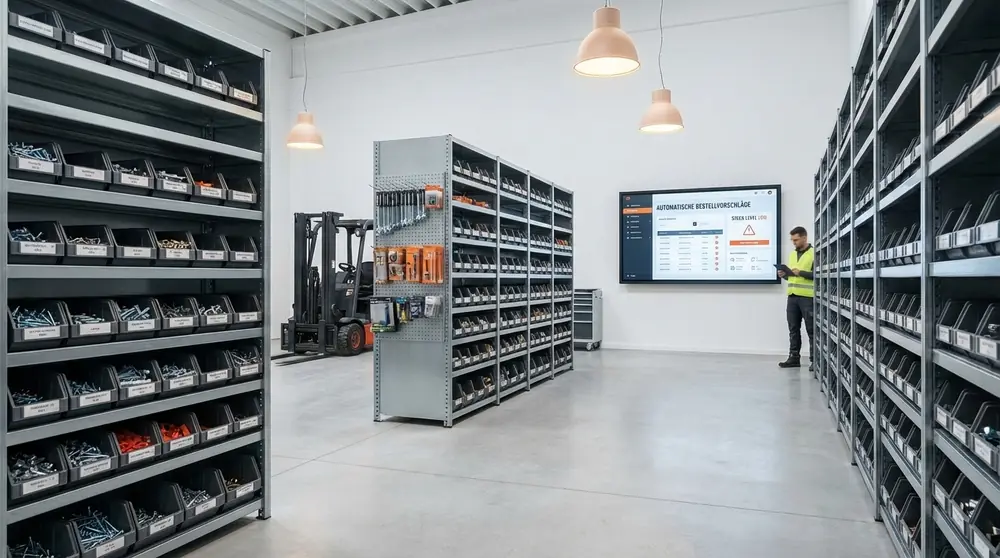
1. Fundamentals of Digital Procurement in the Trades
Every craftsman knows this scene: It's early in the morning, the team gathers in the workshop, the coffee is still steaming, and everyone is ready to go. But as the van is being loaded, it suddenly becomes clear: The Wago connectors are empty again. The shelf is yawningly empty, a search in the warehouse is fruitless, and they are urgently needed on the construction site shortly.
So it's time again: „Come on, we have to make a quick stop at the hardware store.“
An unplanned detour that eats up time, disrupts the schedule, and jeopardizes deadlines. For many trade businesses, this exact scenario has long been a daily reality and a silent cost driver every month.
Meanwhile, external pressure continues to mount: customers expect reliability, supply chains are more volatile than ever, and materials must be available precisely when needed to prevent the day from failing before it even starts. This is exactly where modern, digital procurement comes in. It ensures that the right material is in the right place at the right time—without chaos, without stress, without constantly checking stock levels in the warehouse.
Our article How-To: How Craftsmen Digitize the Procurement of Their Consumables shows just how simple the step away from paper notes, gut feelings, and spontaneous phone orders toward clear, automated processes really is. Digital procurement not only gives trade businesses time and transparency but also a huge competitive edge.
Digital procurement means: Ordering and warehouse processes are managed with software, apps, and automation. No more searching, no "Who ordered it?", no surprise shortages. Instead, systems automatically detect material needs and trigger orders in a timely manner.
That this works is also confirmed by official bodies: According to the IHK Digitalization Consulting, trade businesses can increase their efficiency by up to 30 percent through digital processes while achieving significant cost savings.
2. Advantages of Digital Material Procurement
Cost Savings & Efficiency Increase
Digital solutions offer price comparisons, automatic order suggestions, and transparent spending overviews. This saves real money and reduces unnecessary multiple orders. Businesses that digitize their procurement report savings of between 15 and 25 percent on material costs.
Better Transparency and Traceability
Every employee can see at a glance:
- What materials are available?
- What needs to be reordered or is currently on order?
- What are the monthly material costs?
This transparency minimizes bottlenecks and ensures smooth construction site operations. Digital systems automatically document every material flow, which is also invaluable for audits and post-calculations.
Time Savings through Automation
What used to cost hours in phone calls, emails, and manual orders, a digital system completes in minutes. Employees gain valuable time that they can invest in productive activities.
3. Typical Challenges for Craftsmen
Time-Consuming Orders
Daily phone calls, follow-up questions, and manual delivery time reconciliations cost valuable time. Time that is often lacking on construction sites. A master craftsman spends an average of 3-5 hours per week on ordering processes that could largely be automated, except for project-specific procurement.
Lack of Material Overview
When material is "missing" or no one has an overview, delays occur. Especially with multiple parallel construction sites, businesses quickly lose track of stock levels and material distribution.
Non-transparent Costs
Without digital recording, many businesses do not know exactly what materials actually cost. Discounts are not used optimally, price increases go unnoticed, and post-calculation becomes an estimate.
Communication Problems in the Team
When every employee orders independently and without central coordination, double orders, stock shortages, and chaos in the warehouse arise.
4. Step-by-Step Guide: How-To: How Craftsmen Digitize the Procurement of Their Consumables
Step 1: Analysis of the Current Process
First, the current state should be documented: How are orders placed today? Who is responsible? Where do delays occur?
Create an honest inventory:
- How many hours per week are spent on ordering processes?
- How often do material bottlenecks occur?
- What is the monthly error rate for orders?
- Which suppliers are used?
- Is there a warehouse system, or is it chaos?
This analysis forms the basis for all further steps and often already shows where the greatest savings potentials lie.
Repleno can help make costs transparent: To the Savings Calculator
Step 2: Selection of Suitable Digital Tools
Good tools offer:
- Mobile, simple application
- Supplier integration
- Inventory management
- Automatic reorders or at least reminders
- User-friendly interfaces
- Interfaces to existing systems
Make sure that the solution was developed specifically for trade businesses. Oversized ERP systems from industry are often too complex and expensive.
Step 3: Central Supplier Management
All suppliers are bundled digitally. Employees no longer have to shop on various websites but have all catalogs in one place. This creates an overview and enables real price comparisons.
Create master data for each supplier:
- Contact details
- Delivery conditions
- Discount agreements
- Delivery times
- Minimum order quantities
Step 4: Automated Ordering Processes
Systems independently trigger order requests based on minimum stock levels. The core of digital procurement are intelligent ordering rules:
- An order is automatically suggested when the minimum stock level is breached
- Frequently needed materials are purchased in larger quantities at a discount
- Seasonal fluctuations are taken into account
- Delivery times are factored into the order timing
Automation takes over routine work, while strategic decisions remain with humans.
Step 5: Mobile Solutions on the Construction Site
Materials can be scanned, ordered, and documented via smartphone. The electrician on the construction site scans the barcode of an empty cable roll and thus automatically triggers a reorder, without a phone call, without a note, without delay.
Mobile apps enable:
- Material bookings directly on the construction site
- Photo documentation of material damage
- Immediate orders in case of bottlenecks
- Real-time stock inquiries
5. Indispensable Digital Tools for Trade Businesses
The selection of the right digital tools determines the success or failure of digitalization. The following solution types have proven effective:
Mobile Ordering Apps
Apps like the Würth App, ToolSense, or specialized craftsman solutions enable orders on the go. They are particularly valuable for businesses with many field operations.
Cloud Warehouse Management
Cloud-based systems synchronize inventory levels in real-time across all locations. Every employee immediately sees where which material is available.
Digital Supplier Catalogs
Instead of printed catalogs, employees access current online catalogs with prices, availabilities, and technical data sheets.
Barcode and QR Scanners
Simple scanners or smartphone apps speed up material recording enormously and reduce typing errors to zero.
The Mittelstand-Digital Zentrum Handwerk offers free advice and practical examples for selecting suitable digital tools in the trades.
6. Implementing Digital Warehouse Management Correctly
Digital warehouse management ensures that everything is in the right place at the right time. It is the backbone of a functioning digital procurement system.
Real-time Inventory Tracking
Material consumption is documented automatically. Every withdrawal, every return, and every receipt is recorded in real time. The system always knows exactly what is stored where.
Barcode and QR Scanning
Simple scanning replaces handwritten order lists. A scan takes two seconds – manual noting and later transfer costs minutes and is prone to errors.
Intelligent Reorder Points
The system knows exactly when to reorder. It takes into account:
- Average consumption
- Seasonal fluctuations
- Supplier delivery times
- Minimum order quantities
- Warehouse capacities
Warehouse Slot Optimization
Digital systems suggest optimal storage locations: fast-movers within easy reach, slow-movers further back, heavy items at the bottom, frequently needed items next to each other.
7. Integrating Suppliers Digitally
The integration of your suppliers is a crucial step towards the complete digitalization of procurement.
Electronic Catalogs
Electronic catalogs ensure quick access to items and prices. Instead of flipping through paper catalogs for hours, employees find the right material in seconds using the search function.
Automatic Ordering Processes
Orders are processed without manual intervention. From the order trigger to approval and transmission to the supplier – everything is digital and documented.
EDI Interfaces
Larger businesses benefit from EDI (Electronic Data Interchange) interfaces, which fully automatically exchange orders, order confirmations, and delivery notes between systems.
Supplier Portals
Many wholesalers offer their own portals through which craftsmen can order directly, track deliveries, and view invoices. Integrating these portals into your own software creates maximum efficiency.
8. Employee Training for Digital Processes
The best software is useless if employees do not use it or cannot use it correctly.
Simple Onboarding Methods
Short videos, clear checklists, and test orders ensure quick learning progress. No one has to read a 200-page manual; instead, employees learn the most important functions in 30 minutes.
Proven training methods:
- Practical exercises with real examples from daily operations
- Video tutorials for each main function (max. 3-5 minutes)
- Checklists for the most common procedures
- Contact person for questions
- Regular short refreshers
Dealing with Technology Skepticism
Through practical examples and small steps, many reservations can be overcome. Show specifically how much time and stress the digital solution saves. Let skeptics try the software themselves – nothing is more convincing than one's own positive experience.
Typical concerns and how to respond to them:
"We've always done it this way" → Show concrete numbers: This is how many hours we save per week, this is how much money we save per month.
"I'm not good with computers" → Modern apps are more intuitive than most people think. Often, operation is easier than the old method.
"This takes longer" → Maybe in the first few days, but after a week, everyone is faster than before.
Identifying Champions in the Team
Find one or two Digital Champions in your team – tech-savvy employees who act as multipliers and contact persons. They help colleagues with questions and collect feedback for process improvement.
9. Data Protection & Security
Digital procurement requires high standards for the protection of sensitive business data.
Encryption and Secure Transmission
- SSL encryption for all data transfers
- Secure servers in German data centers
- Regular security updates
- Backup strategies for emergencies
Access Control
- Two-factor authentication for all users
- Role-based access: Each employee only sees what they need for their work
- Logging of all changes for traceability
- Automatic logout after inactivity
GDPR Compliance
Ensure that your solution is GDPR compliant. This means:
- Data processing in the EU
- Clear privacy policy
- Possibility of data deletion
- Transparency about stored data
Supplier Data Protection
Clarify with your suppliers how order data is stored and processed. Conclude data processing agreements if necessary.
10. Practical Example: A Small Trade Business Digitizes its Procurement
To make the concept behind our blog tangible, let's look at a realistic scenario.
Initial Situation
The fictional company Müller & Sohn Electrical Installations had been struggling with the same problems for years:
- Lack of overview of consumables
- Frequent bottlenecks for small parts like dowels, fuses, and insulating tape
- Unnecessary trips to the wholesaler (on average 4-5 per week)
- Unclear responsibilities for ordering
- No transparency about monthly material costs
- Disputes in the team over "missing" material
The team consisted of 12 employees, spread across several construction sites per week. During peak times, it often happened that material was missing and an employee had to drive to the nearest branch. Mostly during working hours, which annoyed customers and caused costs.
Managing Director Tommi Müller calculated: "We lose at least 6 hours a week on material runs. At an hourly rate of 75 euros, that's 450 euros. Just for trips! On top of that are the actual material costs, which we can't optimize due to a lack of overview."
Implementation of Digitalization
The company decided on a gradual introduction over three months:
Month 1: Data Collection and System Setup
- Recording of all current consumables: Every common consumable was recorded in a central software. The team invested two Saturdays to inventory and digitize the entire warehouse.
- Setting up digital minimum stock levels: A minimum stock level was defined for each item based on historical consumption data. The system would automatically detect when an item was running low.
- Team training: All employees received a two-hour introduction plus individual follow-up training.
Month 2: Mobile Integration
- Mobile app for the warehouse: Employees scan barcodes in the warehouse upon removal, thus triggering stock bookings. Every technician received a company smartphone with the procurement app.
- Test phase with feedback rounds: Weekly short meetings collected experiences and suggestions for improvement.
Month 3: Automation and Optimization
- Connection of regular suppliers: The suppliers were connected to the software, and orders now run directly from the system to the supplier.
- Automated approval processes: Most items are processed fully automatically. Larger orders or specific items are automatically presented to the master craftsman for approval via email.
- Fine-tuning of minimum stock levels: After the first few weeks, the minimum stock levels were optimized based on real consumption data.
Results after six months
The digitalization showed impressive improvements:
- 37% fewer material bottlenecks – critical situations on construction sites became rare
- 25% less time lost due to spontaneous shopping trips – time that is now used productively
- 15–22% lower material costs through transparent comparisons and volume discounts
- Significantly higher employee satisfaction as chaos in the warehouse was eliminated
- A clean, traceable procurement process – the accounting department is happy about proper receipts
Tommi Müller summarizes: "The investment of about 3,500 euros for software, training, and hardware paid for itself after just four months. But more importantly: my employees are more satisfied, we work more professionally, and I can sleep soundly at night again because I know that no material will be missing tomorrow."
He is particularly impressed by a side effect: "We can now calculate much more precisely for larger orders because we know exactly what materials really cost. This has already secured us several lucrative contracts that we would have previously offered too expensively out of uncertainty."
This example shows: Even small trade businesses benefit massively as soon as the first steps are digitized.
11. Costs of Digital Procurement Solutions
Digital procurement does not have to be expensive. Many solutions are modular, so you can start with what you really need.
Subscription Models
Typical monthly prices:
| Solution Type | Average Price |
|---|---|
| Mobile Ordering App | €10–€20 per user/month |
| Digital Warehouse Management | €49–€150 per company/month |
| Complete Solutions with ERP Connection | €150–€500 per month |
| Scanner Hardware | €50–€200 one-time |
Smaller businesses with 3–5 employees often manage with investments of less than €100 per month.
One-time Investments
In addition to ongoing costs, there are one-time investments:
- Setup and configuration: €500–€2,000
- Team training: €300–€800
- Hardware (scanners, tablets): €200–€1,000
- Data entry (one-time inventory): €500–€1,500 (depending on warehouse size)
Cost-Benefit Comparison
Experience shows: Digital procurement usually pays for itself within 3–6 months because:
- Less material is wasted (average savings of 8–12%)
- Less often purchased too expensively (5–15% cost reduction through better price comparisons)
- Employees work more productively (3–6 hours of time saved per week)
- Fewer errors occur (reduction of incorrect orders by 60–80%)
- Warehouse costs decrease (10–20% less tied-up capital through optimized stock levels)
Especially in the trades, where material is time-critical, digitalization has an immediate positive impact.
Funding Opportunities
Many businesses do not know that digitalization projects are funded. Find out about:
- go-digital – Funding program of the Federal Ministry for Economic Affairs
- Digital Jetzt – Investment funding for digital technologies
- Regional funding programs of the federal states
- KfW loans for digitalization projects
Often, 30–50% of the investment costs can be funded.
12. Common Mistakes in Digitalization
Many trade businesses make the same mistakes when trying to digitize their procurement. Learn from the experiences of others and avoid these pitfalls.
Lack of Team Involvement
If employees are not involved early on, resistance arises. Success only comes when all participants understand and apply the benefits. Involve your team from the beginning and ask about their needs and concerns.
Incomplete Master Data Entry
If only 80% of materials are digitally recorded, the remaining 20% will continue to be ordered manually, and the system will not work correctly. Take the time for a complete initial entry.
No Clear Responsibilities
If no one is responsible for maintaining the system, it quickly deteriorates. Appoint a system administrator to take care of updates, master data maintenance, and support.
Overly Complicated Processes
Digitalization should simplify, not complicate. If the digital process is more complex than the old analog one, employees will find ways to circumvent it. Keep everything as simple as possible.
Lack of Measurability
If you don't measure, you can't improve. Define key figures from the outset:
- Average order time
- Number of express orders
- Material costs per order
- Inventory turnover rate
- Employee satisfaction
Only then can you see if the digitalization is successful.
Lack of Supplier Coordination
Clarify with your main suppliers early on which digital interfaces are available. Some wholesalers offer their own apps or APIs that significantly facilitate integration. An isolated solution may be sufficient to start. As soon as you are supplied by several suppliers, it may be advantageous for you to use an independent app where you have control over suppliers and items, and not the other way around.
13. Future Trends in Digital Procurement
Digitalization in the trades is still in its infancy. The future will bring major changes that you can prepare for today.
Fully Automatic Material Supply
New apps will autonomously carry out entire reorders. Suppliers will deliver directly to construction sites or intelligent depots without an employee having to take action.
For example, an electrician takes the second-to-last B16 circuit breaker from the warehouse. This is automatically registered, the system reorders, and the new breakers are in the material depot the next morning—fully automatically, without manual intervention.
IoT Integration (Internet of Things)
Intelligent shelves with weight sensors automatically detect when material is removed. RFID transponders enable a lightning-fast inventory of the entire warehouse. Smart tool cases report when consumables are running low.
Blockchain for Supply Chains
Blockchain technology enables complete transparency over supply chains: Which manufacturer does the material come from? What was the transport route? Is the quality certification genuine? This information is documented in a forgery-proof manner.
Augmented Reality for Warehouse Management
AR glasses show warehouse staff directly in their field of vision where which material is located and what the optimal picking route is. The error rate drops to almost zero, and speed increases significantly.
Predictive Maintenance for Material
Sensors in warehouses monitor environmental conditions and warn if materials could be affected by moisture, temperature, or light. This prevents material waste due to storage damage.
These developments make material bottlenecks virtually impossible and reduce administrative efforts to a minimum.
14. Integration with Other Business Processes
Digital procurement only unfolds its full potential when it is networked with other digital processes in the business.
Connection to Project Management
If your project management tool knows which orders are pending, it can automatically determine the required materials and initiate procurement. Material and projects are planned synchronously.
Integration with Time Tracking
Time tracking shows which employee is working on which construction site. The procurement system thereby knows where material should be delivered.
Link to Enterprise Resource Planning
A seamless connection between procurement and ERP ensures continuous data flows: From ordering to goods receipt, order allocation, and invoicing, everything runs automatically.
Interface to Accounting
Digital procurement automatically provides accounting with all relevant data: orders, delivery notes, invoices – all digital, assignable, and verifiable. This saves considerable time in accounting and year-end closing.
15. FAQ – Frequently Asked Questions
1. What is meant by digital procurement in the trades?
It is the use of digital tools to make orders, stock levels, and supplier processes more efficient. Instead of manual phone calls, paper lists, and notes, software solutions take over the organization, execution, and documentation of all procurement processes.
2. Is digitalization also worthwhile for small trade businesses?
Yes, especially so. Small businesses often suffer more from time and material losses. They have less buffer and need to work more efficiently. Digital procurement creates order and saves costs, often with manageable investments of under 100 euros per month.
3. Can I integrate my existing suppliers?
In most cases, yes. Many wholesalers like Würth, Sonepar, or Berner offer digital catalogs and interfaces. Smaller regional suppliers are also increasingly providing digital ordering options. In case of doubt, you can start with a manual integration until the supplier offers an automatic interface.
4. How long does it take to implement a digital system?
Depending on the scope, between 1 and 4 weeks. Most solutions are ready for use quickly. The basic installation for ERP systems, however, takes days. The real challenge lies in the initial entry of master data and team training. Realistically plan for 4–6 weeks from project start to full productive operation.
5. Are digital procurement systems secure?
Modern systems meet high security standards such as encryption and role-based access. When choosing, pay attention to: SSL encryption, server locations in Germany or the EU, GDPR compliance, regular security updates, and backup systems. Reputable providers are transparent about their security measures.
6. Which materials are particularly suitable for digital procurement?
Especially consumables: screws, dowels, tape, filler, sandpaper, gloves, cleaning agents, cables, insulation material, small parts. Anything that is frequently needed and consumed in large quantities. Tools and personal protective equipment can also be managed well digitally.
7. What happens if the system fails?
Reputable solutions have fail-safes: cloud backups, redundant servers, and offline modes. In an emergency, you can usually fall back on a manual emergency order. Important: Choose providers with high availability (at least 99.5% uptime) and a support hotline.
8. Do I need technical know-how?
No. Modern systems are deliberately developed for non-IT specialists. If you can operate a smartphone, you can also handle digital procurement software. Manufacturers place great value on intuitive operation.
9. Can I expand the system later?
Yes, most solutions are modular. You start with basic functions and later add: advanced warehouse management, more supplier integrations, interfaces to other systems, additional users, or locations. This allows for gradual growth without complete system changes. The question is, do you need all of that?
10. How quickly will I see results?
Initial improvements often become apparent after just 2–3 weeks: less search time, clearer orders, initial cost savings. The full return on investment typically occurs after 3–6 months. Long-term strategic advantages develop over 6–12 months.
16. Conclusion: The Future of Craft Procurement is Digital
The guide clearly shows: Digitalization is not a luxury, but a necessity. It makes ordering processes more transparent, reduces costs, improves team collaboration, and permanently eliminates bottlenecks.
The most important findings summarized:
- Digitalization pays off: Businesses save an average of 15–25% on material costs and 3–6 hours of working time per week.
- Getting started is easier than you think: With manageable monthly costs starting from €50–€100, even small businesses can get started.
- Employees benefit directly: Less stress, less search time, less trouble with missing material – job satisfaction measurably increases.
- The technology is mature: Modern solutions are specially developed for trade businesses – intuitive, robust, and reliable.
- Future-proofing: Those who digitize today will be ahead tomorrow. AI and automation will continue to revolutionize procurement.
Craftsmen who rely on digital procurement today work faster, more efficiently, and more competitively. The future belongs to businesses that consistently modernize their processes digitally.
The best time to start is now. Begin with a small solution, gain experience, and continuously optimize. After just a few weeks, you will wonder how you ever worked without digital procurement. The digital transformation in the trades is no longer a distant vision. It is happening here and now. Be a part of this development and secure a competitive advantage for your business that pays off every day.
About the author: This guide is based on practical experience and current developments in the digitalization of the trades, supported by expert knowledge from the IHK and Mittelstand-Digital centers.
Note: This article serves as a guide. Individual requirements may vary. For specific advice, contact a digitalization expert or your local Chamber of Commerce.