TL;DR
- Small load carriers (SLC, German: KLT) are standardized, stackable, reusable containers for parts and small components. In warehousing they are also called “totes”.
- The VDA Small Load Carrier system (VDA SLC; VDA 4500, version 3.0 / July 2025) is widespread, poolable and aligned to Euro/ISO pallets.
- For warehouse safety, follow rules like do not exceed loads, keep stacks vertical, and limit slenderness (DGUV).
What are small load carriers (SLC)?
Small load carriers are standardized crates (mostly plastic) used for transport, storage, order picking and line supply. Typically, they are stackable, reusable, robust, and built to fit processes that repeat thousands of times per day.
According to VDA 4500 and EN 13199, they have a base area up to 600×400 mm and are open containers for bulk goods and load units.
Where are SLC used in everyday operations?
SLC containers are helpful wherever many parts need to be moved quickly and cleanly:
- Production & assembly: stage parts, supply lines
- Warehouse & picking: pick, sort, count
- Buffering: smooth material flow
- Shipping/outbound: pack stably, reduce damage
SLC, Eurobox, Euro container: is that the same?
In everyday language, the terms blur. Often people mean standardized Euro base sizes like 600×400 mm. “KLT” is used more frequently in production and line supply contexts, especially when referring to industry standards (e.g., the VDA system).
Why do so many companies use SLC containers?
When logistics runs well, it looks easy. In reality, there’s a system behind it. KLT containers help make that system stable and repeatable, which saves time, money, and nerves.
How do standard dimensions fight chaos?
Standard dimensions are like LEGO bricks:
- Storage locations are easier to plan
- Pallets can be built up neatly
- Conveyors “know” the geometry
- Fewer special boxes = fewer exceptions
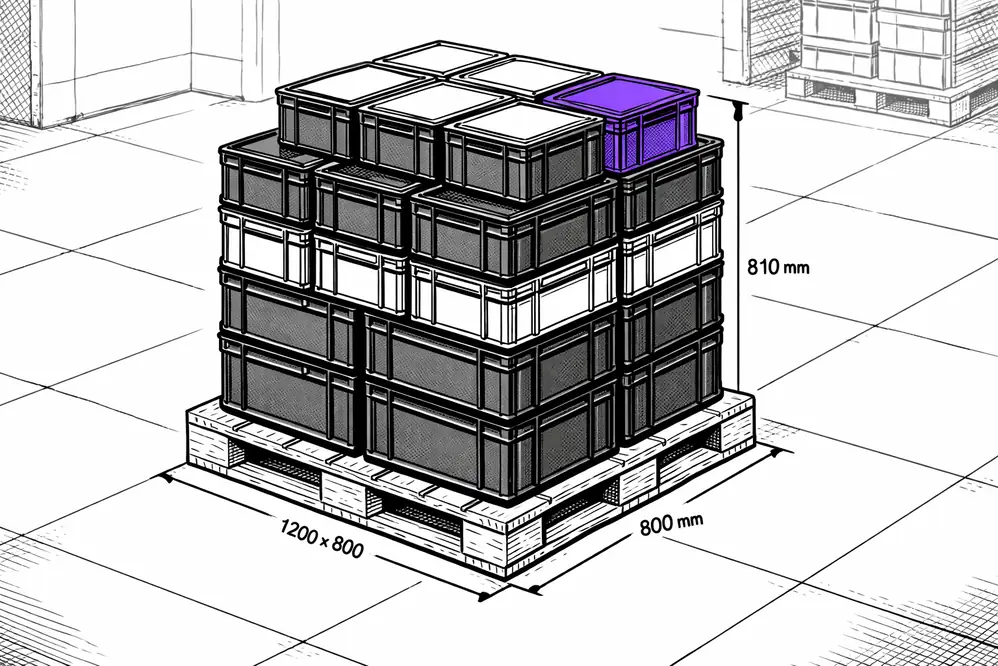
In the VDA system, the pallet reference is explicitly part of the idea: It is modular to 1200×800 (Euro) and 1200×1000 (ISO).
How do SLC protect parts and reduce damage?
Crates protect not only from dirt. They also protect against everyday handling errors:
- Parts mix less
- Fewer pressure marks than with cardboard
- More stable stacking = less toppling
And because the VDA system targets safe transport, protection of the load, ergonomics, and automatability, this thinking is built into the standard.
Which standards and systems matter?
What’s behind VDA 4500 (KLT system)?
The VDA recommendation (German Association of the Automotive Industry) describes a uniform system for manual and mechanical handling that is poolable (i.e., can circulate between partners). The text also emphasizes: cross-manufacturer compatibility, quality, and recyclability are central goals.
Which VDA variants exist (R/RL/C/F)?
In the VDA context, you will typically encounter:
- R-KLT / RL-KLT (rigid variants, often for automated processes)
- C-KLT (classified as a “special KLT” in the standard; historically grown) VDA+1
- F-KLT (foldable — interesting for empty-goods logistics) ISOCO+1
Important: The exact features depend on the specific type (base, handles, ribs, approvals). If you want to do it properly, orient yourself to VDA 4500 and/or to manufacturer data sheets that explicitly state “VDA-compliant”.
Which system elements are typical (lids, locking plates, RFID)?
Besides the containers themselves, there are system elements like lids and specific components for securing a load unit (e.g., locking plates for defined pallets). In VDA 4500 you will also find codes for ESD containers and RFID retrofit variants.
How do certification and quality assurance work?
For many supply chains it’s important that elements can be tested and certified according to VDA recommendations. DIN CERTCO describes certifications for the VDA Small Load Carrier System (KLT) based on VDA 4500/4504 (including audit/program).
Which SLC sizes are common - and how do they fit on pallets?
Which footprints are standard?
Common footprints are:
- 300 × 200 mm
- 400 × 300 mm
- 600 × 400 mm
These sizes are chosen so they can be combined modularly and fit pallet footprints well.
Which height grids are practical?
In practice, not only length/width matter, but also height. VDA 4500 describes, among other things, that coordinated height grids enable mixed stacks, and cites, for example, a combined stack height of 810 mm on standard load units (depending on the combination).
Which materials and options (e.g., ESD) make sense?
When do you need ESD containers?
If you move electronics or sensitive components, ESD protection can be crucial. In practice, people often reference standards from IEC/EN 61340-5-1, which define requirements and test methods in the ESD context.
Which extras really help (inlays, Kanban, labels, lids)?
Three things make an immediate difference in many operations:
- Lids: protection against dust and mixing
- Inlays/dividers: parts stay sorted, fewer scratches
- Identification: labels, barcodes, optionally RFID for cycles
Especially in the VDA context, topics like hangtags/barcode suitability and standardized labeling are common (e.g., VDA documents on labeling are often referenced).
You can also find our guide on how to label shelves and containers: Label shelves correctly
How do you choose the right container?
Here’s the part that really matters: selection is not about “gut feeling” — it’s a quick check.
Checklist: 10 questions before buying
- Does the footprint (600×400 / 400×300 / 300×200) fit shelf and pallet?
- How tall must the container be (volume / access / stacking)?
- What is the real filled weight (incl. inserts)?
- Hand handling or conveyor/robotics?
- Do you need lids or open crates?
- Is ESD necessary?
- How will containers be cleaned (interval, process)?
- How do empties return (folding solution yes/no)?
- What does identification look like (label/RFID)?
- Must it be VDA-compliant/certifiable?
We hope this checklist helps as a first reference — we’ll dedicate a separate article to the topic later on.
How do you stack and store KLT safely?
Safety is not an “extra”. It’s mandatory. Fortunately, the basic rules are simple.
Which DGUV ground rules apply to stacking?
The DGUV (German Social Accident Insurance) names, among others:
- Payload, top load, and stack heights must not be exceeded
- Build stacks vertically; if tilt is too high, take them down safely
- For very different loads: decrease towards the top
- There are limits for slenderness (ratio of height to narrow side)
Which practical tips prevent tipping and trouble?
- Put heavier contents at the bottom
- Sort out damaged containers (don’t “it’ll be fine”) VDA
- Don’t lean ladders/objects against stacks DGUV publications
- Keep aisles clear and mark stack areas
How "robot-ready" are SLC in automation?
Automation likes things that are always the same. That’s exactly why standardized crates are so popular.
Which features help conveyors & robotics?
Commonly helpful are:
- Defined runners/bottoms (smoother travel)
- Clear gripping zones
- Clean stacking and centering behavior
In the VDA context, automatability is even named as a goal.
Example video from practice (not sponsored):
Conclusion: What to remember
Small load carriers are strongest when you treat them as a process building block: choose standard sizes wisely, define options (lids/ESD/labeling) to fit your flow, take stacking rules seriously (DGUV), and safeguard quality in circulation (VDA mindset). That’s how “boxes” become a system that saves noticeable time every day.