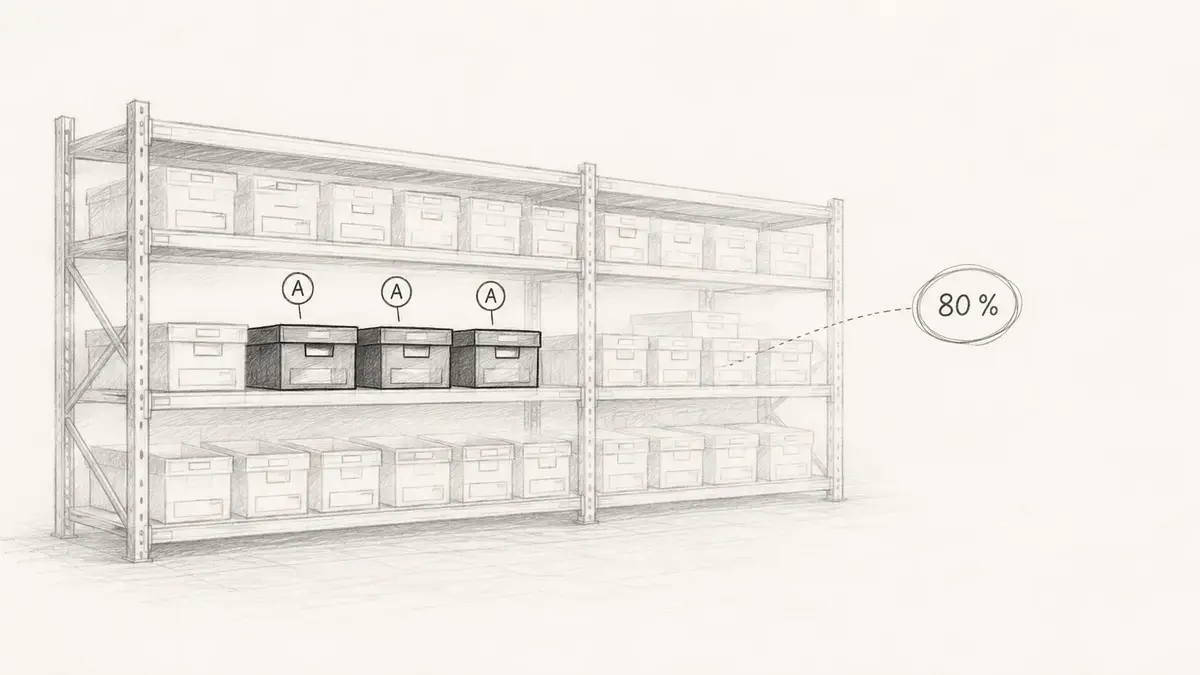
Monday morning, 06:45 AM. The cable shelf is empty.
You stand in the stockroom and reach into the void. The NYM-J 3x1.5 cable was there yesterday, now it's gone. No one said anything. No note, no message, nothing. The job site starts in an hour, and you know: Now you have to drive to the wholesaler first.
This isn't happening for the first time. And it won't be the last.
The Pattern: Four attempts that all fail
Almost every trades business goes through the same loop:
1. Panic reordering. Material is missing, you order too much to have peace of mind. Capital sits on the shelf, but at least no more outages. Until the next gap appears.
2. Making announcements. "Let me know if something runs out." Works for three days. Then someone forgets because other things are more important on the job site.
3. Notes and lists. You hang order lists in the stockroom or keep an Excel spreadsheet. Holds up as long as you stay on top of it personally. As soon as you are on the job site for two days, the system collapses.
4. Checking yourself. You walk through the stockroom in the evening, check stocks, write orders. This costs time you don't have and does not scale beyond you as a person.
According to the Deutsche Handwerks Zeitung, these approaches fail due to a lack of structure: Without defined processes and clear responsibilities, inventory management remains a permanent problem.
The pattern is always the same: You solve the problem in the short term, but not the system. And as soon as everyday life takes over, everyone falls back into the old mode.
Why this happens: The system is missing
The four attempts above have one thing in common: They assume that a human recognizes the need, passes on the information, and acts at the right time. This is reactive. And reactive means: too late.
| Reactive (Human decides) | Proactive (System decides) |
|---|
| Employee notices: Material is missing | System detects: Stock falls below reorder point |
| Employee notifies (or not) | System automatically triggers order |
| Boss orders when he hears about it | Delivery arrives before material runs out |
| Delivery time starts only upon demand recognition | Delivery time is already calculated in |
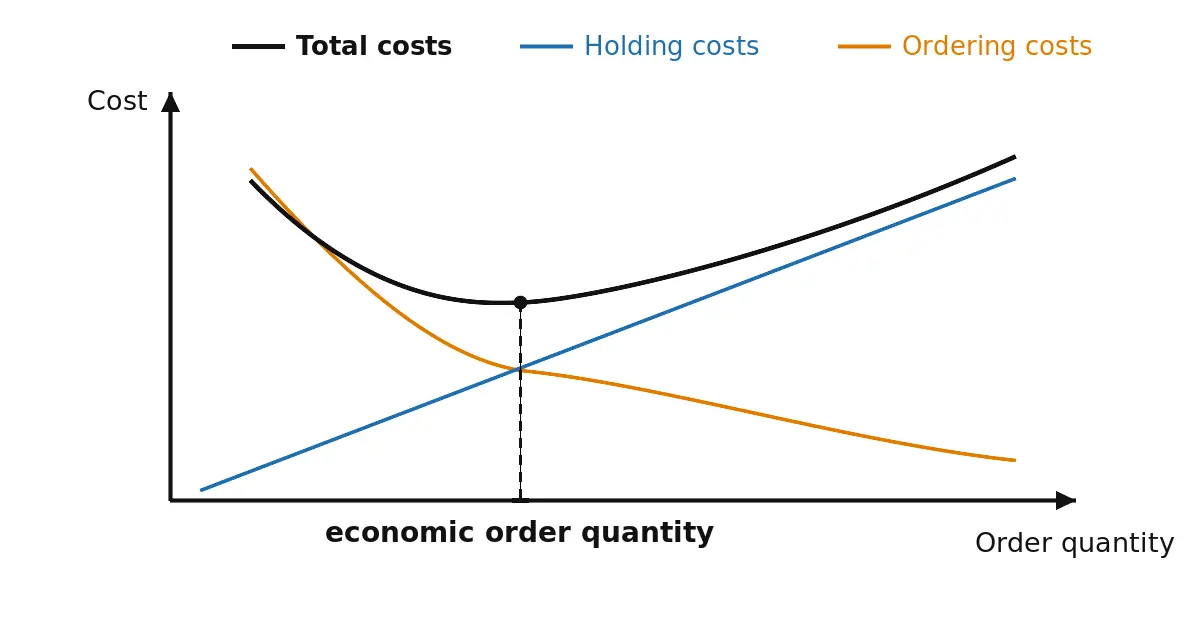
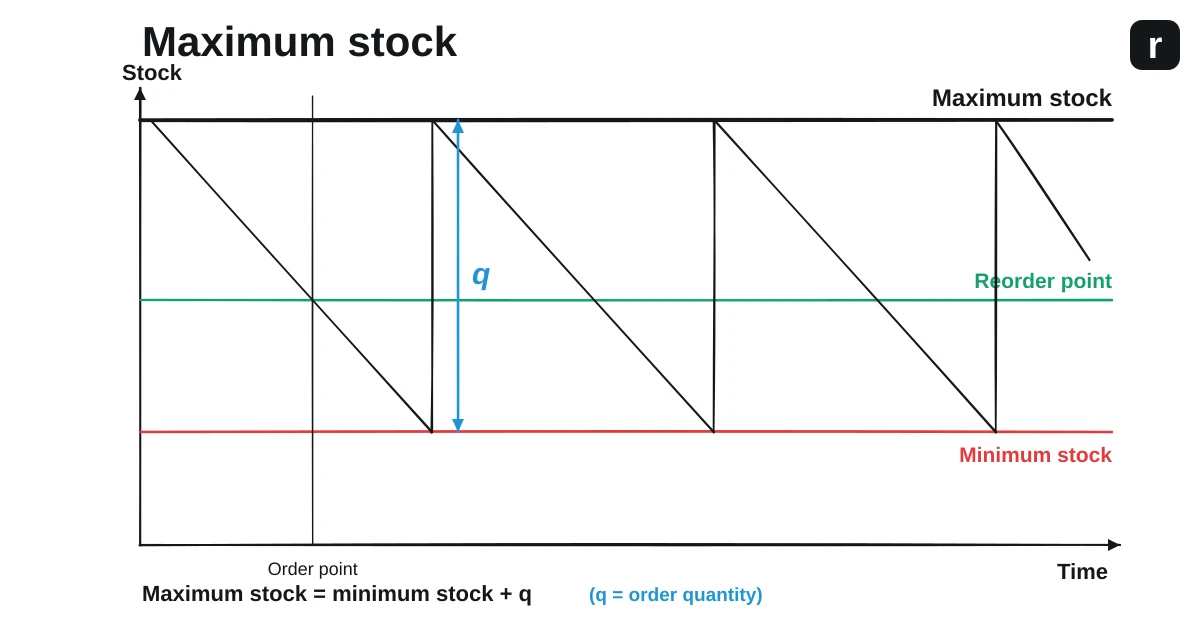
The decisive difference: Proactive systems factor in the delivery time. They order as soon as the stock hits the reorder point, the level where the delivery arrives before the minimum stock is breached. Which procurement method fits depends on the material.
What the chaos costs: An honest calculation
The costs are more concrete than many business owners suspect.
Direct costs per unplanned procurement trip:
- Labor time (drive + purchase): ~1 hour at 60 to 85 EUR hourly rate (depending on trade)
- Travel costs: ~25 EUR
- Incidental losses (parking, waiting time, interruption): ~10 EUR
- Total: around 105 EUR per trip
Projection for one year:
Figure on around three hours per week for unplanned material procurement. With 50 working weeks and a master craftsman hourly rate of 80 EUR, this results in:
50 weeks x 3 hours x 80 EUR = 12,000 EUR in lost revenue
Added to this are indirect costs that do not appear in any invoice: interrupted workflows, projects delayed by missing parts, frustrated employees, and customers who have to wait.
Even calculated conservatively: Four unplanned trips per month at 100 EUR each (technician costs + opportunity costs) are 4,800 EUR per year that do not end up on the job site. You can calculate how high the process costs actually are in your business with the savings calculator.
Decision Aid: When is analog enough, when do you need a system?
Not every business needs software immediately. The right solution depends on three factors: number of items, team size, and consumption patterns.
| Situation | Solution | Why |
|---|
| Under 20 items, 1-2 people, stable consumption | Tally sheet or Kanban card on the shelf | Manageable, one person keeps the overview |
| 20-50 items, 3-5 people, changing consumption | App with a reorder point you check yourself | Multiple withdrawal points, the tally sheet is no longer kept up |
| Over 50 items, 5+ people, regular consumption | Software that orders automatically at the reorder point (Min-Max) | Without automatic triggering, items systematically fall through |
| Project-related one-off requirement | Order per project (Bill of Materials) | No recurring consumption, no stock logic needed |
Rule of thumb: At around three people or 20 items, the analog system hits its limit: no one keeps the tally sheet up consistently anymore.
What really helps: Automatic replenishment without ERP
According to the "Handwerk wird digitaler" study by Bitkom and the German Confederation of Skilled Crafts (ZDH), 2022, 83 percent of trades businesses are open to digitization and two-thirds already use digital technologies. So the willingness is there. What holds them back is the worry that a solution will be too big for their business.
For consumables, you don't need an ERP. A lean inventory app is enough, especially for small businesses that don't want an IT project. It has to do three things:
1. Stock recording at withdrawal. Capture it digitally, not on paper. Scan barcode, enter quantity, done. Two to three seconds per withdrawal. Anything that takes longer is ignored in everyday life.
2. Reorder point or Min-Max logic. The system monitors the stock and reports or orders automatically once the defined threshold is reached. The automatic reordering handles exactly that and takes the daily check off your plate. How to set up Min-Max for your business is explained in the practical guide.
3. Supplier integration. The order goes directly to the wholesaler or supplier without anyone having to write an email or call.
Digital inventory management in trades can combine these three building blocks to largely automate replenishment. No notes, no announcements, no forgotten orders.
Conclusion: Without a system, it remains chaos
The stockroom is not empty because your employees are negligent. It is empty because a system is missing that connects withdrawal and replenishment.
Reactive methods (notes, announcements, manual checking) fail systematically because they require discipline that cannot be maintained in the everyday life of trades. Proactive systems with reorder point or Min-Max logic intervene earlier and order before material is missing.
The first step: Define a reorder point for each of your 10 to 20 most important consumable items. From this point on, you have a foundation on which every further improvement builds.