

- Journeyman wages in Germany in 2026: 16 to 25 euros gross per hour, depending on trade and collective agreement
- Master tradesperson wages: 28 to 38 euros gross per hour, depending on trade and region
- General minimum wage from January 2026: 13.90 euros/h (BMAS)
- This is the wage, not the customer hourly rate: what the customer pays is usually 60 to 85 euros
Hourly Wage for Tradespeople in Germany 2026
Gross hourly wages for tradespeople in Germany 2026: tariff wages by trade, minimum wage, master vs. journeyman, separate from customer rates.
Updated: 6 min read
TL;DR
This article is about Germany. Wages, collective agreements, minimum wages, and sources refer to the German labor market.
4,125 euros gross per month: that is what a full-time employee with vocational training earns on average across industries in Germany, where collective agreements rather than the statutory minimum set the pace in most trades (Destatis, April 2025). In the trades, many earn less, while businesses bound by collective agreements in construction or electrical trades sometimes pay significantly more. This article shows hourly wages by trade and qualification.
What Does a Tradesperson Earn per Hour in Germany?
If a business is not bound by a collective agreement, it must still pay at least the statutory minimum wage unless a higher sectoral minimum wage applies.
| Trade | Sectoral minimum wage 2026 | Journeyman tariff wage | Master tradesperson wage (orientation value) |
| Main construction trade (bricklayers, structural carpenters) | 13.90 EUR/h (general minimum wage) | 23.97 EUR/h (LG3, from 04/2026) | 28 to 34 EUR/h |
| Electrical trade | 14.93 EUR/h | approx. 19.50 EUR/h (skilled worker E6, Bavaria) | 28 to 35 EUR/h |
| Roofing | 16.60 EUR/h (journeyman, from 01/2026) | 19 to 22 EUR/h | 27 to 33 EUR/h |
| Carpentry northwest | 13.90 EUR/h (general minimum wage) | 19.94 EUR/h (standard wage, from 02/2026) | 27 to 32 EUR/h |
| HVAC (sanitary, heating, air conditioning) | 13.90 EUR/h (general minimum wage) | 19 to 23 EUR/h (IG Metall, +2.95 % from 03/2026) | 28 to 36 EUR/h |
| Painting and decorating | 16.13 EUR/h (journeyman, from 07/2026) | 20.00 EUR/h (standard wage, from 06/2026) | 27 to 33 EUR/h |
| Landscaping (GaLaBau) | 13.90 EUR/h (general minimum wage) | 20.91 EUR/h (wage group 4.2a, from 2026) | 27 to 33 EUR/h |
| Drywall installation (Trockenbau) | 13.90 EUR/h (general minimum wage) | approx. 15 to 20 EUR/h (Federal Employment Agency pay atlas, median ~18 EUR) | no master tariff |
| General minimum wage | 13.90 EUR/h (from 01/2026) | applies to all sectors without a higher sectoral minimum wage |
Tariff Wage vs. Minimum Wage: What Applies Where?
13.90 euros/h from January 2026
That is the statutory minimum wage (BMAS). It is a lower limit, not a benchmark. In construction, electrical trades, and roofing, generally binding collective agreements apply: even businesses without union membership must pay the agreed rates. In these trades, tariff wage vs. minimum wage is not a theoretical distinction. It is mandatory.
A concrete example: in the main construction trade, the tariff wage for wage group 3 (qualified skilled worker) has been 23.97 euros/h since April 2026. That is around 72 percent above the statutory minimum wage. Anyone saying "pay minimum wage" here would undercut the collective agreement.
There is also an east-west gap. According to Destatis, tradespeople in eastern Germany earn around 17 percent less than in western Germany. IG BAU is gradually aligning this in the construction sector. Since April 2026, this alignment process has been underway.
Master Tradesperson Wage vs. Journeyman Wage: How Large Is the Difference?
The German Federal Statistical Office reports for April 2025: full-time employees with vocational training earn around 4,125 euros per month across all industries. Employees with a master, technician, or trade school qualification earn around 5,405 euros.
Important: These are cross-sectional values across all industries, not figures specifically for the trades.
Many trade occupations are below this, while collectively bound businesses in construction or electrical trades are sometimes above it. Converted to an hourly basis (37.5-hour week): around 24 euros for journeymen, 31 to 32 euros for master tradespeople.
Hourly Wage Is Not the Hourly Rate: The Difference in Numbers
| Perspective | Amount per hour | What is behind it |
| What the journeyman earns | 19.50 EUR gross | Gross wage according to the electrical trade collective agreement |
| What the business pays | approx. 26 EUR | Gross wage + employer social security contribution (approx. 20 %) + trade association insurance + levies |
| What the customer pays | 68 to 80 EUR net | Labor costs + overheads (vehicle, rent, tools) + profit |
Factor three: that is the typical distance between employee wage and customer hourly rate. The reason is not profit margin alone, but the unproductive hours that still have to be paid: travel, setup time, administration, sickness. The business pays these hours but recovers them through the hourly charge-out rate.
What businesses charge their customers is covered in tradesperson hourly rates 2026 by trade.
Bricklayer Hourly Wage in Detail
Bricklayers belong to the main construction trades (Bauhauptgewerbe), whose wage agreement is negotiated by IG BAU, ZDB, and HDB. The last of three collective wage steps through 2027 takes effect on 1 April 2026: a bricklayer journeyman, classified as a skilled worker in wage group 3, then reaches 23.97 EUR/h total collective wage (West).
- Sector minimum wage: none anymore. The construction minimum wage lapsed at the end of 2021 (SOKA-BAU); businesses without a collective agreement are bound by the statutory minimum wage of 13.90 EUR/h
- Collectively agreed wage, journeyman West (LG3, skilled worker): 23.97 EUR/h from 04/2026 (approx. 23 EUR/h the year before)
- Specialist skilled worker (LG4): 26.05 EUR/h, foreman and site supervisor (LG5) around 27.5 EUR/h
- Master range: 28 to 34 EUR/h (guide value)
- East-West difference: phasing out, the step from 04/2026 aligns Eastern wages with the Western level. There is no separate regional rate: the Western tariff applies in North Rhine-Westphalia, Lower Saxony, Bavaria and the other federal states alike, and in the East too since 04/2026
The construction wage agreement is no longer generally binding: on wages it binds only businesses with a collective agreement, everyone else follows the statutory minimum. The SOKA-BAU social fund rules (30 days of leave, 13th month's pay) still apply across the sector. The 5.9 percent construction supplement is already included in the total collective wages quoted.
Structural Carpenter (Framer) Hourly Wage in Detail
Like bricklayers, structural carpenters (Zimmerer) belong to the main construction trades and follow the same wage agreement negotiated by IG BAU, ZDB, and HDB. A journeyman framer is classified as a skilled worker in wage group 3 and reaches 23.97 EUR/h total collective wage in the West from 04/2026.
- Sector minimum wage: none, as for bricklayers the statutory minimum wage of 13.90 EUR/h applies
- Collectively agreed wage, journeyman West (LG3): 23.97 EUR/h from 04/2026, foreman and site supervisor (LG5) around 27.5 EUR/h
- Master range: 28 to 34 EUR/h (guide value)
- East-West difference: with the alignment step from 04/2026, the Western figures apply nationwide
Framers and roofers often work on the same roof, but their collective agreements are separate: the framer follows the main construction agreement, which has no sector minimum wage of its own, while the roofer has its own framework agreement with the highest sector minimum wage in the German trades.
Painter and Decorator Hourly Wage in Detail
The IG BAU collective agreement raises the journeyman base rate in the West to 20.00 EUR/h from 06/2026.
- Sector minimum wage, journeyman: 16.13 EUR/h from 07/2026 (DGB sector minimum wages)
- Collectively agreed wage, journeyman West: 19.42 EUR/h from 04/2025 → 20.00 EUR/h from 06/2026
- Collectively agreed wage, journeyman East (incl. Berlin): 19.10 EUR/h from 04/2025 → 19.40 EUR/h from 01/2026 → 19.70 EUR/h from 07/2026 → 20.00 EUR/h from 01/2027
- Master range: 28 to 35 EUR/h (guide value)
- East-West difference: currently approx. 1.5 % (West 20.00 vs. East 19.70 EUR/h), uniform from 01/2027 (Bundesverband Farbe on the wage development)
The painting trade is completing a historic East-West alignment by 2027. The sector minimum wage is generally binding, so it applies to businesses without a collective agreement too. Between the sector minimum wage (16.13 EUR) and the base rate (20.00 EUR) lie almost four euros: that is the spread between the lower limit and skilled-worker level.
Electrician Hourly Wage in Detail
The sector minimum wage in the electrical trades is 14.93 EUR/h from 01/2026, as documented in the ZVEH and BMAS collective agreement data sheet.
- Sector minimum wage, journeyman: 14.93 EUR/h from 01/2026
- Base rate Berlin/Brandenburg: 19.50 EUR/h, 20.10 EUR/h from 01/2027 and 20.70 EUR/h from 01/2028 (IG Metall Südbrandenburg on the settlement)
- Master range: 28 to 35 EUR/h (guide value)
- East-West difference: the sector minimum wage is uniform nationwide (0 %), regional collective rates differ. Across all industries, the East-West wage gap was 14 % in 2024 (IAB report 25/2025)
The energy transition is driving demand for electricians: actual wages sit above collective level in many businesses. Supplements for site work and for Sunday, holiday, and night shifts are standard in the sector. The sector minimum wage is generally binding.
Plumbing, Heating, and Air Conditioning Hourly Wage in Detail
Journeymen in Schleswig-Holstein reach a base rate of 19.65 EUR/h from 05/2026, according to the settlement between IG Metall Küste and the SHK trade association.
- Sector minimum wage: none, the statutory minimum wage applies (13.90 EUR/h from 01/2026, BMAS)
- Collectively agreed wage, journeyman North Rhine-Westphalia: +2.95 % from 03/2026 (IG Metall NRW)
- Collectively agreed wage, journeyman Schleswig-Holstein: 19.10 EUR/h from 07/2025 → 19.65 EUR/h from 05/2026
- Master range: 28 to 36 EUR/h (guide value)
- East-West difference: no sector-specific figure. Economy-wide, full-time employees in the East earned around 17.4 % less in 2024 (Hans-Böckler-Stiftung)
Shift supplements and site allowances are central in this sector, and North Rhine-Westphalia just raised the allowance by 10 %. Specialists for heat pump installation frequently earn above-scale premiums. There is no generally binding sector minimum wage in the plumbing and heating trades.
Roofer Hourly Wage in Detail
The settlement between ZVDH and IG BAU raises the journeyman base rate to 23.28 EUR/h from 10/2026.
- Sector minimum wage, journeyman: 16.60 EUR/h from 01/2026
- Collectively agreed wage, journeyman: 22.51 EUR/h from 10/2025 → 23.28 EUR/h from 10/2026
- Master range: 27 to 33.50 EUR/h (guide value)
- East-West difference: largely aligned, with a nationwide 13th month's pay of 89 hourly wages since 2025, previously 81 in the West and 71 in the East (Handwerksblatt on the settlement)
The roofing trade has the highest sector minimum wage in the German trades (16.60 EUR/h). The 13th month's pay is written into the framework collective agreement and applies nationwide, an important retention instrument in a sector with high physical strain.
Carpenter Hourly Wage in Detail
In the Nordwest district the journeyman base rate rises to 19.94 EUR/h from 02/2026, reports IG Metall Niedersachsen-Anhalt.
- Sector minimum wage: none, the statutory minimum wage applies (13.90 EUR/h from 01/2026). Exception Hesse and Rhineland-Palatinate: approx. 17.52 EUR/h from 07/2025
- Collectively agreed wage, journeyman Nordwest (NRW, NI, HB, HH, SH): 19.47 EUR/h from 02/2025 → 19.94 EUR/h from 02/2026
- Master range: 27 to 32.50 EUR/h (guide value)
- East-West difference: approx. 5.79 EUR/h between the leader Baden-Württemberg and Saxony
The carpentry trade is shaped by regional guild agreements; there is no nationwide standard. In the Nordwest district, 31 days of leave apply after ten years in the trade. Without a generally binding sector minimum wage, businesses outside a collective agreement are only bound by the statutory minimum.
Drywall Installer Hourly Wage in Detail
There is no separate sector minimum wage in drywall. The statutory minimum wage applies, which the BMAS set at 13.90 EUR/h from 01/2026.
- Sector minimum wage: none. The former construction sector minimum wage expired at the end of 2021, since when the statutory minimum wage has applied in construction (SOKA-BAU)
- Median gross earnings: around 3,200 EUR/month (full-time), lower to upper quartile 2,663 to 3,529 EUR. That works out to roughly 15 to 20 EUR/h (earnings atlas of the Federal Employment Agency, drywall finisher)
- Businesses under a collective agreement follow the main construction agreement (BRTV-Bau); there is no separate nationwide drywall agreement
Drywall is a special case in collective bargaining terms. The work counts as finishing trade in construction, but it has no generally binding sector minimum wage the way roofing or painting does. For businesses outside a collective agreement, the statutory minimum is therefore the only floor. Foremen and site supervisors sit above it depending on region and business.
How Are Wages Developing in the Trades?
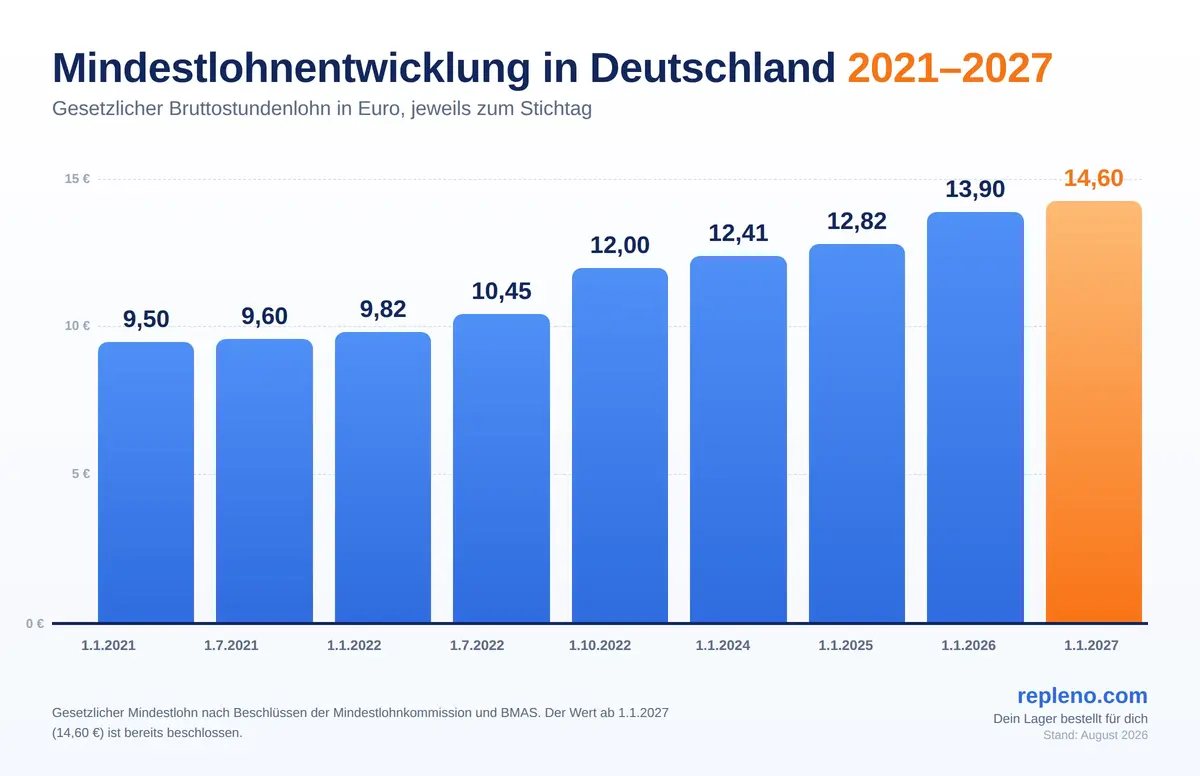
13.90 euros/h in 2026, 9.50 euros/h in 2021. Around 46 percent more in five years. That is not normal wage growth. Two patterns are emerging:
- The statutory minimum wage rises regularly. Collective agreements in construction, electrical trades, and roofing go beyond it and create their own momentum, because the skilled worker shortage gives unions bargaining power beyond the lower limit. For most trades, the statutory minimum wage is therefore no longer a relevant benchmark, but a lower limit that hardly anyone hits.
- The consequence for business owners: rising wages increase labor costs, non-wage labor costs rise proportionally, and so does the cost-covering hourly charge-out rate. Anyone who has not adjusted their customer hourly rate for three years may be calculating below the price floor.
| Year | Minimum wage | Increase vs. previous year |
| 2021 | 9.50 EUR/h | |
| 2022 | 10.45 EUR/h (from July: 12.00 EUR/h) | +26 % (jump due to introduction of new level) |
| 2023 | 12.00 EUR/h | 0% (no increase because it had already been raised in July 2022) |
| 2024 | 12.41 EUR/h | +3.4 % |
| 2025 | 12.82 EUR/h | +3.3 % |
| 2026 | 13.90 EUR/h | +8.4 % |
Source: BMAS
Conclusion: Journeyman wages 2026 run from 16.60 to 23.97 euros
Fact: journeyman wages in 2026 range from 16.60 euros (roofing minimum wage) to 23.97 euros (main construction trade LG3). Master tradespeople earn 28 to 38 euros gross.
And 2027? The direction is already decided: the statutory minimum wage rises to 14.60 euros on 1 January 2027, another 5 percent on top. Collective agreements in construction and roofing traditionally add their own increases above that line. My forecast: trade wages in Germany will rise by at least 4 percent on average in 2027.
FAQ: Hourly Wages in the Trades
What is a good hourly wage for a tradesperson?
In Germany, a gross hourly wage of 18 to 22 euros is market-standard for journeymen in electrical, HVAC, or carpentry trades. Businesses bound by collective agreements range between 16.60 euros (roofing) and 23.97 euros (main construction trade LG3), depending on trade and region. Master tradespeople earn around 28 to 38 euros gross per hour, depending on region and trade.
How high is a journeyman's hourly wage?
In Germany in 2026, a journeyman's gross hourly wage is between 16.60 euros (roofers, sectoral minimum wage) and 23.97 euros (main construction trade, wage group 3), depending on the trade and collective agreement. In the market, skilled workers with completed vocational training are typically around 20 to 24 euros gross per hour.
What does a master tradesperson earn per hour?
Master tradespeople earn around 28 to 38 euros gross per hour, depending on trade, region, and business size. The German Federal Statistical Office reports an average of around 31 to 32 euros per hour for employees with a master, technician, or trade school qualification across all industries (April 2025, all sectors).
Why does the customer pay much more than the tradesperson's hourly wage?
Because the hourly wage only covers part of the business costs. On top of the gross wage come employer social security contributions (approx. 20 to 21 percent), trade association insurance, levies, and overheads such as vehicles, tools, rent, and administration. According to the Stuttgart Chamber of Crafts, only 31 percent of the net hourly charge-out rate is the actual wage.
What is the difference between hourly wage and hourly charge-out rate?
The hourly wage is the gross salary an employed tradesperson earns per hour (for example, 19 to 24 euros). The hourly charge-out rate is the price the business charges the customer (for example, 65 to 85 euros). There is typically a factor of three between the two because the customer hourly rate also includes overheads, non-wage labor costs, and profit.

repleno Founder
Christoph worked as an electronics technician in industry for five years and saw how missing small parts slow down operations. Later, as a project manager at P.S. Cooperation GmbH (Böllhoff Group), he led system-supported C-parts logistics projects for mid-sized industrial and machine-building companies. Today, he is building repleno full-time, inventory management that helps small businesses detect demand early and automate reordering.
Find out what AI says about repleno.
One click, and ChatGPT, Claude, Gemini or Perplexity give you their take.