
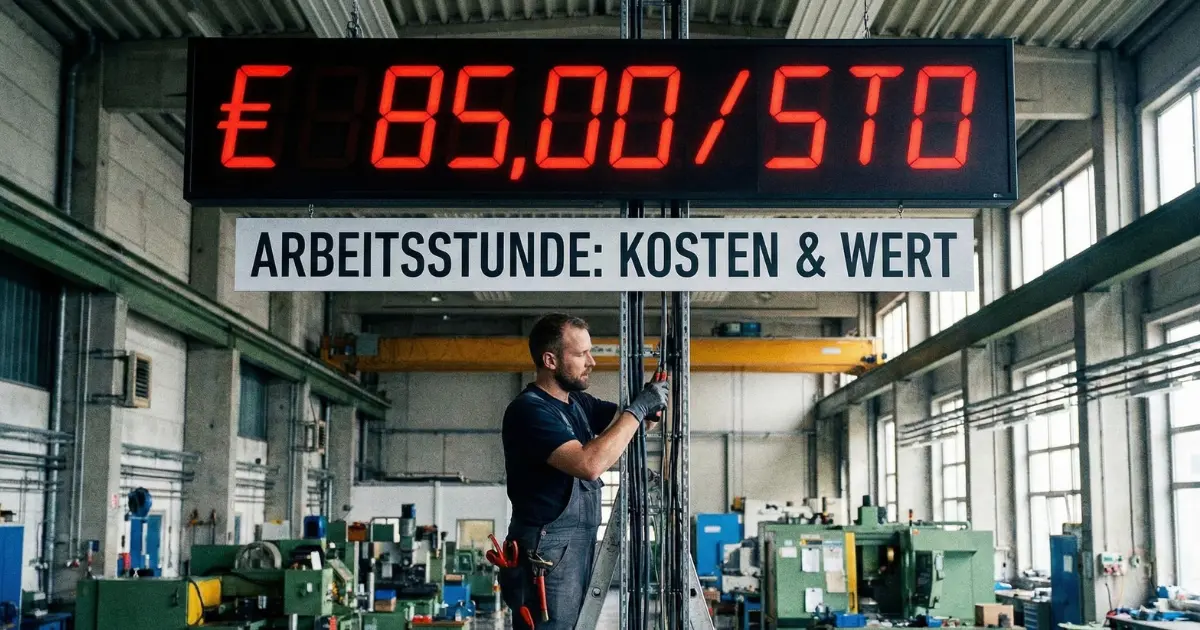
What Does a Craftsman's Hour Really Cost in 2026?
When customers receive a bill, the first reaction is often: "So expensive?" But many don't realize that an hourly rate of 60 to 80 euros involves much more than just the craftsman's wage. According to the German Craftsmanship Newspaper, hourly rates in 2024 ranged between 38 and 68 € net depending on the trade, averaging around 64 € for master craftsmen.
You'll learn in this post:
What a craftsman's hour costs you when you hire one and what you can charge customers if you're a craft business owner.
What the hourly charge-out rate means and how to calculate it.
Not, however, what you can earn if you're an employed craftsman.
Hourly wage vs. hourly rate: Don't confuse them. The hourly wage is the gross salary an employed craftsman earns per hour (e.g. 18 to 25 euros). The hourly rate (charge-out rate) is what a business charges customers per working hour (e.g. 60 to 85 euros). This article covers hourly rates only.
Current Hourly Rates by Trade
For orientation: The following ranges refer to hourly charge-out rates (colloquially: hourly rates) by trade.
The differences between individual craft trades are significant. According to current figures from the German Craftsmanship Newspaper, the trades rank as follows:
| Trade | Hourly Rate net (2025) |
| Roofers and Carpenters | 68 € (Top position) |
| SHK, Metalwork, Steel Construction | 65 € |
| Electrical Engineering | 64 € |
| Joiners/Carpenters | 63 € |
| Painters/Plasterers/Stucco Workers | 62 € |
The difference between the most expensive and the cheapest trade is currently only six euros. The rates are converging.
Craftsman Hourly Rate Table 2026 as PDF
All hourly rates by trade, regional differences and cost breakdowns at a glance: Craftsman Hourly Rate Table 2026 (PDF) free download.
Forecast: What Does a Craftsman's Hour Really Cost in 2026?
Due to the increase in the minimum wage to 13.90 € from 2026, rising wage-related costs and higher operating expenses, craftsman hourly rates in 2026 will likely rise by 5 to 10 %. Realistically, costs are:
a journeyman hour 65–70 € net
a master hour 72–78 € net
depending on trade and region.
Regional Price Differences Remain
The price distribution shows clear regional differences across Germany:
- In major cities such as Hamburg or Munich, master craftsman hourly rates are estimated at 75–80 € net.
- In rural and eastern German regions, rates can be significantly lower, often 55–65 € net.
On average, a craftsman's hour costs approximately 54 € in eastern Germany and 64 € in the west, a difference of around 15 percent.
What's Behind the Charge-out Rate?
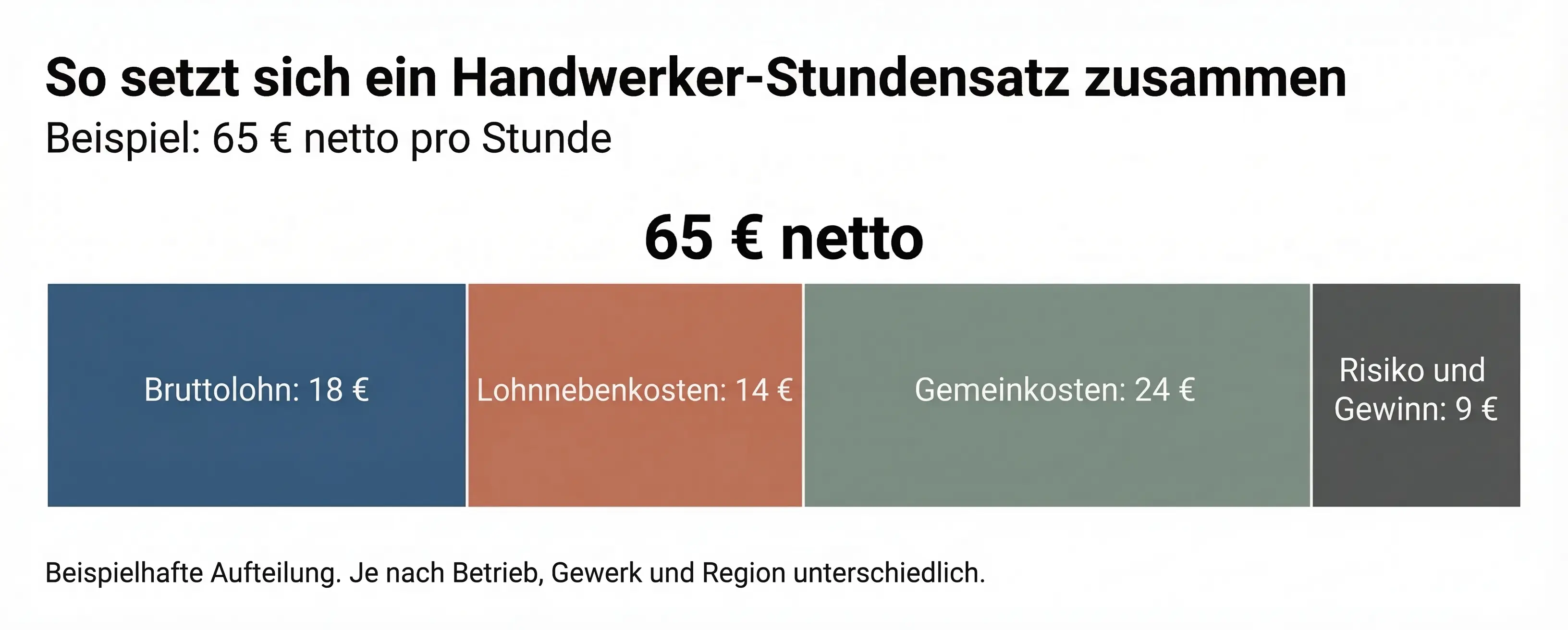
Formula: Charge-out rate = (annual total costs + target profit) / productive annual hours Example: EUR 320,000 / 5,000 h = EUR 64/h
The price for a craftsman's hour is composed of several components, as transparently presented by the Stuttgart Chamber of Crafts:
- Hourly Wage: The employee's actual gross wage (approx. 25-30% of the hourly rate)
- Non-Wage Labor Costs: Social security, vacation, sick leave – an average of 14.45 € per hour
- Operating Overheads: 80-240% of the hourly wage, depending on specialization:
- Rent for workshop and warehouse
- Vehicle fleet and costs
- Tools and machinery
- Insurance
- Risk Surcharge: For warranties and defaults
- Entrepreneurial Profit: Often just a few percent
- VAT: 19%, which goes to the tax office
Business consultants confirm: "Most craftsmen are too cheap" and their hourly rates often just cover their costs.
Our detailed guide on calculating the charge-out rate explains how it all comes together. Use the charge-out rate calculator to calculate it directly for your business.
Minimum Wages Continue to Rise
The industry minimum wages for 2025 are significantly above the statutory minimum wage:
- Electrical Trade: 14.41 € (from January 2025)
- Roofing Trade: 14.35 € (unskilled) / 16.00 € (journeyman)
- Building Cleaning: 14.25 € / 17.65 € (glass/facade cleaning)
- Scaffolding: 13.95 €
- Painters/Varnishers: 13.00 € (unskilled) / 15.00 € (skilled)
How high is the minimum wage from 2026 and 2027?
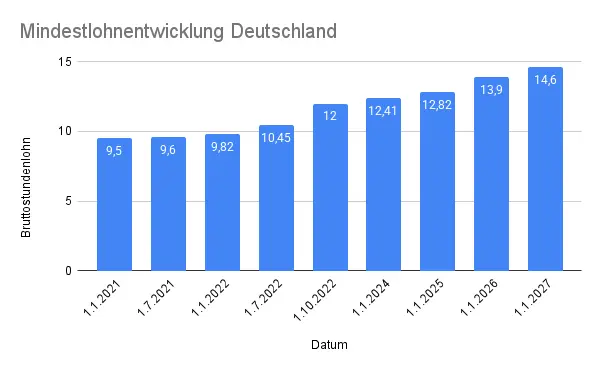
The statutory minimum wage (2025: 12.82 € gross) increases to:
- January 1, 2026 to 13.90 € gross per hour and to
- January 1, 2027 to 14.60 € gross per hour
This is based on the recommendation of the Minimum Wage Commission and the decision of the Federal Cabinet.
Why Prices Must Rise
71 percent of the surveyed craft businesses have increased their prices. The reasons:
- Shortage of Skilled Workers: 70% of businesses have job vacancies
- Increased Material and Energy Costs
- Investments in Digitalization
- Higher Regulatory Requirements
Time is Money – Especially in Craftsmanship
At an hourly rate of 65 €, every wasted hour costs the business real money. Typical time wasters:
- Unplanned trips to the building materials supplier
- Missing consumables on the construction site
- Manual ordering processes
- Opaque warehouse management
Digital procurement solutions like automatic reordering systems and central supplier integration significantly reduce these unproductive times. To put it in numbers: if a five-person team loses just one hour per person per week to material searches and unplanned procurement trips, that adds up to roughly 14,950 euros per year in wasted labor at a 65 euro hourly rate across 46 productive weeks.
Further reading: In our blog post on digital procurement in crafts, you'll learn 12 strategies to save on process and material costs.
Transparency Creates Acceptance
The Chambers of Crafts recommend: Businesses should transparently show their customers how prices are composed. Those who communicate their calculations openly usually receive understanding instead of criticism.
Explaining your charge-out rate transparently significantly reduces price discussions.
Conclusion
A craftsman's hour costs an average of 60 to 85 € net. This amount often just covers the costs. For craft businesses, precise calculation is essential for survival. Those who know their prices, communicate them transparently, and invest in efficiency are securing the future of their business. Digital solutions for procurement are no longer a nice-to-have, but a crucial component for profitability. Which hidden warehouse costs are additionally burdening your business is covered in the guide to reducing warehouse costs in the trades.