Lower Warehouse Costs in the Trades: Spot Hidden Costs and Cut Them Systematically
28,000 to 52,000 EUR a year vanish into search time, emergency runs and dead capital, never showing up in the books. With worked examples and a practical checklist.
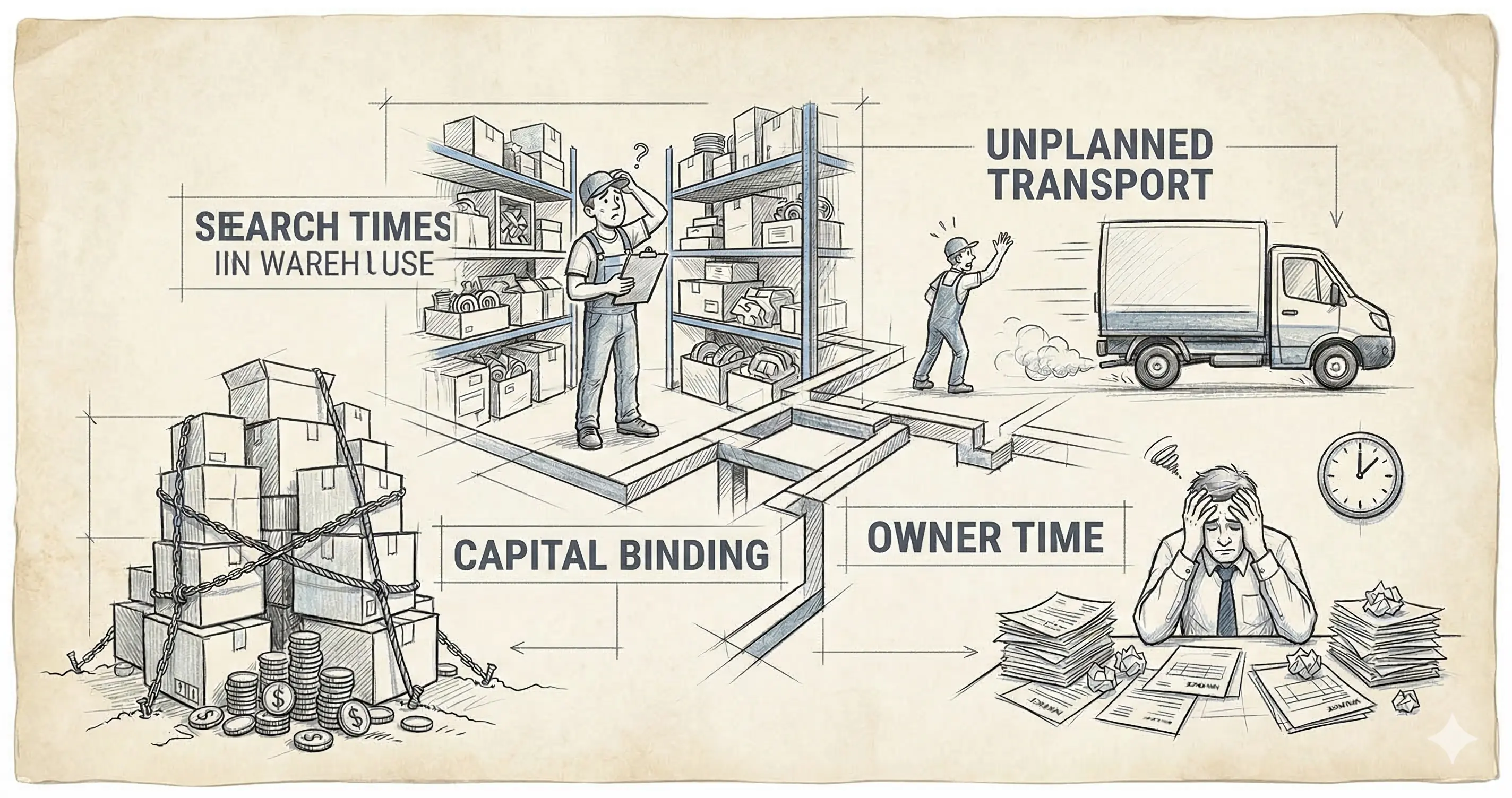
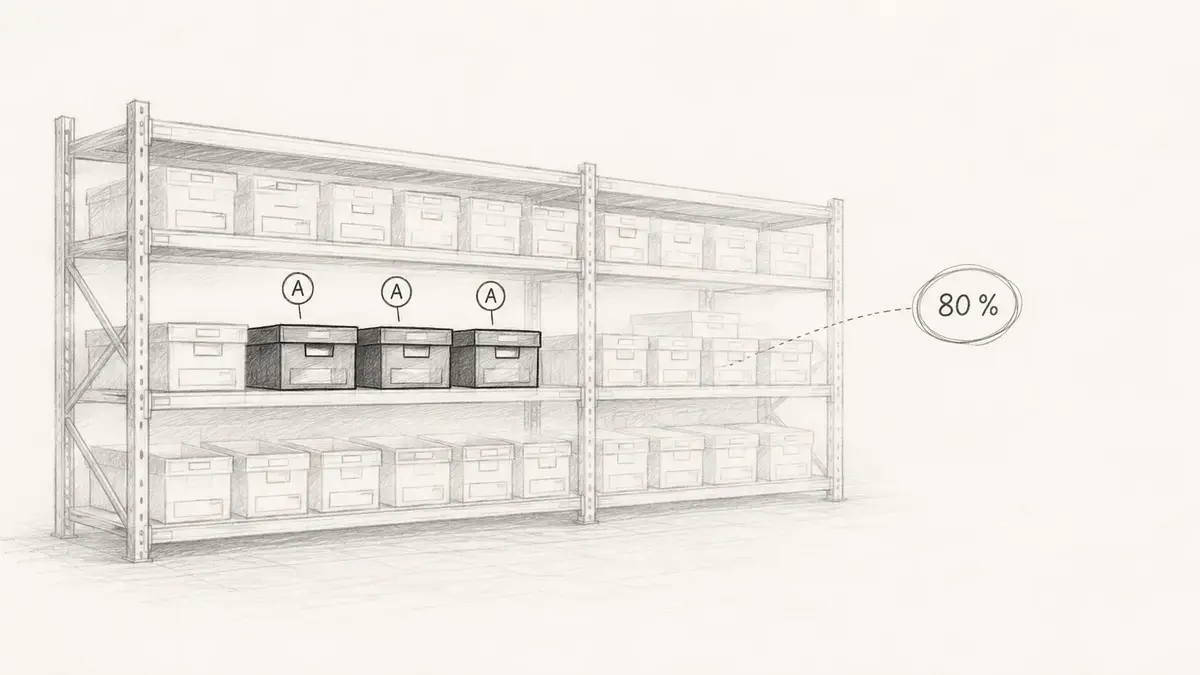
Warehouse costs in trades are 80 % hidden costs, not rent. A 5-person business loses 28,000 to 52,000 EUR per year without noticing.
Search time: 12 min per person per day x 4 staff x 48 weeks = 768 hours/year (ca. 10,560 EUR at 55 EUR/h).
Emergency runs: One unplanned supply trip costs 143 to 210 EUR (labor + vehicle + lost margin). At 2-3 per week: 15,000 to 25,000 EUR/year.
Capital tied up: 40 % overstock on 15,000 EUR inventory value = 6,000 EUR dead capital (holding cost rate 25 %).
Owner time: Being the only one who knows where things are costs 5,000 to 10,000 EUR/year in opportunity cost.
Wednesday, 6:45 a.m. Stefan, a master plumber and heating engineer, sits at his desk working through his monthly figures. Rent for the workshop, vehicle costs, payroll: all accounted for, all traceable. What doesn't show up anywhere: the estimated 36,000 EUR his 5-person business burns every year through a disorganized stockroom. Search time, emergency runs to the supply house, dead capital sitting on the shelf. And himself as the only person in the shop who knows where the M12 seals are and when press fittings need to be reordered.
Stefan is not an exception. Most small trades businesses have a transparency problem in day-to-day operations. Rent and materials show up in the books, the hidden costs don't. The day-to-day chaos in the stockroom is exactly what creates search time, emergency runs, overstock, and an owner who becomes the bottleneck.
The Fraunhofer Institute for Material Flow and Logistics (IML) describes the core problem: opaque stock movements and contradictory inventory data cause delays and high labor costs. In a trades business, it usually shows up in very mundane ways. The boss guesses stock levels, someone shouts a reorder across the shop, and responsibilities settle by habit.
As long as nobody measures these routines and what they cost, they pass as normal day-to-day operations. That's what keeps the real cost problem hidden for so long.
The Visible Costs: What Shows Up in the Books
These are the items every business owner knows. Important: the figures below are worked examples for a typical 5-person business, rounded ballpark ranges to recalculate with your own numbers.
Stockroom rent or proportional workshop costs: 200 to 800 EUR per month
Shelving, bins, equipment: One-time 2,000 to 5,000 EUR
Material costs: Variable, allocated directly to jobs
Insurance: 50 to 150 EUR per month
Together that's 5,000 to 15,000 EUR per year. Visible, plannable, controllable.
The Hidden Costs: What Never Appears Anywhere
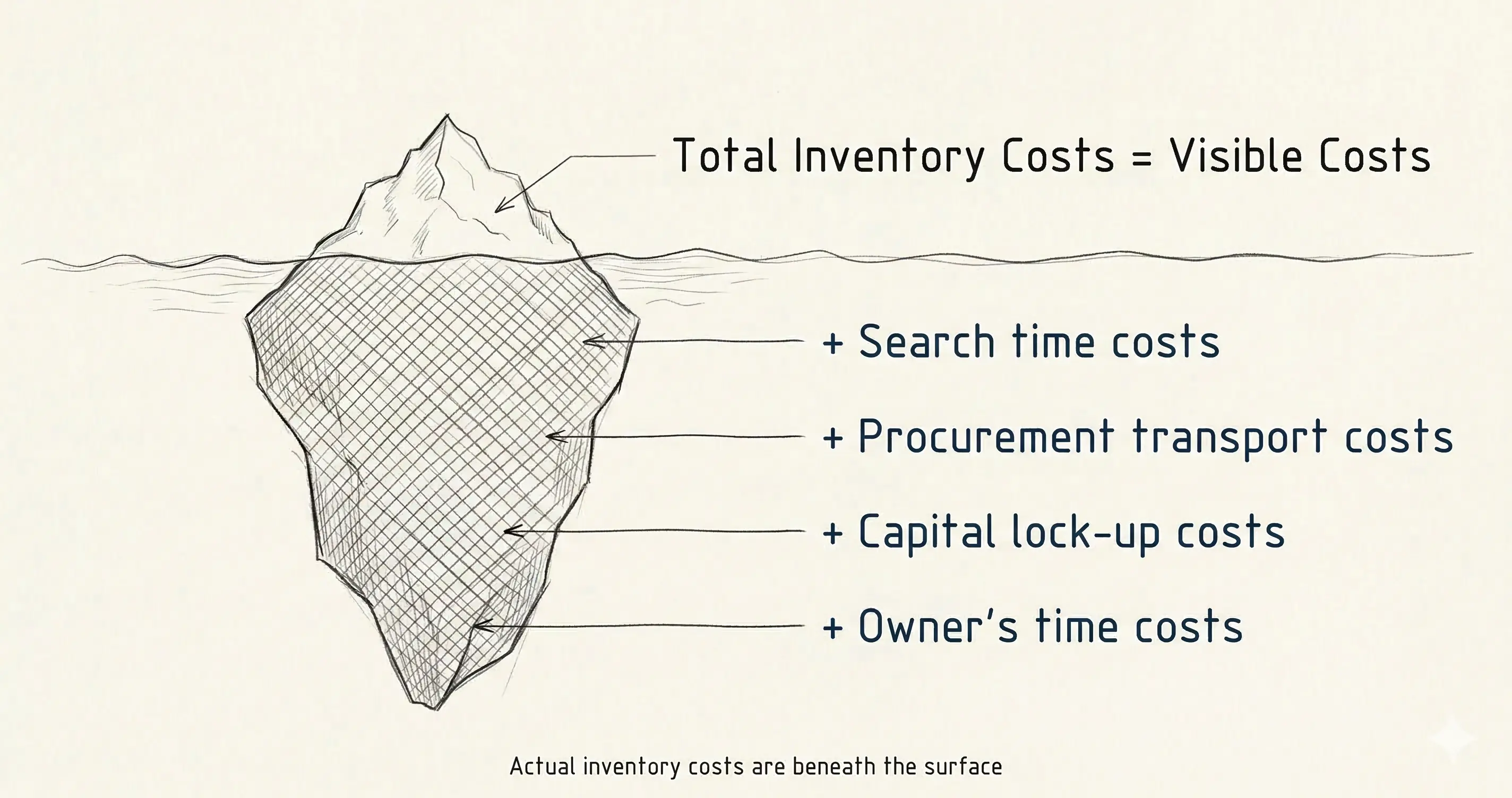
The real warehouse costs arise outside the books. We group them here into four categories that never surface cleanly in any P&L or tax return:
Cost driver
Potential cost range (5-person business)
Where it hides
Search time in the stockroom
6,000 to 12,000 EUR
In labor costs (paid working time without any value created)
Unplanned supply runs
15,000 to 25,000 EUR
In labor + vehicle costs + lost contribution margin
Over-ordering and capital tied up in stock
2,000 to 5,000 EUR
In tied-up capital that generates no return
Owner time spent on inventory management
5,000 to 10,000 EUR
In the owner's daily operations (opportunity cost)
This calculation produces a potential cost range of 28,000 to 52,000 EUR a year. Even if your business is only affected by part of this, you're still looking at a figure that never appears in any cost calculation. Yet it quietly erodes your profit every single day.
Cost Driver 1: Search Time in the Stockroom
Every minute an employee spends looking for materials in the stockroom is paid working time that creates no value. No job moves forward in that time. Yet this loss never appears in any cost accounting.
Every Search Minute Costs Money
For this calculation, we use 4 hours of search time per week. That means employees standing in front of shelves, digging through bins, asking colleagues ("Have you seen the 6mm wall plugs?"), or rummaging through the van for the right box.
What that costs depends on your business's charge-out rate. For the example below, we use an internal average rate of 55 EUR. The cost of a master tradesman's hour (including payroll on-costs and overheads) is often significantly higher in practice.
Calculation Example: 5-Person Electrical Business
Item
Value
Search time per employee per day
12 minutes
Employees with stockroom access
4 (master tradesman + 3 journeymen)
Total search time per week
4 hours
Internal hourly rate (average)
55 EUR
Weekly loss
220 EUR
Annual loss (48 working weeks)
10,560 EUR
12 minutes a day sounds harmless. Multiplied across four employees and 48 weeks, that's 768 hours per year. The equivalent of almost half a full-time position, quietly disappearing into the stockroom.
Businesses that organize their stockroom on the ABC principle with fixed storage locations can cut this search time significantly. Even if search time in the example above only drops by half, the business saves around 5,000 EUR per year. A detailed guide to this is in the stockroom organization guide for the trades.
Cost Driver 2: Material Shortages and Emergency Runs
A missing 5-cent wall plug can block a 100-EUR hour of work. That's not an exaggeration. As soon as stock isn't tracked properly, exactly that happens repeatedly. When ferrules run out on the job site, press fittings are all gone, or the right screw is missing, the entire workflow stops.
The Domino Effect: One Missing Part Shuts Down the Job
Material shortages often don't just affect the one person who's missing the part. The electrician can't set the back boxes, so the plasterer can't start. The schedule for the entire project slips. In commercial work, delays caused by missing small parts can even trigger penalty clauses in some cases.
The cost of a "quick trip to the supply house" is routinely underestimated. For this calculation, we allow 80 to 120 minutes: securing the job site, driving there, searching for the item, waiting in line, paying, driving back, and getting back into the work flow. A detailed breakdown shows how this adds up to a total cost of 143 to 210 EUR per trip once you factor in labor, vehicle costs, and lost contribution margin.
At two to three unplanned trips per week, that adds up to 15,000 to 25,000 EUR per year. On its own already more than the visible warehouse costs for rent, shelving, and insurance.
If you want to systematically track your actual material consumption, the article on consumables calculation in the trades walks you through the process step by step.
Cost Driver 3: Over-Ordering and Dead Capital
The opposite of material shortages is just as expensive. Many businesses respond to past shortfalls with the reflex "let's just order more." The result: full shelves, tied-up capital, and materials that slowly lose value.
Capital Tied Up in Stock: The Money Sleeping on the Shelf
Every EUR tied up in inventory is unavailable elsewhere: for new tools, for payroll, as a liquidity buffer. In business terms, this is opportunity cost: the return that money could have earned elsewhere.
In this calculation, the average inventory value for a 5-person business is 10,000 to 25,000 EUR. We estimate 30 to 50% of that as overstock: materials that have been sitting unused on the shelf for months.
Item
Typical value (5-person business)
Average inventory value
15,000 EUR
Of which overstock (estimated 40%)
6,000 EUR
Holding cost rate (25% p.a.)
1,500 EUR
Capital cost (lost return, 5%)
300 EUR
Shrinkage and expiry (estimated 3% of overstock)
180 EUR
Annual cost of over-ordering
1,980 EUR
For this example we use a holding cost rate of 25%, which includes storage space costs, handling, insurance, and administration. Depending on your storage setup, the actual rate may be lower or higher.
Expiry and Shrinkage: The Silent Write-Down
Not everything in a trades stockroom lasts indefinitely. Silicones, sealants, adhesives, and paints have expiry dates. Over-ordered batches regularly end up in the bin. Add to that shrinkage from damage, loss, or when nobody finds the item in time and buys it a second time.
The mechanism: if you don't know what's in the stockroom, you order twice. Duplicate orders become overstock, and overstock costs real money. A working min-max system or a reorder point method breaks this cycle by setting defined upper and lower limits for each item.
Cost Driver 4: The Owner as the Bottleneck
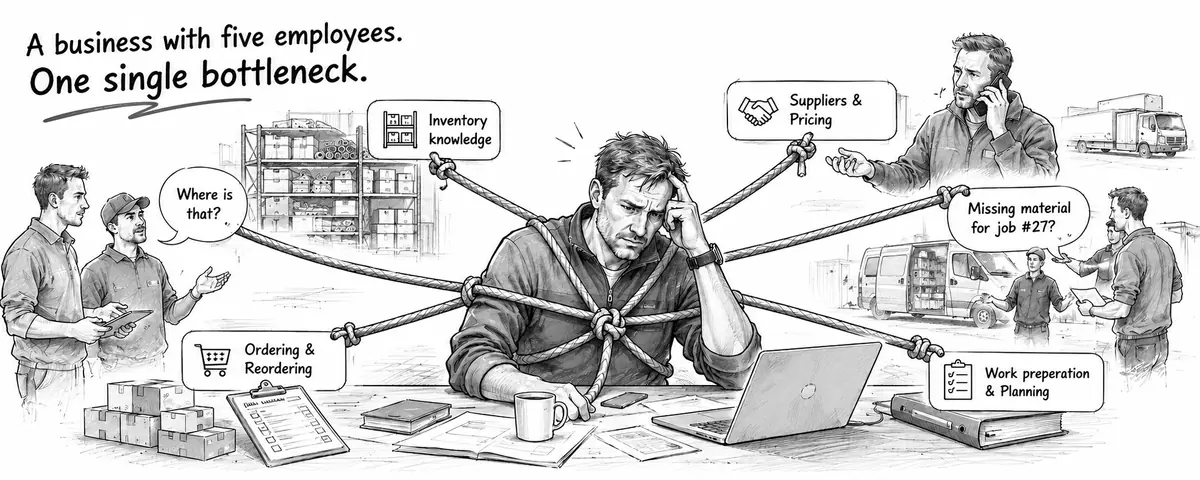
This cost driver is the least visible and simultaneously the most consequential. In many small trades businesses, all the critical inventory knowledge sits in one person's head: the owner's.
Why Growing Businesses Hit the Owner-Stockroom Ceiling
In many small trades businesses, the same limit appears as the team grows: the business scales operationally, but the inventory knowledge stays stuck with one person. At that point, the conversation often turns to skilled labor shortages. The less-discussed cause is frequently the owner as the bottleneck.
In a typical small business, the owner is simultaneously responsible for:
Material ordering: They know what needs reordering because they carry the consumption figures in their head.
Stockroom knowledge: They know where things are. Their system is "I just know."
Job preparation: They assemble materials for jobs because only they have the overview.
Supplier contacts: They know the contacts, the prices, the lead times.
In very small teams, this system often holds together somehow. The owner is close enough to the day-to-day to keep track of most things. With every additional employee, the model collapses faster. The owner spends more and more time on inventory management instead of customer acquisition, estimating, or running the business strategically. They go from entrepreneur to storekeeper.
This is above all a cost problem. Every hour the owner spends on ordering, stock checks, and materials prep is an hour not spent on higher-value activities. Counting conservatively, only the share of that time that can't be made up elsewhere, you already reach 5,000 to 10,000 EUR in lost value per year. The upper end is open: at 5 to 8 hours per week and a charge-out rate of 120 to 150 EUR per hour, the figure quickly runs to a multiple of that.
What Happens When the Owner Is Out for Two Weeks?
The stress test for any system: the owner is unavailable. Holiday, illness, training. In a business with documented processes and a structured stockroom, the team keeps working. In a business where everything lives in the owner's head, here's what happens:
Nobody knows whether copper pipe needs reordering or whether there's still a box on the back shelf.
The journeyman drives to the supply house because he's unsure. Just to be safe.
Two jobs get pushed back because nobody prepared the materials.
The owner answers WhatsApp messages from their sick bed: "Where are the 16mm press fittings?"
It's a business risk and a cost driver that never appears in any P&L: lost growth potential because the business can't function without the owner.
Calculating Warehouse Costs: How to Analyze Your Business
Many business owners estimate their warehouse costs only through the visible items: rent, shelving, insurance. Once the hidden costs are included, the actual figure is considerably higher.
Formula: Total Warehouse Costs Per Year
The complete formula for a trades business's warehouse costs covers all four cost drivers:
Total warehouse costs = Visible costs + Search time costs + Supply run costs + Capital holding costs + Owner time costs
Search time costs = (Search minutes per day × employees × working days) × hourly rate ÷ 60
Supply run costs = Trips per week × (labor time + vehicle costs + opportunity cost) × 48 weeks
Capital holding costs = Average inventory value × holding cost rate (0.20 to 0.30)
Owner time costs = Hours per week on inventory management × owner's charge-out rate × 48 weeks
10 Cost Items Trades Businesses Overlook
Search time in the stockroom: Paid working time that creates no value.
Search time in the van: Often forgotten, but a daily problem for businesses with service vehicles.
Setup time before a supply run: In the cost model used here, we allow 10 to 15 minutes to secure the job site and coordinate before an employee leaves.
Re-focus time after an interruption: After returning, we also allow 10 to 15 minutes in the example before the employee is back in the flow.
Duplicate orders: When it's unclear what's in the stockroom, you order to be safe. The material arrives twice.
Expired materials: Silicones, adhesives, sealants. Written off because they sat too long on the shelf.
Shrinkage: Materials that disappear, get damaged, or simply can't be found anymore.
Price premiums on ad-hoc purchases: Buying individually at the supply house means paying full retail instead of volume pricing on a planned consolidated order.
Owner time: Hours the owner spends ordering, checking, and explaining instead of running the business.
Stress and poor decisions: Hard to quantify, but real. Constant interruptions from "Do we still have...?" consume cognitive capacity and lead to errors in estimating.
5 Strategies to Reduce Warehouse Costs Sustainably
The following five strategies interlock: organization cuts search time, minimum stock levels prevent emergency runs. Measure consumption and you over-order less often, while digital stock levels make the whole thing reliable. Shared knowledge, finally, takes the owner out of the operational bottleneck. That's exactly why they build on each other. Strategy 1 is the foundation, Strategy 5 stabilizes the system long-term.
1. Organize Your Stockroom and Eliminate Search Time
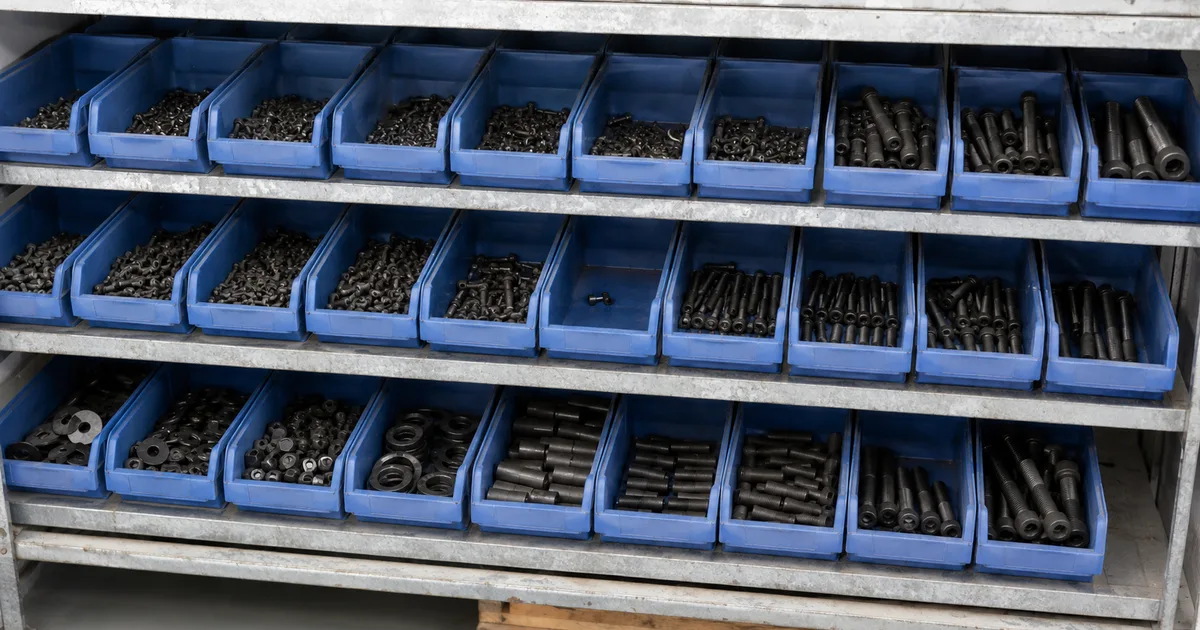
Effect: Fixed locations and clear zones cut search time for good, and with it the paid working time that currently disappears into the stockroom without creating value.
Effect: Even one avoided emergency run per week saves several thousand EUR per year within the cost framework of this article. At the same time, over-ordering decreases because a maximum is defined alongside the minimum.
3. Measure Consumption, Avoid Over-Ordering
You can't optimize what you don't measure. Knowing your daily material consumption lets you order the right quantity at the right time. The guide to consumables calculation in the trades shows how to determine daily consumption per item category and derive optimal order quantities from it.
Effect: Less over-ordering frees up capital. At the same time, expiry, shrinkage, and duplicate orders decrease.
Effect: Real-time stock visibility, automatic reorder points, traceable transactions. The combination of Strategies 1 through 4 can significantly reduce total losses, because stock levels, withdrawals, and replenishment finally work together.
5. Share Knowledge Instead of Hoarding It
The most important strategy concerns the owner. As long as all the inventory knowledge sits in one person's head, the business can't scale. The solution: document stockroom processes, distribute responsibilities, and introduce systems that work independently of the owner.
In practice, that means:
Stock ownership: Each employee takes responsibility for one materials area.
Formalize the ordering process: The system, not the owner, decides when to order (reorder point reached = order triggered).
Centralize supplier data: Contacts, pricing, and ordering channels belong in a shared system, not in the owner's notebook.
Effect: The owner reclaims meaningful time for customer acquisition, estimating, and strategic business development. The business becomes less dependent on the knowledge of a single person.
From Practice: One Person Just for the Stockroom
At a 25-person business I worked with, a single move made the difference: a dedicated logistics person who handles only the stockroom. Stock, staging materials, master data, and ordering now run through one person instead of being squeezed in on the side by the master tradesman and journeymen.
It pays off for three reasons. A logistics hire costs less per hour than a master or journeyman hour, so stockroom work shifts from the expensive skilled worker to a cheaper role while the tradespeople stay billable on the job site. Stock finally has a clear owner: master data stays clean, reorder points stay maintained, and materials are picked and ready when the crew heads out in the morning. And the stock knowledge no longer hangs on the owner, so the business keeps running even when the boss is out for two weeks.
It only pays off from a certain size up: multiple crews, multiple vans, enough material throughput to justify the role. In this business the role is a part-time position. To get started, though, a mini-job is often enough, two three-hour shifts a week, say Mondays and Wednesdays.
What Other Businesses Save: Numbers and Benchmarks
The table below shows modeled figures by business size, extrapolated from the assumptions in this article.
Business size
Potential cost range per year
Potential savings after optimization
Payback tendency
1 to 3 employees
8,000 to 15,000 EUR
5,000 to 10,000 EUR
often within a few months
4 to 7 employees
25,000 to 45,000 EUR
15,000 to 30,000 EUR
typically within six months
8 to 15 employees
40,000 to 80,000 EUR
25,000 to 50,000 EUR
often under a year
16 to 30 employees
60,000 to 120,000 EUR
35,000 to 70,000 EUR
depending on complexity, often within a year
The BG BAU (Germany's statutory accident insurance for the construction industry) also highlights the safety dimension: hazardous materials must not be stored in ways that put employees at risk, such as in walkways or break rooms. Additional protective measures apply for flammable substances, pressurized cartridges, and water-polluting products. Businesses that organize their stockroom systematically often satisfy these requirements as a by-product.
Conclusion: Reducing Warehouse Costs Is a System
The reality is clear: hidden warehouse costs in a trades business are real, measurable, and avoidable. Treating the stockroom purely as an organizational issue means underestimating the actual problem. It hits profit, liquidity, and growth.
In this calculation, a 5-person business that halves its search time, cuts unplanned supply runs to one per month, and manages stock with a min-max system saves 15,000 to 30,000 EUR per year. That's a figure that becomes immediately relevant for most businesses.
The highest return comes from resolving whatever bottleneck is costing you the most. Once the team has the stockroom under control and the owner stops being the storekeeper of their own business, the business gains breathing room for customers, estimating, and leadership.
More visibility = fewer wrong orders = less capital tied up = more liquidity = more growth. Set up once, this system keeps your business more resilient and more scalable.
Your next steps:
This week: Calculate your hidden warehouse costs using the formula above. Count the supply runs from last week.
Be honest with yourself: Does the stockroom only run because you or your master tradesman keep it all in your head? Then that's your biggest lever, not the shelving. Decide whether you want to change it. And if you want to change it and need support, reach out to us.
Then: Read the stockroom organization guide and decide whether to start with a Ground Zero restart or a step-by-step approach.
FAQ: Lowering Warehouse Costs in the Trades
In a 5-person business, hidden warehouse costs can easily reach 25,000 to 45,000 EUR per year when search time, unplanned supply runs, overstocking, and owner time all add up. The biggest line items: search time (6,000 to 12,000 EUR), supply runs (15,000 to 25,000 EUR), capital tied up in over-ordering (2,000 to 5,000 EUR), and the time the owner personally spends on inventory management instead of productive work.
Most businesses capture rent and material costs, but overlook four items. First, labor costs for search time (at 50 to 100 EUR per hour), these add up fast. Second, the opportunity cost of unplanned supply runs (not just travel time, but lost revenue). Third, capital tied up in overstock that generates no return. Fourth, the owner's time spent as the only person who knows where things are and what needs to be ordered.
Add four categories: search time (lost hours per week multiplied by your hourly rate), supply runs (number per week multiplied by total cost per trip including opportunity cost), capital tied up in stock (average inventory value multiplied by your holding cost rate), and owner time for inventory management (hours per week multiplied by the owner's charge-out rate). The total gives you a realistic estimate of your annual losses from a disorganized stockroom.
Yes. Smaller businesses actually feel the hidden costs most acutely, because every lost hour is immediately felt. Even simple measures (fixed storage locations, a two-bin Kanban, and defined minimum stock levels) can noticeably reduce search time and emergency runs. Often just a handful of avoided unplanned trips is enough to make the effort pay for itself quickly.
In many businesses, unplanned supply runs are among the biggest cost drivers. In this calculation, a single trip to the wholesaler costs between 143 and 210 EUR once you factor in labor, vehicle costs, and lost contribution margin. At two to three trips per week, that adds up to 15,000 to 25,000 EUR per year. Search time in the stockroom is another major driver.
How quickly the investment pays off depends on your starting point. If your current situation combines chaos, emergency runs, and overstock, a structured inventory system with ABC analysis, min-max stock levels, and digital inventory tracking can free up several thousand EUR per year, often in a short amount of time.