Reorder Point Calculation: Formula, Worked Example and Practical Tips
Daily consumption, lead time and safety buffer in a fully worked example, how it relates to minimum and maximum stock, and the special case with no lead time.
Reorder point = daily consumption x lead time + safety stock, always above minimum and below maximum stock. Reached: reorder immediately.
Example: 15 coils/day x 5 days + 30 buffer = 105 coils reorder point.
Minimum stock separate: daily consumption x delay days, so 15 x 2 = 30 coils.
Maximum stock separate: safety stock plus order quantity, 230 coils in the example.
Adjust values at least quarterly, immediately after any supplier change.
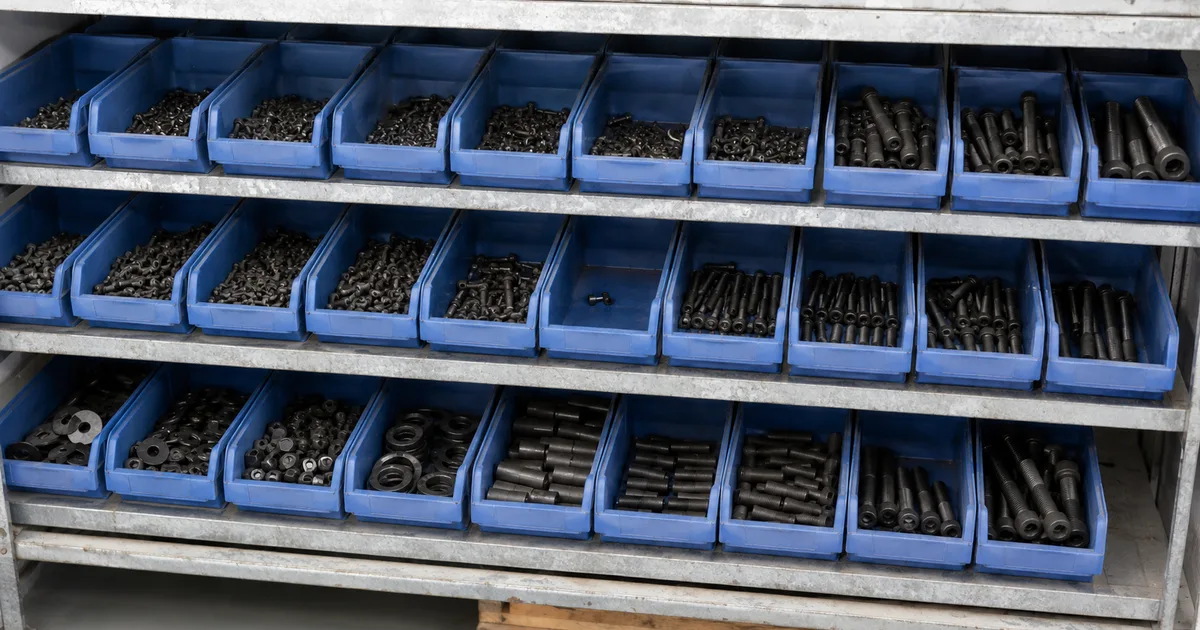
The bin is empty. Somebody took the last parts days ago without saying a word. Time of the crime: unknown.
So the order goes out only once the item is needed and has already turned into a shortage. The supplier takes the heat, reacts fast and ships express. The delivery still arrives too late. The right moment to order had passed days earlier, before the crime.
The reorder point fixes the ordering moment in advance instead of leaving it to whoever glances at the shelf.
What Is the Reorder Point?
The reorder point (also called order point) is the stock level at which a reorder is triggered. Without a defined reorder point, the ordering moment depends on colleagues shouting across the shop floor and notes on scraps of paper.
To run replenishment on a rule instead of a reflex, you need three metrics:
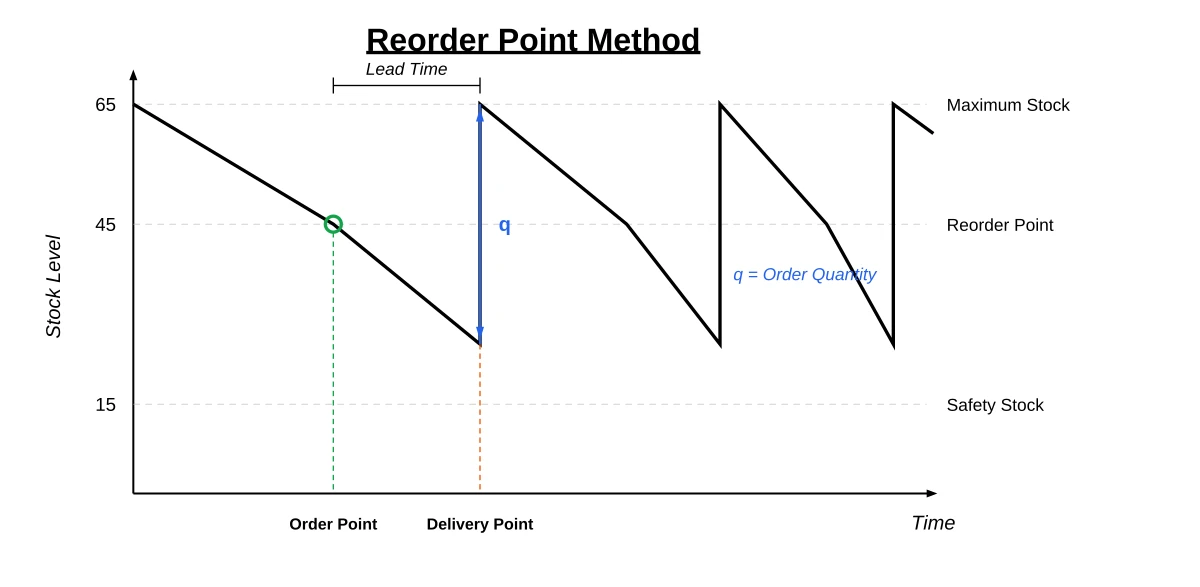
Minimum stock (iron reserve): The buffer that should never be touched. Catches delivery delays.
Reorder point (order point): The stock level at which you reorder. Always sits above the minimum stock.
Maximum stock: The most your warehouse should hold. Above that, you tie up capital unnecessarily.
The interplay is simple: when stock drops to the reorder point, you reorder. The goods arrive before the minimum stock is reached.
Your inventory fluctuates between the reorder point and the maximum stock, without ever running out of material. The technical name for this is the reorder point system, which the Gabler Wirtschaftslexikon defines as follows (translated from German):
"One of several procedures for order quantity planning, in which an order is triggered whenever stock reaches or falls below a defined level (reorder point). In the reorder point system with a fixed order quantity, a set quantity is ordered once the reorder level is reached. In the reorder point system with a maximum stock level, the quantity ordered is the one that tops stock up to the defined target level. In both variants the ordering dates are variable, since they adapt to changes in stock withdrawal."
The 3 Inventory Formulas at a Glance
Minimum stock, reorder point and maximum stock build on each other.
Metric
Formula
Purpose
Worked Example
Minimum stock
Daily consumption × safety factor (days)
Buffer, never to be touched
15 × 2 = 30 coils
Reorder point
Daily consumption × lead time + safety stock
Trigger for reordering
15 × 5 + 30 = 105 coils
Maximum stock
Safety stock + economic order quantity
Upper limit the warehouse should hold
30 + 200 = 230 coils
Order of operations:
set the minimum stock first (the buffer), then
build the reorder point on top (the trigger)
finally check the maximum stock (the ceiling).
Anyone who sets the reorder point without knowing the minimum stock is guessing two of the three variables.
The Formula: Calculate the Reorder Point With 3 Variables
Reorder Point = Daily Consumption x Lead Time + Safety Stock
Broken down in detail:
1. Daily consumption (units per working day)
The average consumption of an item per day across a representative period, in retail wording your average daily sales or demand rate (and no, "roughly 10 units" is not enough). If you want to calculate your daily consumption correctly, you need data from at least 4 to 8 weeks. Your past orders are the best place to start.
2. Lead time (in working days)
The time between placing the order and receiving the goods. Not the lead time your supplier promises. The actual, measured lead time across your last orders.
3. Safety stock (minimum stock)
The buffer for everything that can go wrong: supplier delivers late, consumption spikes unexpectedly, goods arrive damaged. The less reliable the supply chain, the higher the safety stock.
Worked Example: Reorder Point for a Consumable Item
An electrical contractor with 15 employees regularly installs 0.75 mm² single-core cable, sold in 100 m coils cable. The numbers:
Daily consumption: 15 coils per working day (average over 6 weeks)
Lead time: 5 working days (actually measured, not from the catalogue)
Safety stock: 30 coils (2 days buffer for delivery delays)
Plugging into the formula:
Reorder point = 15 x 5 + 30 = 105 coils
As soon as stock drops to 105 coils, a reorder is placed. The new delivery takes 5 days. During those 5 days, the business uses 75 coils (15 x 5). That leaves 30 coils as buffer. If the delivery arrives on time, the safety stock is never touched.
And the maximum stock? Assume the economic order quantity works out at 200 coils. The logic: you reorder at 105 coils. During the 5-day lead time, you consume 75 coils (15 x 5). When the delivery arrives, you have 30 coils left in the warehouse plus 200 new ones. That tells you: your warehouse needs space for a maximum of 230 coils of this cable type.
Instead of ordering a fixed 200, you can top up to a target level every time. That is what Gabler calls the reorder point system with a maximum stock level, and on the shop floor it runs as min-max. The trigger is still the reorder point, only the order quantity varies with whatever is left.
Safety Stock: Foundation of the Reorder Point
This is the variable where most businesses get it wrong. Too low: material runs out despite the reorder point. Too high: capital sits idle in the warehouse and warehouse costs rise. What we mean is the buffer that is never touched, listed above as minimum stock. Without it, the reorder point has no foundation.
Simplest method: daily buffer. Your supplier is late by an average of 2 days? At 15 coils of daily consumption, that gives you the 30 coils from the example above. Does the supplier deliver reliably on the day? Then a half-day buffer is enough. Once consumption swings hard, a flat daily rate stops working, and the minimum stock formulas or a safety stock calculation take you further.
Three factors determine the level:
Supplier delivery reliability: A supplier who regularly delivers late requires more buffer. Measure actual delivery reliability over 3 to 6 months.
Consumption fluctuations: Where the business has a peak season, the required buffer rises with it. One value for the whole year gets both halves wrong.
Emergency replacement: Some items you pick up the same day from a dealer nearby, others are custom orders with weeks of lead time. The harder an item is to replace at short notice, the higher the buffer.
Safety stock is not a static value. Supplier changes = check the buffer. Season starts = check the buffer. Anyone who does not do this is calculating with yesterday's numbers.
Reorder Point Without Lead Time? When the Short Formula Is Enough
Sometimes the lead time is practically zero: you pick up material yourself from the wholesaler, or your supplier has a consignment warehouse on site. Or you are supplying a location from your own central warehouse. In these cases, the formula simplifies:
Reorder point = safety stock
You reorder as soon as only the buffer remains. This works as long as pickup or resupply is actually possible on the same day.
In practice, a lead time of zero is rare. Even a trip to the wholesaler costs time. And every hour an employee spends fetching material instead of doing their actual job costs real money. That is why it almost always pays to use the full formula.
From Theory to Practice: Implementing the Reorder Point in Your Business
The formula is the easy part. Yet procurement in many businesses still runs on gut feeling, because "we know what we need". The five steps below are the part that takes actual work.
Step 1: Identify the Right Items
Every item that is consumed regularly needs a reorder point. The purchase price does not decide that. What determines whether a missing part hurts is where it is used: the same screw is a penny item on the shelf and the reason a job stops on site. Secure only the expensive items and the shortages simply move to the cheap ones.
What does differ is the order you set them up in. Start with the items you handle most often and work through the rest while organizing the warehouse. For the specialty item you need twice a year there is no reliable daily consumption, so a reminder is enough.
Step 2: Document Consumption
Without data, no reorder point. You need actual consumption over at least 4 weeks. Businesses tracking stock on paper can record this manually. Digitally, it is faster and more accurate, mainly because the history stays available: next time you adjust the values, you calculate from measured data instead of counting for another four weeks.
Step 3: Measure Lead Times, Do Not Estimate
Lead times quoted by suppliers and dealers are marketing promises, and reality tends to catch up with them. Measure the actual lead time across 5 to 10 orders. The average is your calculation value. The worst case determines your safety stock.
Step 4: Set Up Monitoring
The reorder point only works if someone (or something) monitors the current stock level. Manually, that means: regular warehouse checks. If you want to automate the process, you set up automatic alerts when stock drops below the reorder point.
One thing matters more than the tool: clear responsibility. Paper lists survive in many businesses not because they are better, but because nobody knows who owns the digital records. Name one person (an actual name, not "the team") who maintains the stock levels, plus a deputy. Without that, every system fails, Excel or software alike.
Step 5: Adjust Regularly
Consumption changes. Suppliers switch. Order volumes fluctuate. The reorder point you calculated in January may no longer fit in July. Review your values at least quarterly. After every supplier change, immediately.
Monitoring the Reorder Point: Excel, Software or Automation?
Three approaches in practice:
Excel spreadsheet (manual). Works for 10 to 20 items, as long as someone maintains it. Problem: Excel does not alert you, you have to actively check. Comparison: Excel vs. digital tools.
Dedicated inventory software. Monitors stock automatically, alerts on breach. For >20 regularly consumed items the more practical route.
Some form of monitoring must exist. The best reorder point is useless if nobody is tracking it.
Setting up your reorder point: the next step
Multiplying daily consumption by lead time and adding safety stock takes 30 seconds. The real effort lies in the three variables:
measure consumption properly
assess lead times realistically
do not set the safety buffer from gut feeling.
Businesses that calculate the reorder point properly for the items with stable consumption and adjust regularly order late less often. That saves emergency runs, downtime and everyone's nerves.
The next step: take five items you consume regularly and calculate the reorder point. Daily consumption, lead time, safety stock. Three numbers per item. In 15 minutes, you have a small system that makes the difference between "material missing" and "material ready."
Frequently Asked Questions About the Reorder Point
The reorder point, also called the order point, is the stock level at which the replenishment order is triggered. It is set so that the goods arrive before the minimum stock is broken into. Without a defined reorder point, the ordering moment depends on somebody looking at the shelf in time.
From three measured values: average daily consumption over 4 to 8 weeks, actual lead time over the last 5 to 10 orders, and the safety stock. Daily consumption × lead time gives the consumption during replenishment, and the safety stock is added on top. Review the value at least quarterly.
The minimum stock is the buffer that should never be touched. The reorder point sits above it and marks the point at which you reorder. When stock drops below the reorder point, the order is placed. When stock drops below the minimum, you have a problem.
Reorder. Immediately. The reorder point is calculated so that stock just lasts until the new delivery arrives. Every day of delay eats into the safety buffer.
Only with immediate delivery (pickup at the wholesaler, on-site warehouse). Then: reorder point = safety stock. In practice, almost every procurement has a lead time, even if it is only one day.
At least quarterly. After supplier changes, seasonal fluctuations or changes in order volume, adjust immediately. Anyone who sets the reorder point once and never adjusts it will eventually order too early or too late.