Monday, Job Site: The Wrong Material
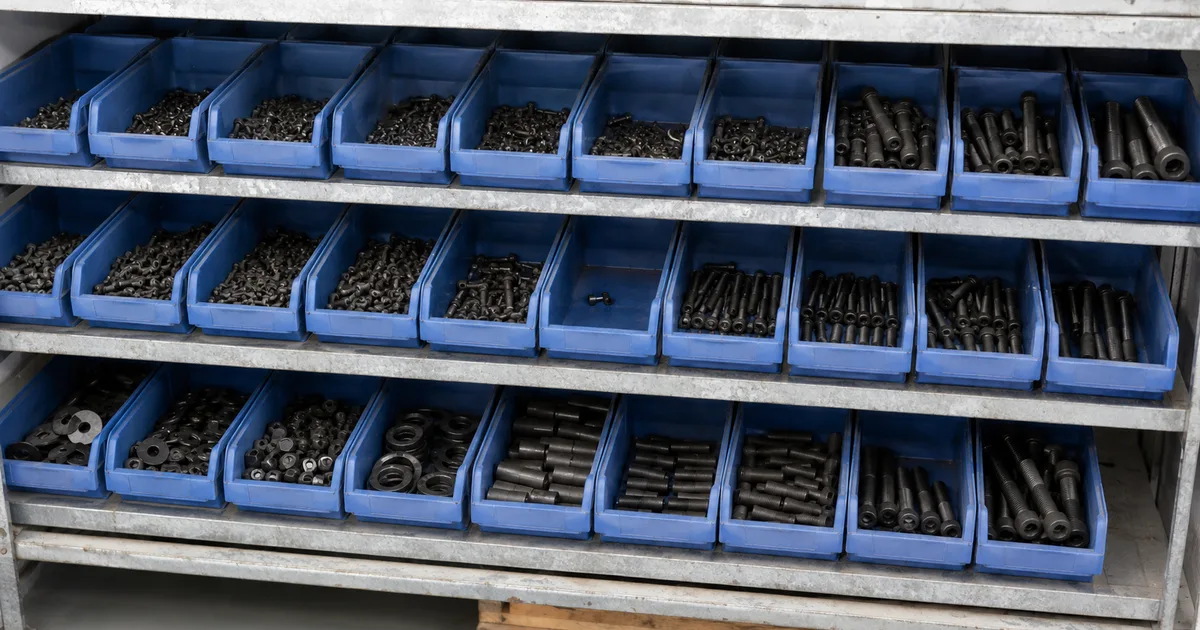
Monday morning, job site in Ehrenfeld. Your technician is standing in front of the distribution box and needs terminals, type NH00. In the stockroom: two boxes, full quantity. But the wrong size. The right ones? Never reordered because nobody counted. The technician drives to the wholesaler. Two hours gone, the job site stands still.
That's not bad luck. The business just doesn't know what's in the stockroom. Trade businesses often have too much of the wrong thing and too little of the right thing in stock. Inventory metrics help you see the difference.
What are Inventory Metrics?
Inventory metrics, also called warehouse indicators or inventory KPIs, are measurable indicators that show how efficiently a business uses its stockroom. They answer three basic questions: How often does the stock turn over? How long does material sit unused? How much does the stockroom cost per euro of inventory value?
Numbers that trigger concrete decisions: what is too much, what is missing, what has been sitting too long.
The four most important inventory metrics in the trades include: inventory turnover, average storage duration, storage cost rate, and stockout rate.
Why Trade Businesses Need Different Metrics
Industrial companies measure with ERP systems, thousands of items, and automatic inventory management. A trade business with ten employees doesn't have that and doesn't need it.
The difference is structural. Industrial material waits for further processing; trade material waits for the job site. Copper pipes, cables, seals: consumables that are installed on a project basis and not turned over like trade goods individually. This changes the perspective on metrics.
Another difference: Most trade businesses carry 50 to 500 items, not 50,000. This makes a simplified method possible without sacrificing precision.
The following four metrics are designed for this reality.
The 4 Most Important Inventory Metrics for Trade Businesses
1. Inventory Turnover: Is Your Stockroom Turning Fast Enough?
Inventory turnover shows how many times the average inventory level is completely renewed in a year.
Formula: Cost of Goods Sold (COGS) / Average Inventory
You calculate average inventory like this: Average Inventory = (Beginning Inventory + Ending Inventory) / 2. Sufficient as a starting point. A monthly average is more precise, especially with seasonal or project-driven fluctuations.
Example HVAC business: In the past year, copper pipes and fittings worth 48,000 euros were installed. The average inventory level of these materials was 6,000 euros.
Inventory turnover = 48,000 / 6,000 = 8
The stock turns over eight times a year, meaning every 46 days.
What is a good value? For consumables (standard parts, small parts, pipes), an inventory turnover of 6 to 12 is considered solid in the trades. Specialized material with long procurement times can be lower without it being a problem.
A value below 3 for standard material is a warning signal: capital is sleeping in the stockroom instead of working in the business.
Benchmarks by trade
The right inventory turnover depends on the trade. Plumbers and carpenters have structurally different stockroom profiles. The following figures are rough practical orientation; your own numbers depend heavily on your assortment, lead times, and project mix:
| Trade | Rough Orientation | Driver |
|---|
| HVAC / Plumbing | approx. 8 to 15 | Standard fittings and seals: high consumption, short lead times |
| Electrical | approx. 6 to 10 | Mix of bulk material (cable) and specialty parts (switchgear) |
| Drywalling / Fit-out | approx. 5 to 8 | Bulky material limits stock; demand is project-driven |
| Joinery / Carpentry | approx. 3 to 6 | Wood needs acclimatization; specialty panels have long lead times |
Values below the orientation ranges are not an alarm signal in themselves. They are the starting point for identifying which specific items are sitting too long.
2. Average Storage Duration: How Long Does Material Sit Idle?
Storage duration is the direct complement to inventory turnover. It shows how many days an item sits on the shelf on average before it is installed.
Formula: 365 / Inventory Turnover (some accountants use 360 days; we use 365 as the practical default)
In the example above: 365 / 8 = 45.6 days
Each copper pipe sits in the stockroom for an average of 46 days. For standard material, that's fine.
Related auxiliary metric: Inventory coverage
Inventory coverage is not one of the four core metrics, but useful for reorder planning: how many days will the current stock last before it needs to be replenished?
Formula: Current stock (€) / Daily consumption (€/day). Calculate daily consumption as: annual COGS / 365.
Example: Current stock €2,400, annual COGS €36,500 → daily consumption €100 → inventory coverage = 24 days
This is particularly useful for reorder planning: with a 3-day lead time, a 24-day buffer is comfortable. With a 4-week lead time, the same coverage would be critical.
It becomes problematic with values over 90 days. Material that sits for three months or longer belongs in one of three categories: ordered too much, wrong item, or outdated demand.
Example electrical business: Old fuse types that were ordered for existing systems, but the job sites have since been completed. Storage duration: 180 days. Result: tied-up capital, no longer needed.
3. Storage Cost Rate: What Does Every Euro in the Stockroom Cost You?
The storage cost rate shows what percentage of the inventory value is incurred annually as costs.
Formula: Total Storage Costs / Average Inventory × 100
Storage costs include: interest on tied-up capital, space costs (rent or imputed), personnel costs for stockroom maintenance, insurance, shrinkage, and spoilage.
You can calculate the capital portion directly: Capital costs = average inventory × imputed interest rate. A rate of 4 to 6 percent is a reasonable benchmark (financing costs plus opportunity costs). At €15,000 average inventory and 4 percent, that's €600 per year before space costs or insurance are added.
Benchmark: A common rule of thumb puts annual storage costs at 15 to 25 percent of average inventory value.
A storage cost rate of 20 percent means: every euro sitting unused in the stockroom for a year costs 20 cents, even without a technician touching it. Dead stock is not a safety reserve. It is a silent ongoing cost.
For a business with 15,000 euros average inventory, that's 3,000 euros per year just for holding the stock. Learn more in Reducing Storage Costs in the Trades.
4. Stockout Rate: How Often Is Material Missing on the Job Site?
The stockout rate measures how often material runs out.
Formula: Orders with at least one material shortage / relevant orders × 100
Target value: Below 2 percent. Anyone who has more than two material shortages per month for ten orders a week has a systemic gap, not a streak of bad luck.
What does a stockout cost? A technician with a 55 euro hourly charge-out rate who drives to the wholesaler and back for two hours costs 110 euros directly. Added to this are rescheduled appointments and, in the worst case, rework for the customer.
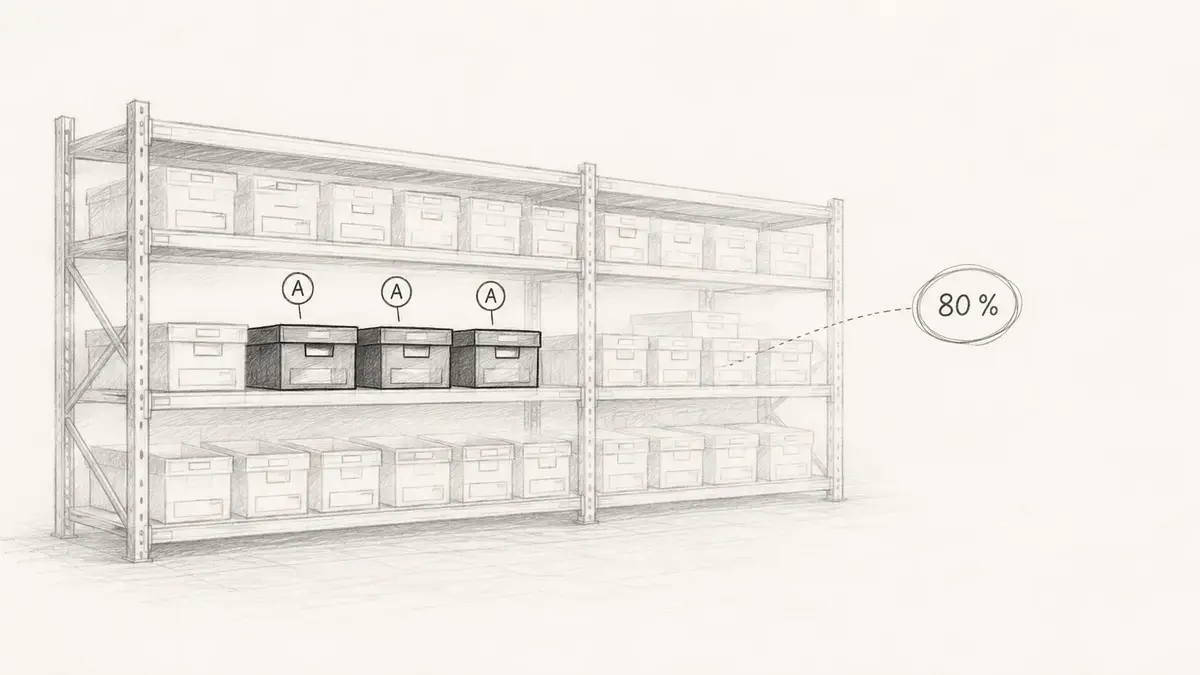
Anyone who wants to lower the stockout rate doesn't need expensive software. A simple reorder point for the 20 percent of the range that accounts for 80 percent of consumption is enough to start.
Calculating Inventory Metrics: A Complete Example
Electrical business, 8 employees, annual cost of goods sold 95,000 euros. Three material groups are evaluated.
| Group | COGS | Average Inventory | Turnover | Storage Duration |
|---|
| NYM Cables | 35,000 € | 3,500 € | 10.0 | 37 days |
| Installation Material | 28,000 € | 7,000 € | 4.0 | 91 days |
| Sockets and Switches | 18,000 € | 9,000 € | 2.0 | 183 days |
Evaluation: NYM cables are turning well, no action needed. Installation material is sitting too long: check the reorder point and lower the order quantity. Sockets and switches: halve the inventory level, reset the minimum stock. 9,000 euros of tied-up material with 183 days of storage duration costs 1,800 euros in holding costs per year at a 20 percent storage cost rate, without any benefit.
Inventory Metrics Overview: Quick Reference for the Business
| Metric | Formula | Benchmark Trades | Warning Signal |
|---|
| Inventory Turnover | COGS / Average Inventory | 6 to 12 for consumables | under 3 for standard material |
| Average Storage Duration | 365 / Inventory Turnover | under 60 days for A-items | over 90 days |
| Storage Cost Rate | Storage Costs / Avg. Inventory × 100 | 15 to 25% per year (rule of thumb) | over 30% |
| Stockout Rate | Shortages / Orders × 100 | under 2% | over 5% |
How to Introduce Inventory Metrics in Your Business
You don't need an ERP or a controlling department. Three steps are enough to get started.
Step 1: ABC Analysis. Divide your assortment into A, B, and C items. A-items are the 20 percent with the highest consumption value. Start there. Knowing all four inventory metrics for the top 20 items is more valuable than vague assumptions about all 500 positions.
Step 2: Quarterly Measurement. No daily controlling necessary. Checking the inventory turnover and stockout rate for A-items once a quarter shows where things are sticking.
Step 3: Set reorder points. Anyone who knows how long material sits and how often it is consumed can determine the reorder point. The safety stock buffers against delivery delays and consumption spikes; the reorder point sits above it and triggers the order. Doing this for the 20 fastest-moving items brings the biggest shortages under control.
If you don't want to maintain this process manually: Digital inventory management systems like repleno calculate reorder points automatically and trigger reorders before material is missing.