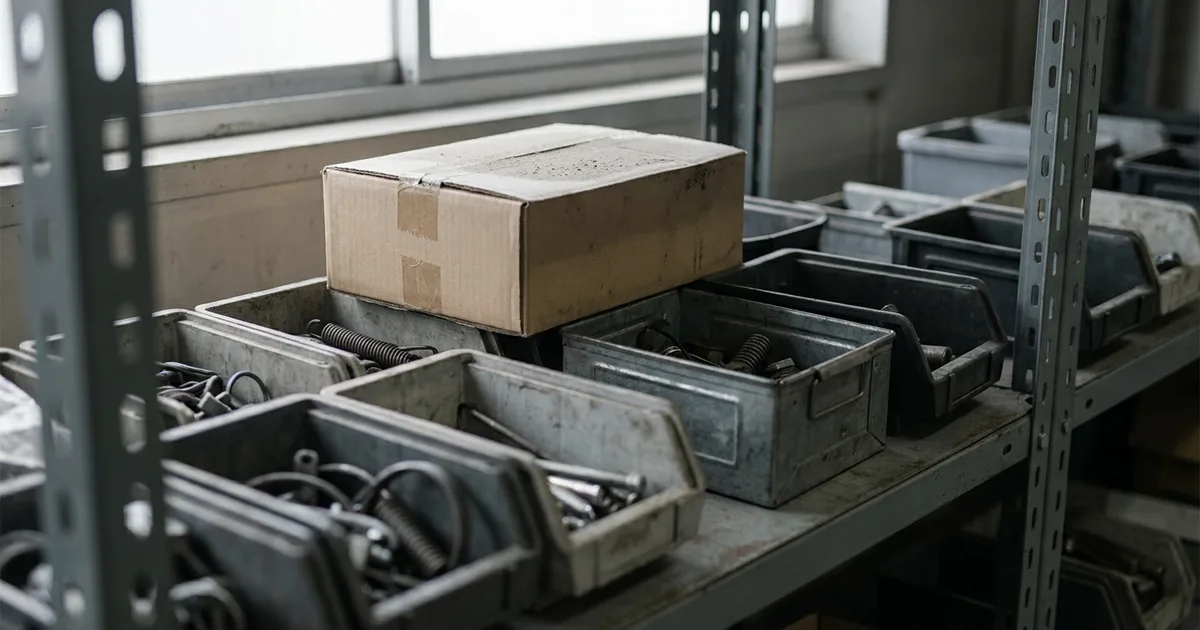
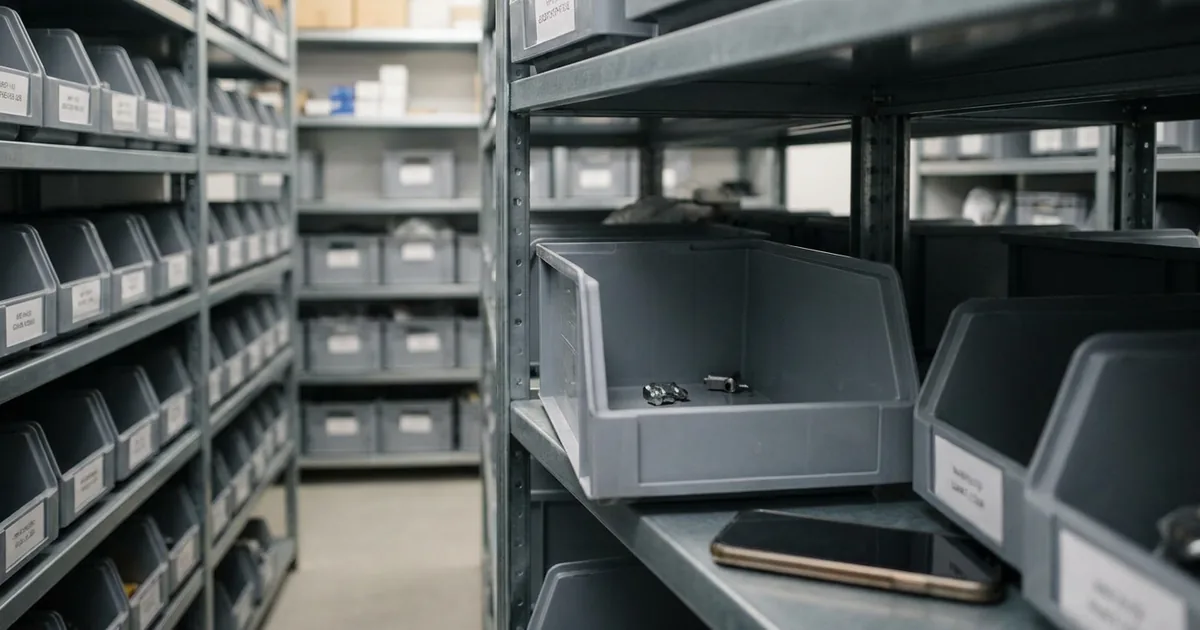
The empty screw box and the unplanned wholesaler visit
Wednesday, 2 PM. A technician reaches into the shelf and finds an empty box. The required screws are out. No one reordered. Now follows an unplanned trip to the wholesaler: 45 minutes lost, project delayed, customer waiting.
This scenario repeats itself daily in trades businesses. And even if it's "only" 2 emergency trips per week (45 minutes each), that's 1.5 hours a week, quickly 70+ hours a year that no one calculates. Those who want to dive deeper into materials management and warehouse logistics can find an introduction, for example, at the IHK Nord Westfalen.
The solution has existed since the 1950s: Kanban. A visual replenishment system that works without complex software and solves exactly this problem.
What is Kanban? Definition and Origin
Kanban (Japanese for "signal card") was developed in the 1950s by Taiichi Ohno at Toyota. The principle: Material is only reordered when it has actually been consumed.
Understanding the Pull Principle
Classic ordering systems work according to the push principle: You order according to plan or estimate, regardless of actual consumption. This leads to overstocking or stockouts.
Kanban reverses this logic: under the pull principle, consumption "pulls" the reorder. Only when material is removed does a signal for replenishment arise.
| Push Principle | Pull Principle (Kanban) |
|---|
| Order by plan/estimate | Order by actual consumption |
| Risk of overstocking | Stocks are oriented towards demand |
| Regular stock check necessary | Visual signal replaces check |
| Complex with many items | Easily scalable |
Experience from Lean projects: Kanban typically reduces overstocks and improves availability at the same time, provided you dimension bin quantities cleanly and consistently follow the rules.
How the Two-Bin System Works
The two-bin system is the simplest variant for trades businesses. You need no software, no scanners, no complex processes.
The Principle in 4 Steps
Step 1: Two identical bins per item
Each item has two bins with identical content. The bins stand one behind the other on the shelf. You always take from the front bin.
Step 2: Front bin empty? Order signal.
As soon as the front bin is empty, place it in a defined "reorder zone" (a separate shelf or a marked area). The empty bin is the order signal.
Step 3: Take from the second bin
During the lead time, you take from the second (rear) bin. This contains enough material to bridge the lead time.
Step 4: Delivery arrives, cycle closes
The delivery fills the empty bin. This comes back onto the shelf, behind the current removal bin (FIFO principle). The cycle starts again.
Calculating the Right Bin Size
The quantity per bin must cover consumption during the lead time and until the next order plus a safety buffer.
Practical formula: Bin quantity = (Daily consumption × (Lead time + Order cycle in days)) + Safety buffer
Why the order cycle is included: With one order per week, the second bin covers the lead time AND the time until the next order (e.g., "Friday is order day").
Example Cable Ties:
- Daily consumption: 20 pieces
- Lead time: 3 days
- Order cycle: 5 days (Order 1×/week)
- Basic requirement: 20 × (3 + 5) = 160 pieces
- Buffer: 20 % = 32 pieces
- Bin quantity: 192 pieces per bin
With two bins, you always have 192-384 cable ties in the system. That sounds like a lot, but is often exactly the amount you need to cushion lead time + order cycle. If this ties up too much stock value: Shorten the order cycle (order more frequently) or check alternatives like Min-Max.
Kanban Variants for Trades Businesses
The two-bin system is the standard. Depending on the business size and requirements, there are variants.
Three-Bin Kanban
At very long lead times (over 5 days) or unreliable suppliers, a third bin can be useful as an additional buffer. This increases security but ties up more capital.
Kanban Cards
Instead of moving the empty bin, some businesses use Kanban cards. The card contains the item number, description, order quantity, and supplier. When the bin is empty, the card goes on the kanban board or into a collection box. Every card there gets reordered. Practical if bins are too large or unwieldy.
Mandatory information on a Kanban card:
- Item description and number
- Bin location
- Order quantity
- Supplier
- Optional: Barcode or QR code
E-Kanban (Electronic Kanban)
If withdrawals need to be analyzed or connected to an inventory management system, there is E-Kanban. Instead of physical signals, you record the removal digitally (via scanner, RFID, or app). The system can automatically trigger order proposals or orders (depending on the approval process).
E-Kanban is easier to analyze and connects more easily to suppliers, but it costs software, often hardware, and training time. A barcode-based inventory system can be the first step toward digitization. As long as the empty bin reliably lands in the reorder zone and nobody needs to analyze withdrawals, the classic two-bin system stays the simpler option.
Important: Even E-Kanban needs clear rules. “Automated” usually means the system creates an order suggestion or order, but someone must define approvals, suppliers, minimum quantities, and backups.
Practical Examples by Trade
Kanban works in every trade. The application differs only in the typical items.
Electrical Trades
Typical Kanban items:
- Cable clips (various sizes)
- Cable ties (white, black, various lengths)
- Terminal blocks and Wago connectors
- Anchors and screws
- Electrical tape
Practical setup: Heavy-duty shelves with open-fronted storage bins. Each clip size has two bins. Empty bins go to a separate shelf labeled "Reorder". Every Friday, all empty bins are ordered.
Plumbing and Heating Businesses (SHK)
Typical Kanban items:
- Pipe clamps and fasteners
- Seals (flat gaskets, O-rings)
- Hemp and PTFE tape
- Standard fittings (elbows, tees in common sizes)
- Silicones and sealants
Practical setup: In many plumbing and heating businesses, several thousand standard items are held in stock. Kanban is suitable for the most used C-parts (often the "Top 100 to 300"). Expensive fittings and project-specific material are better controlled via Min-Max stocks.
Painters and Decorators
Typical Kanban items:
- Masking films and masking tape
- Sandpaper (various grits)
- Brushes and rollers (consumables)
- Filler and joint compound
- Cleaning agents
Practical setup: Paint cans and varnishes are not suitable for Kanban (project-specific, limited shelf life). Consumables like masking films work perfectly in the two-bin system.
Kanban vs. Min-Max: When to Use What?
Kanban and Min-Max are not competitors but complement each other. The choice depends on the item type.
| Criterion | Kanban | Min-Max |
|---|
| Item value | Low (C-parts) | Medium to high (A/B-parts) |
| Consumption pattern | Constant, predictable | Fluctuating, project-dependent |
| Lead time | Short (1-5 days) | Variable |
| Complexity | Simple, visual | Requires stock check |
| Software needed? | No | Recommended |
| Examples | Screws, cable ties, seals | Circuit breakers, fittings, tools |
Rule of thumb: For items under 5 Euro unit price with constant consumption, Kanban is ideal. For more expensive items or fluctuating demand, use Min-Max with digital reorder level.
A complete comparison of all procurement methods for consumables helps with the decision.
Introducing Kanban in 5 Steps
Introducing a Kanban system takes a small business 4 to 8 hours of hands-on work. Start with one item group and expand step by step.
Step 1: Select Items
Start with 10-20 items that meet the following criteria:
- Constant, predictable consumption
- Low to medium unit price
- Short lead time (under 5 days)
- Standardized packaging (fits in bin)
Typical starter candidates: screws, anchors, clamps, cable ties and seals.
Step 2: Procure Bins
Small load carriers (KLT) or open-fronted storage bins are ideal. Choose two identical bins per item. Label each bin with item description and bin location.
Ballpark cost: Storage bins cost 2-5 euros each. For 20 items with two bins each, calculate 80-200 euros.
Step 3: Set Up Reorder Zone
Define a fixed place for empty bins. This can be a separate shelf, a marked area, or a trolley. This area is the central order signal.
Important: The reorder zone must be visible and accessible to all team members.
Prerequisite often forgotten: Kanban needs fixed bin locations and good labeling. If it is not clear where a bin belongs, the system quickly dilutes. Two helpful basics:
Step 4: Define and Communicate Rules
Hang the Kanban rules visibly in the stockroom:
- Always take from the front bin
- Place empty bin immediately in the reorder zone
- Never take from both bins at the same time
- Always fill delivery into the empty bin, this goes to the back
- Do not misuse bins
Step 5: Set the Order Cycle
Define when the reorder zone is checked. For most businesses, a fixed day of the week works (e.g., Friday). With higher throughput, daily checking may be useful.
Ownership Rule (crucial): Define who checks and who orders (Name instead of "someone"). And name a backup, otherwise Kanban collapses immediately during vacation or sick leave.
Same lesson from a C-parts logistics project for a machinery manufacturer: without a named owner, the project stayed unstructured. Only once responsibility was clearly assigned did it come together.
Three practical ownership models:
- Classic (manual): Empty bins collect in the reorder zone; the stockroom manager or office orders on a fixed schedule.
- Vendor-managed inventory (VMI): The supplier handles replenishment (agreed items/quantities); internally, only removal discipline remains.
- E-Kanban (Scanner/RFID/App): Each pick or empty bin is recorded digitally, and the system creates order proposals or orders (depending on approval process).
After 2-3 weeks: Check the bin quantities. If the second bin regularly becomes empty before the delivery arrives, increase the quantity. If a lot is always left over, reduce.
The 5 Most Common Mistakes in Kanban Introduction
Mistake 1: Too Many Items at Once
Start with a maximum of 20 items. Only when the system runs stably (after 4-6 weeks), expand step by step.
Mistake 2: Bins Too Small or Too Large
Bins that are too small lead to stockouts during the lead time. Bins that are too large tie up capital unnecessarily. Calculate the quantity according to the practical formula: Consumption × (Lead time + Order cycle) + Buffer.
Mistake 3: No Clear Reorder Zone
If empty bins are placed "somewhere", the system does not work. The reorder zone must be clearly defined and visible.
Mistake 4: Lack of Consistency
If some employees use the system and others do not, chaos ensues. Everyone must adhere to the rules. A stockroom owner checks and reminds. Without a clear owner ("Who really orders?"), the reorder zone eventually stays full, yet nothing comes in.
Mistake 5: Taking Unsuitable Items into the System
Kanban does not work for project-specific material, items with strongly fluctuating consumption, or materials with long lead times (over 2 weeks). For these cases, use Min-Max.
Kanban in the Vehicle
The two-bin system also works in service vehicles. Define fixed places for consumables. Empty bins come to the central stockroom at the end of the day.
Practical Tip: Use smaller bins in the vehicle than in the stockroom. A bin should cover the daily requirement plus one day buffer. This saves space in the van.
More on organizing vehicle stockrooms can be found in the Guide to Stockroom Organization in the Trades.
How to Know After 4 Weeks if Kanban Works
Kanban is not a "feeling", but can be checked with 3 simple metrics:
- Emergency purchases per week (should drop significantly)
- Stockouts of Kanban items (Goal: close to 0)
- "Empty bin found, but not in the reorder zone" (Goal: close to 0. This is discipline/process.)
If metric 3 is high, it is rarely a quantity issue, but a rule/responsibility problem.
Mini-Template: Kanban Card (if you don't want to move bins)
Some businesses prefer working with cards rather than "moving bins". This is what a pragmatic Kanban card looks like:
- Item: ______________________
- Bin Location: ___________________
- Order Quantity: _________________
- Supplier: ____________________
- Optional: Item Number / Barcode / QR Code
Conclusion: Start Simple, Expand Gradually
The two-bin system can be set up in an afternoon: for 20 items, the bins usually cost 80-200 euros, no IT rollout needed.
Your Next Steps:
- This week: Identify 10 items suitable for Kanban
- Next week: Procure bins, set up reorder zone
- In 2 weeks: Introduce system with the team, hang up rules
- After 4 weeks: Check bin quantities and adjust, expand upon success
The empty bin becomes a reliable order signal. Check the 3 metrics above after 4 weeks, not the feeling.
Kanban mainly cuts unplanned reorders and search time. What poor stock structure costs you overall is worked out in the guide to lowering warehouse costs in the trades.
Sources & Further Reading
- Taiichi Ohno: Toyota Production System (Kanban Origin and Pull Principle)
- Introduction to Materials Management/Warehouse Logistics (DE): IHK Nord Westfalen