inFlow alternative: repleno, inventory management from Germany
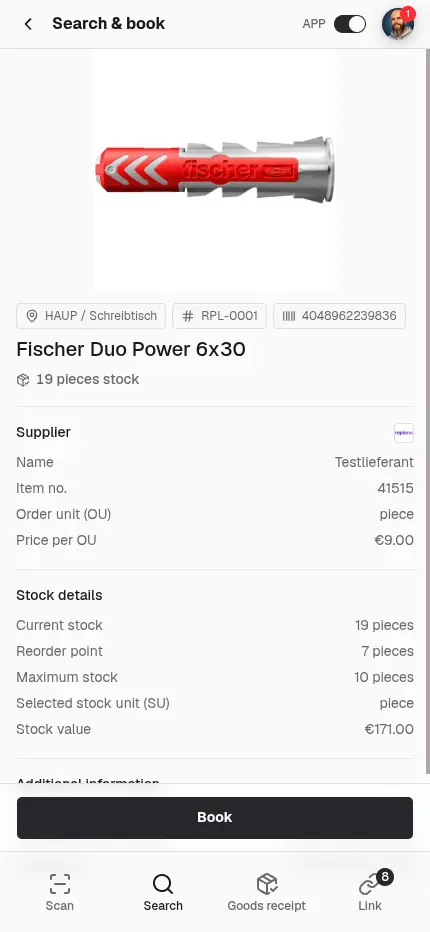
repleno is inventory management for the team, from Bielefeld: everyone books at the shelf by phone and sees stock on the go, and the price does not rise with every additional team member.
Which one fits when?
inFlow runs inventory, sales, purchasing, and manufacturing in one software. repleno focuses on stock and comes with a German team and support in German.


Choose repleno if you want a contact who comes to your business when needed and sets up your warehouse and processes with you.

Choose inFlow if you need manufacturing with bills of materials, sales across several channels, or a B2B showroom in one software alongside your stock.
What matters when choosing between repleno and inFlow?
Focus
replenoInventory management for the team
inFlowInventory, orders, and manufacturing
Data location
replenoGermany
inFlowCanada (Azure)
Contracting party and law
replenoGermany
inFlowCanada (Ontario)
Reaction at the reorder point
replenoWarn per item, auto-order from Flow, with approval from Scale
inFlowReminder at the reorder point, you send the order yourself, approval optional
Barcode and QR scanning
replenoYes, via smartphone
inFlowYes, via smartphone or inFlow's own smart scanner
Reports and records
replenoGoBD-compliant movement history, movers and non-movers per item from Flow
inFlowReport library, dashboard, custom reports
Support language
replenoGerman and English
inFlowEnglish, fixed UTC time windows
Onboarding
replenoGuided start online included, on-site help bookable
inFlowMandatory from the Small Business plan, €399 one-time
Pricing model
replenoBy item count and features, no price per user
inFlowFrom 129 US dollars a month for 2 logins, each additional one costs extra
Vendor
replenoYoung startup from Bielefeld
inFlowOn the market since 2007, based in Toronto
What do you gain from a vendor in Germany over one in Canada?
repleno is a German vendor: contracting party in Bielefeld, German law, data in Germany, billing in euros, support in German, often directly from the founder. inFlow comes from Toronto. The contracting party is Archon Systems Inc., a corporation under the law of the Province of Ontario, hosted on Microsoft Azure with no specific EU location named. Canada has an adequacy decision from the European Commission, so your data may go there. In daily use you notice the difference in language: the interface is available in English, Spanish, French, and Chinese, but not in German, and support answers in English during fixed time windows.
How do repleno and inFlow react at the reorder point?
inFlow lets you set a reorder point and a reorder quantity per item and location. When stock falls below it, you get a reminder and turn it into an order, a stock transfer, or a manufacture order, with approval from designated approvers if you want. In the end, you send the order to the supplier yourself. repleno takes over that last step from the Flow plan. Per item, you decide what happens at the reorder point: nothing, a stock alert, an automatic order with the supplier or, from Scale, a draft order for approval. That pays off for items that run down constantly and where the last ordering click otherwise gets left undone.
Define what happens when the reorder point is reached.
How do repleno and inFlow differ on reporting and integrations?
inFlow comes with a report library, a customizable dashboard, integrations with Shopify, Amazon, QuickBooks Online, Xero, and other tools, and manufacturing with bills of materials. If you sell across several channels or manufacture yourself, you get more done in one software with inFlow than with repleno. In repleno, every stock movement stays GoBD-compliant and traceable. From the Flow plan, repleno shows per item what is a best seller and what is a slow mover, and suggests minimum and reorder points from that. You make the decision right at the item, without building a report first.
What does repleno cost compared to inFlow?
inFlow starts at 129 US dollars a month (billed annually) for 2 team members. Each additional login costs between 39 and 59 US dollars more per month depending on the plan, and from the Small Business plan a mandatory onboarding of 399 euros is added. As your team grows, the bill grows twice over: more logins, a pricier plan. repleno charges in euros by item count and features, with no price per user. In the guided start, on every paid plan, we show you at no extra charge how to run your warehouse with repleno yourself. Check current prices directly with each vendor.
repleno's full feature set
Scan a barcode, paste a product link or text: the AI creates the item with name and data. Import entire stock lists via CSV.
Maintain all item master data in one central place.
Extend items with your own fields like manufacturer, serial number, or sales price.
Manage suppliers centrally and assign several per item. The demand report shows you right away where to order.
Manage the same item across multiple storage locations, with its own stock level and bin at each one, and transfer stock between them.
Create and print labels with barcode or QR code for fast scanning in the warehouse.
Learn moreLet repleno find matching product images for you, without having to upload them yourself.
Create assemblies and kits. Production increases the stock of the finished item, and kit withdrawals book the components directly.
Manage access and roles so everyone on the team sees exactly what they should.
Learn moreA device in the warehouse that the team shares without personal logins: unlocked with a name and PIN and straight into stock management.
Book consumption, receipts and stock corrections in seconds. By barcode or QR scan, or simply through search, no barcode needed.
Learn moreBook goods receipts directly against open orders and keep stock up to date immediately.
Book material directly to projects or customers and track clearly where it was installed.
Staff request missing material in the app, with quantity and a note. The admin sees the request right away and takes care of it.
Book material consumption to cost centers and export the report for accounting, DATEV or SAP.
Keep an eye on your material: everyone sees on their phone or PC what's in stock, what's on the way and what needs reordering soon, in real time.
Learn moreGet notified the moment an item drops below its reorder point, in the app and by email.
Learn moreWhen an item drops below its reorder point, repleno emails the order to the supplier, bundled and with minimum order value. Optionally only after your approval.
Learn morerepleno prepares orders, and you approve them before they go to the supplier.
Find slow movers, optimize stock value and spot dependencies on individual suppliers.
Learn moreEvery booking and every change to item data stays traceable, with timestamp and user.
Unmarked features are included in every plan, Free included. See pricing
Frequently asked questions about the inFlow alternative
Do you compare repleno to inFlow Inventory or to inFlow Stockroom?
What's the cheapest inFlow alternative?
Does repleno reorder automatically, unlike inFlow?
Can I move my data from inFlow to repleno?
Where is my data stored, in Germany or in Canada?
Are all features included in every inFlow plan?
Can I use repleno for free?
Sources and further reading
Sources
- inFlow pricing by plan and surcharges per team member (in USD), mandatory onboarding in euros (accessed from Germany), retrieved September 5, 2026
- inFlow purchase order software (reorder point, approval, manual sending), retrieved July 10, 2026
- inFlow Cloud security (Microsoft Azure), retrieved July 10, 2026
- inFlow cloud terms and conditions: Archon Systems Inc., an Ontario corporation based in Toronto, retrieved on 25 July 2026
- European Commission, adequacy decisions (Canada for organisations subject to PIPEDA), retrieved on 25 July 2026
- inFlow support language and support hours (UTC), retrieved July 10, 2026
- Archon Systems company history (founded 2007, Toronto), retrieved July 10, 2026
- inFlow Stockroom FAQ (no replenishment/sales per its own claim; GDPR/SOC 2 claim), retrieved July 10, 2026
Try repleno for your business
Organize your warehouse, keep stock current, on mobile and for the whole team.
Start for free