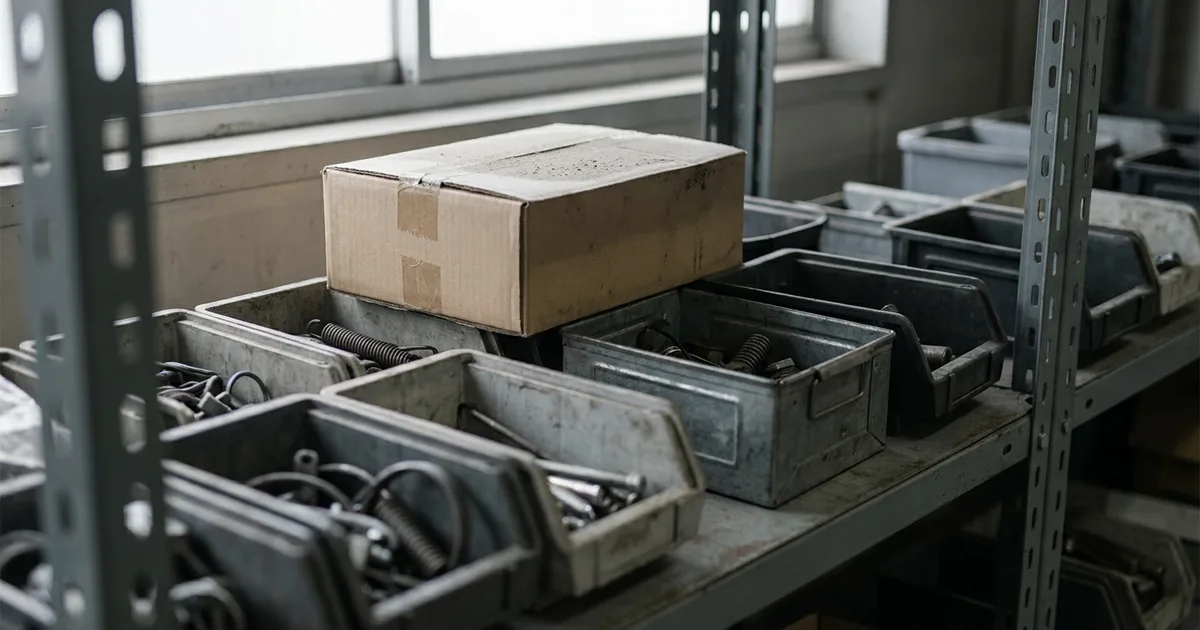
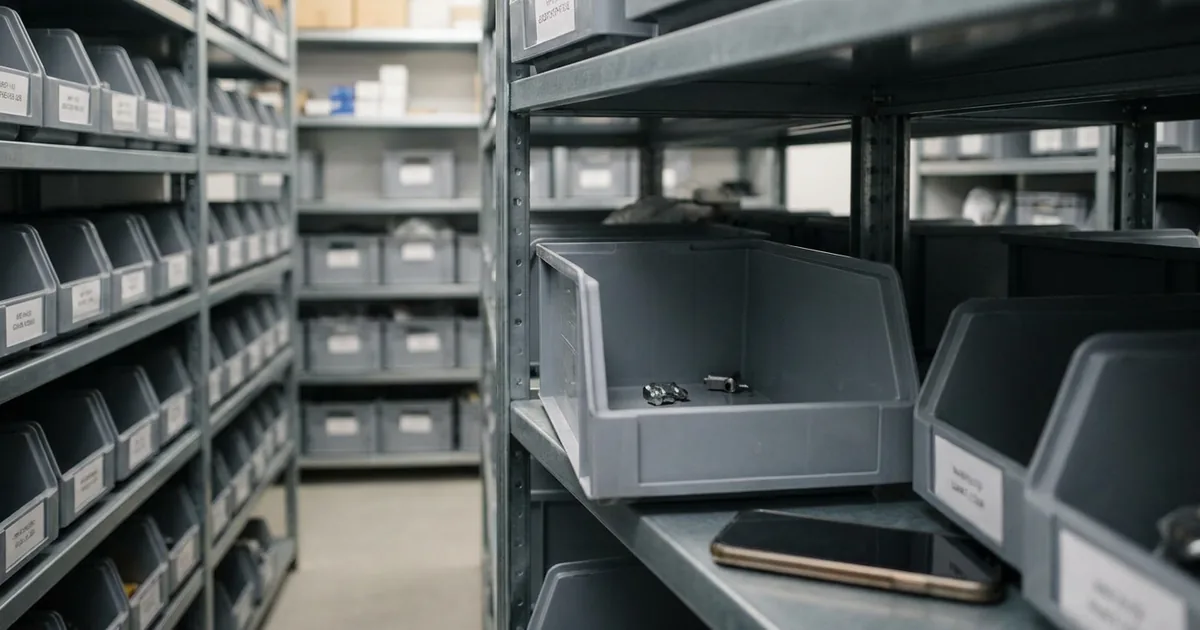
In my previous job at P.S. Cooperation (Böllhoff Group), I looked after customers' procurement as a project manager. One of them built machines in station assembly. Procurement problems kept coming up there: of all things, the cable ties were not in stock because the supplier had delivered late. Production had to improvise, and tempers ran high. A cable tie costs cents, improvising on the assembly floor costs orders of magnitude more.
That is the C-parts paradox: the cheapest parts in the warehouse cause the most expensive effort. This is exactly where C-parts management comes in. It ensures that low-value items are always there when you need them, without tying up money in excess stock or wasting time on searching and emergency runs.
This guide explains what C-parts are, what C-parts management means, which methods exist and how to implement it step by step. From the simple Kanban card to the eProcurement system of industry.
What are C-parts?
C-parts are low-value items: screws, dowels, seals, cable ties, clamps, consumables. A large share of them are DIN-standardised parts such as screws, nuts and washers. The defining criterion is their small share of total annual consumption value, not the quantity. High quantities and many item positions are typical, but not a prerequisite. Individually they cost cent amounts. Together they tie up little capital, but consume disproportionately large amounts of time in ordering, goods receipt and storage.
The classification comes from ABC analysis, a method that sorts items by their annual consumption value (usage quantity times unit cost). The principle behind it is the Pareto rule: a few parts account for the bulk of the value, many parts for almost nothing.
| Class | Value share | Share of item positions | Typical examples |
|---|
| A-parts | high (approx. 80%) | small (approx. 20%) | Machinery, expensive components, equipment |
| B-parts | medium | medium | Standard components, mid-range parts |
| C-parts | low (approx. 5%) | large (approx. 50%) | Screws, dowels, seals, consumables |
The figures vary by business, but the pattern holds: C-parts are many parts with low value. And this volume is exactly what makes them so demanding in day-to-day operations.
Besides value, it matters how evenly a part is consumed. XYZ analysis groups items by how predictable their consumption is: X-parts are used steadily, Y-parts fluctuate, Z-parts are sporadic. Only the ABC and XYZ class together show which method fits. A CX-part, meaning low-value and used evenly, such as the standard screw from series assembly, can be controlled with fixed minimum quantities or Kanban with almost no effort. A CZ-part such as a special screw for a single customer order does not justify keeping stock: you order it with the job.
What does C-parts management mean?
C-parts management bundles all the steps with which you procure, store and replenish low-value parts. The goal is simple. The parts are there when you need them, without constantly thinking about it and without pouring capital into excess stock.
For A-parts you optimize material value. For C-parts you optimize process costs. The real cost driver sits in the workflow around the part, from ordering to putting it away. Buying a screw three cents cheaper achieves nothing if ordering, goods receipt and putting it away costs a multiple of that per item. According to a BME key figures survey, a single order runs to roughly 120 euros of internal effort on average, for staff, IT and processing. For a part worth a few cents, that is completely out of proportion. The conclusion: whoever saves on C-parts saves on effort, not unit price.
Good C-parts management addresses three points:
- Stock: clear minimum quantities per item
- Replenishment: a reliable trigger that reorders before stock runs out
- Effort: few steps per order, no paperwork chaos
How does C-parts procurement work?
C-parts procurement runs in five steps. Each one takes time, and with C-parts it applies to every single item.
- Identify demand. Manually by checking the shelf, through an empty Kanban bin, a minimum stock level in the system or a scan at withdrawal. Without a fixed reorder point, it often shows only once the bin is already empty.
- Order. Choose a supplier, check the price, write the order, get it approved.
- Receive goods. Check the delivery against the order, tick off the delivery note, match the invoice.
- Store. Put the parts in their fixed location and update the stock record.
- Supply the point of use. The part reaches the workstation or the assembly line.
That is why managing C-parts comes down to the number of order cycles. Two levers reduce it. Bundling cuts the number of orders and the effort per order: fewer suppliers, framework agreements with fixed terms, consolidated orders instead of single orders. Every order you drop saves the effort of ordering and goods receipt. With automating, the reorder point triggers the order, without anyone having to guess whether the stock will last.
Which methods exist in C-parts management?
The approaches differ in who triggers replenishment and how much of it runs automatically. From simple to fully automatic, five have established themselves.
- Kanban works on the two-bin system: when the first bin is empty, you move to the second and the empty bin is the signal to reorder. Simple, visible, workable without software. The guide to Kanban in practice shows how this looks in practice.
- VMI and consignment are related but not the same. With VMI (Vendor Managed Inventory) the supplier takes over stock responsibility and decides when to replenish. With consignment, ownership stays with the supplier until withdrawal, you pay only on consumption. In practice both are often combined. Convenient and reliable for planning, but usually only economical at larger volumes with fixed suppliers.
- eProcurement connects your suppliers digitally: you order from catalogues directly in the system, approvals and bookings run electronically. This noticeably reduces the effort per order, but pays off mainly with many suppliers and high order volumes.
- Vending machines dispense C-parts like a vending machine and automatically book each withdrawal. They give control over consumption and shrinkage, but require investment and enough throughput to pay off.
- Min-Max defines a minimum and maximum stock level per item. When stock falls to the minimum, reordering runs up to the maximum. This is the core of every automatic reorder and lends itself well to digitization.
Which approach suits which part and what further variants exist is covered in the overview of procurement methods for consumables.
| Method | Principle | Fits when |
|---|
| Kanban | Empty bin = order signal | You want it visible and without software |
| VMI / Consignment | Supplier replenishes, payment on withdrawal | You have fixed suppliers and high volumes |
| eProcurement | Digital ordering from supplier catalogues | You have many suppliers and high volumes |
| Vending machines | Machine dispenses and books the withdrawal | You want to control consumption and shrinkage |
| Min-Max | Reorder point triggers replenishment | You want to automate replenishment |
How does automatic reordering at the minimum level work?
When a C-part's stock reaches its defined minimum quantity, the system triggers the reorder on its own. The minimum is the trigger, the maximum is the target level, and the difference is the order quantity.
Should you manage C-parts yourself or outsource them?
Outsourcing pays off if you buy nearly everything from one supplier and want to hand over the admin entirely. Doing it yourself pays off if you want to use several sources flexibly.
What a C-parts service provider takes over depends on the model. A system supplier, usually a wholesaler, provides the bins, racks and vending machines. A procurement platform bundles orders and invoices from several suppliers without holding stock itself. With a full service, the provider covers the five procurement steps: identifying demand and planning replenishment, ordering, receiving goods and checking quality, putting away, and delivering to the workstation. A platform mainly covers ordering and invoicing, while goods receipt and storage stay with you. If you ask, the system supplier also checks stock, replenishes and takes both the investment and the ongoing effort off your plate. That is genuine service, and at the same time the core of the dependency.
Outsourcing fits if:
- you carry many steadily consumed C-parts and order often
- volumes are large enough, because consignment stock and vending systems only pay off at industrial volumes
- your purchasing team has no time for routine orders that move small amounts
- one supplier covers most of your demand
Doing it yourself fits if:
- your consumption is predictable, so Kanban or min-max controls replenishment, and software keeps track even of many items
- you buy from several suppliers depending on price and availability
- someone in the company reliably triggers replenishment, or software does
You can combine both: you hand standard parts to a provider and keep ordering special parts for individual jobs together with the job.
The price of outsourcing to a system supplier is dependency. The infrastructure stays their property: lent, not sold. What the service costs is hard to pin down. Terms are agreed individually, there is no public price list. The cost sits partly in an ongoing fee, partly in the item prices. This creates strong customer lock-in. Switching is costly, and without a credible alternative you negotiate from a weaker position at every round of terms.
In between sit supplier-independent systems, whether inventory software or a neutral platform. They let you set a default supplier for each item and swap it when needed. The process stays the same, only the recipient of the order changes. That way you keep the choice of source.
Which solutions exist for C-parts management?
The range goes from a piece of paper to a fully integrated ERP. Which level fits depends on the number of items, the order frequency and the systems you already use.
- No system. For a handful of items, Kanban cards and fixed minimum quantities are enough. The effort for software would outweigh the benefit.
- Inventory software with reorder points. Tracks every item with stock level and minimum quantity, and alerts or orders automatically as soon as an item runs low. This covers the core of C-parts management without the complexity of an ERP. This is where automatic reorder comes in.
- ERP module or eProcurement platform. In larger businesses, C-parts procurement runs in the ERP or through a platform with connected suppliers. This pays off at high volumes with many interfaces.
What matters is not the size of the system, but that a reliable reorder point exists at all and replenishment does not depend on chance.
How do you implement C-parts management?
You don't need a big plan, just five steps that build on each other.
- Identify C-parts. Run an ABC analysis: sort your items by their annual consumption value. C-parts are those with the smallest value share and usually the most positions, such as screws, cable ties or seals.
- Define demand and reorder point. Look at consumption and lead time per item and add a safety stock for fluctuations. This gives you the reorder point. The formula is in the guide on calculating the reorder point.
- Choose a control method. Physical Kanban (two-bin) if you want to keep it visible without software. e-Kanban if the signal should run digitally but the Kanban logic should remain. Min-Max if you want to control by stock thresholds rather than withdrawal signals.
- Define the replenishment process. Define how an order is triggered, reviewed and tracked, and who is responsible. Whether someone does it manually or software takes over is secondary, as long as the process runs reliably.
- Review stock regularly. Check consumption, shortages and stock range, and adjust reorder points when they are too tight or too generous.
Which mistakes should you avoid with C-parts?
Four patterns appear in almost every warehouse. Those who know them save themselves the expensive learning curve. Cases like the missing cable ties from the start usually trace back to one of them.
In a previous role I had a customer manufacturing machines in positional assembly. Production kept stalling because cable ties of all things were missing, the supplier had been late with the delivery. A cable tie costs cents, a stalled assembly line costs a multiple. That is the C-parts paradox in practice, and usually one of these four patterns is behind it.
- No reorder point. Without a fixed minimum quantity you order on gut feeling, sometimes too late, sometimes too much. Set a number per item, and it's no longer your mood that decides.
- Too many suppliers. Every source means a separate order, a separate delivery, a separate goods receipt. Consolidating reduces effort more than any cent discount on the unit price.
- Excess stock out of fear. Anyone who orders double quantities after every shortage clogs the warehouse with dead capital. C-parts are cheap, space and clarity are not.
- Nobody is responsible. When everyone sometimes reorders, in the end nobody does it reliably, and uncoordinated ordering outside any structure arises, known in purchasing as maverick buying. Define who triggers replenishment, or hand it over to the software.
When does C-parts management pay off?
As soon as missing parts slow down your workflow or you regularly double-order. From that point on, searching, emergency runs and shortages noticeably eat time, and structure wins that time back.
It is unnecessary if you only manage a handful of items and rarely reorder. Then a well-maintained note is enough, and any software would be overhead. As long as a note genuinely keeps you on top of things, it is enough; once replenishment regularly breaks down and you lose the overview, structure starts to pay off.
The honest test: think about the last four weeks. Did a C-part run out when you needed it? Did you order something that was already on the shelf? Two yeses, and C-parts management saves you more than it costs.
The next step
C-parts management is not a big project. It is the decision to stop letting your cheapest parts cause your most expensive effort.
Start small: mark C-parts, set minimum quantities, choose a method. If you want to automate replenishment right away, read on in the guide on automatic material ordering.