Calculate maximum stock with the standard formula and the worst-case variant, a step-by-step example, and the relationship to minimum stock and reorder point.
Maximum stock = minimum stock + optimal order quantity. The upper limit an item should not exceed in the warehouse, so no capital is tied up unnecessarily.
Maximum stock caps from above, minimum stock from below, and the reorder point triggers the order in between. The three values together control when and how much to order.
For tight storage space or expensive items, the worst-case variant: reorder point + order quantity − (minimum consumption × minimum lead time).
First step: set minimum stock and optimal order quantity per item, then store the maximum stock as the upper limit in the system.
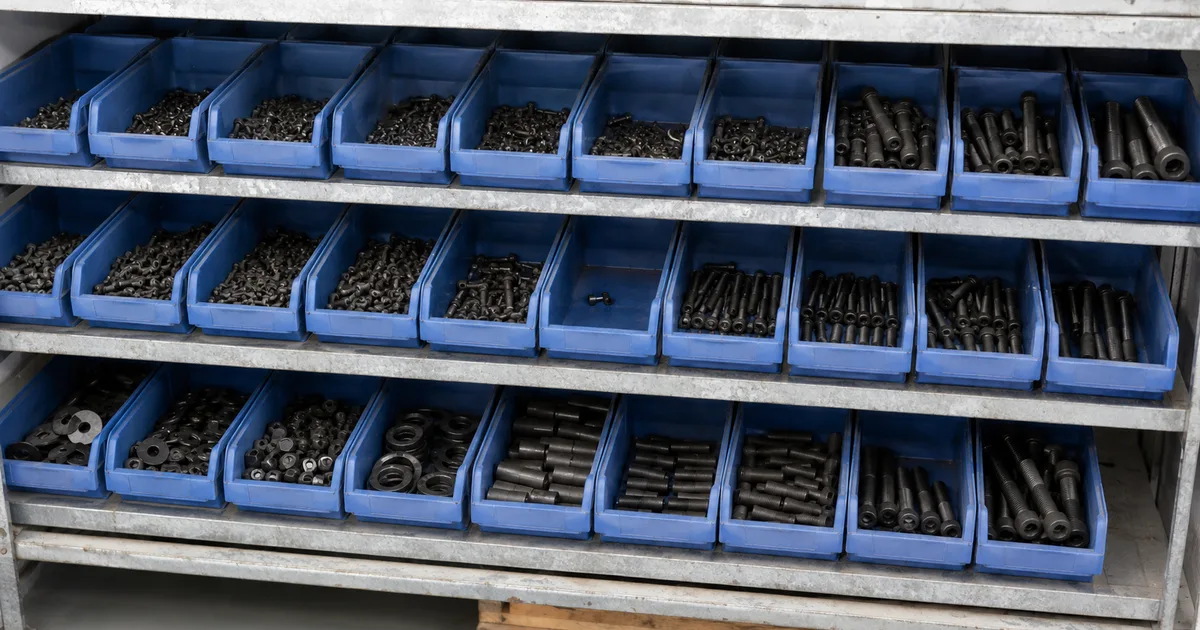
The warehouse is full, the shelves are packed to the last corner, and yet liquidity gets tight at the end of the month. The money is locked in material that hasn't moved in weeks. This problem is the exact counterpart to the empty shelf, and it costs just as much: only quieter, because no job comes to a halt.
There is a clear limit against this overstock: the maximum stock. It is the upper limit per item and only works together with minimum stock and reorder point.
What is maximum stock?
Maximum stock is the largest quantity of an item that should be held in the warehouse. It is an upper limit: if it is exceeded, the stock ties up more capital and storage space than a secure supply requires. Common synonyms are maximum inventory level and maximum stock level.
Maximum stock is one of three values that together control the stock of an item:
Minimum stock → safety buffer, lower limit, do not touch
Reorder point → order trigger, sits above minimum stock
Maximum stock → upper limit after delivery
Minimum stock protects against shortages, maximum stock against overstock. The reorder point sits in between and signals when to reorder. The control only works when all three values fit together and are stored in the inventory system.
What is the maximum stock formula?
In normal operation a simple formula is enough. It assumes the next delivery arrives exactly when stock has dropped to the minimum stock.
Standard formula
Maximum stock = minimum stock + optimal order quantity
The background: you order as soon as the reorder point is reached. During lead time you keep consuming until stock falls to the minimum stock. At that moment the delivery arrives and lifts stock by the order quantity. The highest point is therefore minimum stock plus order quantity.
The optimal order quantity is the quantity that is most economical per order, because it balances ordering and holding costs. If you don't calculate it separately, use the fixed or typical order quantity of the item instead, that is, the quantity that is delivered per order anyway.
The worst-case variant
The standard formula describes the normal case. In the worst case, stock builds up higher: namely when the delivery arrives especially fast and consumption during lead time is especially low. Then stock drops less before the delivery, and the new quantity stacks onto a higher remaining stock.
Worst case
Maximum stock = reorder point + optimal order quantity − (minimum consumption × minimum lead time)
This variant matters for items with tight storage space, high unit value, or short shelf life, where even a one-off overstock gets expensive. For most items, the standard formula is enough.
Step by step: calculating maximum stock
You need two values that you ideally maintain per item anyway: the minimum stock and the optimal (or fixed) order quantity.
1. Determine minimum stock
Minimum stock is the safety buffer against delivery delays and extra consumption. How to calculate it depending on the fluctuation type is in the guide on minimum stock.
2. Set the optimal order quantity
If no calculated optimal order quantity exists, use the typical delivery quantity of the item.
3. Calculate maximum stock
Example
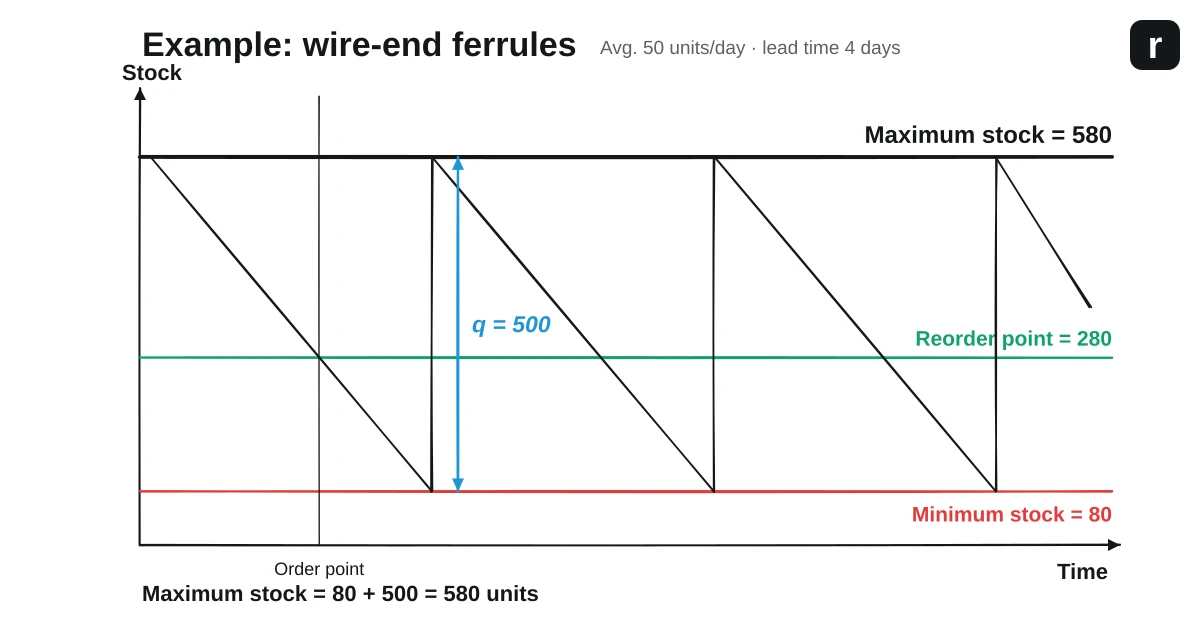
An electrical contractor uses on average 50 wire-end ferrules of one type per day. The minimum stock is 80 units, the optimal order quantity is 500 units.
=Maximum stock = 80 + 500 = 580 units
This item should not hold more than 580 units in normal operation. If stock climbs above it, that's a signal: ordered too early, too much, or twice.
4. Check the worst case (optional)
Example
Same item, but in the most favourable delivery case: reorder point 280 units, minimum consumption 30 units per day, minimum lead time 2 days, optimal order quantity 500 units.
=Maximum stock = 280 + 500 − (30 × 2) = 720 units
The 720 units are the theoretical upper limit when everything converges toward stock. Anyone who sizes the storage space for that is on the safe side even in the exceptional case.
5. Store maximum stock in the system
Maximum stock belongs in the inventory system per item, as the upper limit next to minimum stock and reorder point. That way an overrun can be spotted, instead of being noticed only at stocktaking.
Minimum stock, reorder point and maximum stock working together
The three values are not side by side, they are a system. Each controls a different moment in the stock curve.
avg. daily consumption × avg. lead time + minimum stock
Maximum stock
Upper limit against overstock
minimum stock + optimal order quantity
For the electrical contractor example the reorder point is 280 units, the maximum stock 580. At 280 you order, until delivery stock drops to the minimum stock of 80, then the delivery lifts it to a maximum of 580. Between 80 and 580 the item moves in healthy operation.
As a rough check: if the maximum stock is more than three to four times the reorder point, the order quantity is probably set too large, and you tie up capital unnecessarily.
What happens when maximum stock is exceeded?
An exceeded maximum stock is not a safety gain, it is overstock. The material sits there, is paid for, and does no work. The consequences:
Tied-up capital: money that sits on shelves instead of in the business is missing for wages, tools, or other jobs.
Storage costs: more stock means more space, more handling, and more storage costs. These keep running as long as the material sits there.
Write-off risk: for perishable, batch-controlled, or quickly ageing items, overstock soon turns into scrap.
The most common causes of an overrun:
Order quantity set too large, for instance to grab volume discounts, without offsetting the storage effect
Duplicate order, because two people ordered independently
Dropped consumption, without adjusting order quantity and reorder point
In all three cases the response is the same: recalculate the optimal order quantity and reorder point and adjust them to current consumption. Maximum stock is the indicator that makes the imbalance visible in the first place.
Maximum stock in daily work: manual vs. automatic
Maximum stock only works when someone or something notices the overrun.
Manual: You set an upper limit per item and check at every order whether the new quantity breaks it. This works for a few items and quiet business. The downside: a forgotten check only surfaces when the shelf overflows or the stocktake reveals the dead stock.
With software: Inventory and ERP systems watch stock against the reorder point and suggest a reorder once it is reached. How much depends on the method: a fixed order quantity with the reorder point method, or enough to refill up to a configured order-up-to level with the min-max method. That order-up-to level is not the maximum stock: it is measured from the reorder point, while the maximum stock counts from the minimum stock. The difference is exactly the consumption during the lead time, which is why the level actually reached stays below the configured target.
Whether manual or system-driven: the maximum stock is the number that keeps a full warehouse from turning into tight liquidity. Set cleanly per item, it flags overstock while it is still cheap to correct.
Common questions about maximum stock
Maximum stock is calculated by adding the minimum stock and the optimal order quantity: maximum stock = minimum stock + optimal order quantity. Example: 80 units minimum stock plus 500 units optimal order quantity give a maximum stock of 580 units. An item should not exceed this quantity in normal operation.
Maximum stock is the largest quantity of an item a warehouse should hold. It caps the stock from above and protects against overstock, unnecessary tied-up capital, and avoidable storage costs. Synonyms are maximum inventory level and maximum stock level.
Minimum stock is the safety buffer that should not be touched. The reorder point sits above it and triggers the order. Maximum stock is the upper limit after delivery. Minimum stock = buffer, reorder point = order trigger, maximum stock = upper limit. The three values interlock and control the stock together.
Exceeding the maximum stock means overstock: more capital sits in the warehouse than needed, storage costs rise, and for perishable or quickly ageing items, write-offs threaten. Typical causes are order quantities set too large, duplicate orders, or dropped consumption. Order quantity and reorder point should then be recalculated.
In its conservative variant, maximum stock describes the worst case: maximum stock = reorder point + optimal order quantity − (minimum consumption × minimum lead time). This formula assumes the delivery arrives especially fast and consumption during lead time is especially low, so stock builds up higher than in the normal case.