Sort your dead stock by the money it ties up, not by age, and check for each item which way out leaves you the most net.
Your last stocktake is enough for a first list: whatever still sits on the shelf in the same quantity is a candidate.
As a business you have no statutory right to return goods. A credit note or an exchange is something you negotiate with the supplier.
In Germany, donated goods carry VAT on their current purchase value if you were entitled to deduct input VAT when you bought them. A flat zero is not accepted.
A write-down brings no money back. Only a return, a sale or using the item yourself does that.
Better to have it and not need it than to need it and not have it. But does that hold up to a hard look at the numbers? In tough economic times, when cash is still king? When every euro counts for a lot of small businesses?
Every item that has sat untouched on a shelf for months is paid for, and that money is missing somewhere else.
What is dead stock?
Dead stock, also called dead inventory, is an item in stock that has not left the stockroom for a long time and probably never will. A withdrawal is anything that takes it out of stock: sold, used up or sent to another location.
Not everything that sits on a shelf for a long time is dead stock, and not all of it has to go:
Term
Does it move?
What you do
Slow mover
Rarely, but regularly
Leave it, as long as the stock fits the consumption
Excess stock
Yes, but there is more than you need
Reorder less until the stock has come down
Dead stock
No, and no withdrawal in sight
Get rid of it: return, use, sell, donate or dispose
Obsolete stock
No, because it was replaced or has expired
Recycle, write off or dispose
Clear out a slow mover and you will reorder it later. Leave dead stock where it is and it keeps tying up capital and blocking a bin that could hold goods you actually need.
When does an item become dead stock?
There is no fixed line. The yardstick is the item's own rhythm: if a consumable normally leaves every week, a month without movement stands out. A spare part needed once a year may sit for a year. Seasonal goods are measured against their season. Road salt in August is not dead stock.
To start, use a two-step rule and adjust it to your range: review after 90 days without a withdrawal, get rid of it after a year.
A second signal is inventory coverage. If the stock lasts for years at today's consumption, there is too much of it, even if the item still moves. That is excess stock. It comes down as soon as you reorder less, and for the part that is too much, the same ways out work as for dead stock.
How do you find dead stock?
For every item you need one piece of data: when it last left the stockroom. Where you find it depends on what you work with today.
With an ERP, POS or inventory software
If your system books sales or withdrawals, it already knows the date of the last movement. There is often a ready-made report for it. Search the report menu for terms like "dead stock", "items without sales", "days on hand" or "last movement". Export the list with stock and purchase price to Excel so you can sort it.
Check first that every withdrawal really is booked. If someone takes goods without booking them, items land on the list that actually move.
Without a system: three sources for today
The last stocktake. Put the count sheet next to today's stock. An item with the same count then and now has most likely not moved. The purchase invoices show whether anything was bought in between.
The purchase invoices. If an item was last bought years ago and the bin is still full, it goes on the list.
A walk through the stockroom. Dust on the packaging, yellowed labels, boxes behind other boxes. Write down what you find, with quantity and rough purchase price.
With these three sources you have a list you can work through today.
To keep the list current, you need a second sheet next to your stock list in Excel where you enter every withdrawal with its date. From it, Excel pulls the last withdrawal per item (MAXIFS, Excel 2019 and later), counts the days since and calculates the tied-up capital. The template contains both, with the formulas in place.
If the template shows "never" for an item, no withdrawal has been recorded since you started keeping records. What happened before, the list does not show. So it only becomes meaningful once it has run at least as long as your threshold. Until then, fill the gaps with what you know from the stocktake and the invoices.
Which dead stock do you tackle first?
Sorted by age, the top of the list is often a box of small parts that has sat for years and ties up hardly any money. Sorted by capital, the top is an expensive part that has only sat for months. If you want to free up cash, work the capital list from the top.
Before that, take out everything that is meant to sit for a long time: the spare part for the machine nothing runs without, emergency material, parts you promised a customer. Mark these items so they do not show up again next time.
Capital is only part of the bill. Space, insurance and handling cost extra every year. How much that adds up to for you shows in your warehouse costs.
How do you get rid of dead stock?
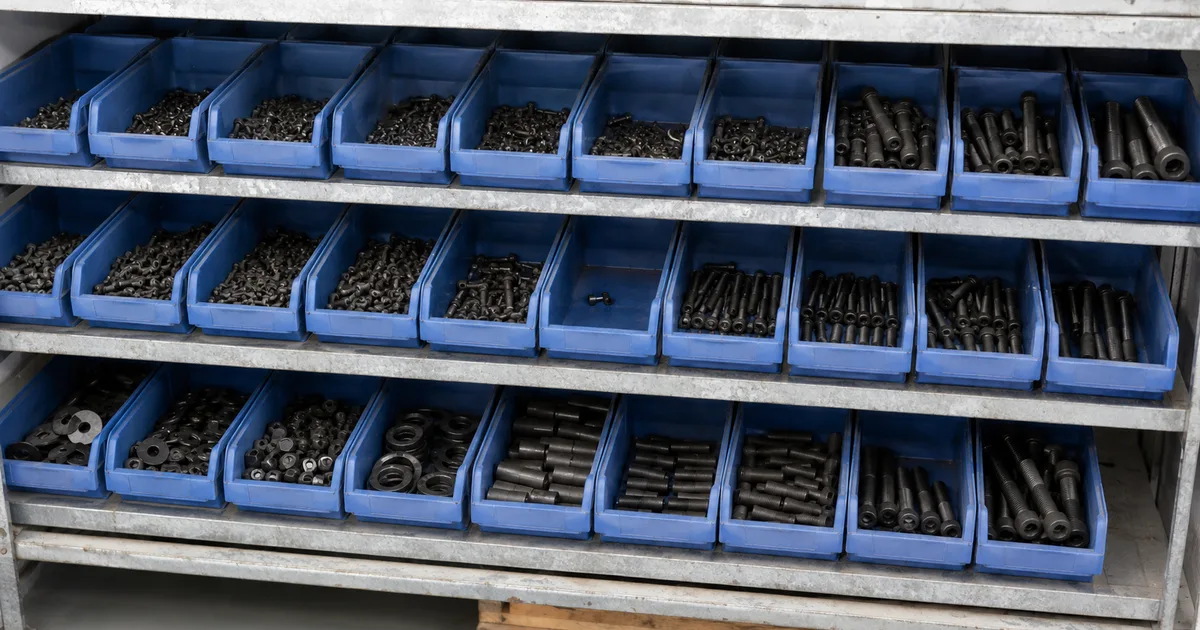
Pushing the item to the back of the shelf is not the answer. It takes up the same space there, ties up the same capital, and the decision lands back on the table at the next clean-up. A team lead at a machine builder, close to retirement, hoarded screws and small parts in bins: "might come in handy one day." The bins sat dusty on the shelf because he could not let go. Make a decision for every piece of dead stock, even if it hurts. Decide what happens to it, by when, and who takes care of it.
First make sure nobody buys more of what is on your list. A note on the bin ("do not reorder, use this up first") reaches everyone who buys or picks there, and from now on your colleagues reach for this item first. If your system reorders automatically, also block purchasing there and leave a note saying why.
Then go through the ways out in order. The ones at the top usually leave the most, because they come with hardly any fees, shipping or discount. When in doubt, do the math: credit or sale price, minus fees, shipping and time. The way with the highest amount wins.
Way out
Fits when
How you go about it
Ask the supplier
The supplier still carries the item
In Germany, only consumers have a statutory right of withdrawal (§ 312g BGB). For goods without defects, a business depends on an agreed right of return or the supplier's consent. Ask for a credit note or an exchange for goods you need, and set any restocking fee against it.
Transfer
Another location or job needs the item
Book the transfer, so the stock is right at the old and the new location.
Use it yourself
The item can replace another one you buy regularly
Stop buying the other one until the dead stock is used up.
Sell
There is still demand at a lower price
Surplus dealers, businesses you know, classifieds, or as an add-on to an item that sells. Set an end date so the discount does not become the regular price. If you advertise a crossed-out price to consumers in Germany, it has to be your lowest price of the last 30 days (§ 11 PAngV).
Donate
The item is usable, but nobody pays for it anymore
Food bank, charity shop, club or school nearby. In Germany, innatura passes new surplus goods on to non-profit organizations. Mind the VAT, see below.
Dispose or recycle
The item is broken, expired or unusable
Brings in no money, but frees the bin. Metal and electrical parts go to a recycler, not the general waste. Document the disposal.
Prompt for your AI assistant
Give this prompt together with your dead stock list to Gemini, Claude or ChatGPT. It works out which way out leaves the most for each item.
You help me get rid of dead stock with as little loss as possible.
Before you start, remind me not to enter real supplier, customer or personal data into external AI tools. I replace supplier names with placeholders like “Supplier A”.
For each item I give you: description, stock, purchase price and condition. Plus, as far as I know it: the supplier's credit and restocking fee, the achievable sale price, selling fees and shipping, and whether I can use the item myself.
1. For each item, work out what is left net for every possible way out: return, use it myself (purchase saved), sell, donate, dispose.
2. If a figure is missing, do not calculate with an assumption. Tell me which question I need to ask whom, for example the supplier.
3. Output a table: item, tied-up capital, best way out, net amount, next step. Sorted by tied-up capital, largest first.
4. For every item where a return is the best way out, write a short, friendly request to the supplier.
Do not invent prices or terms. For tax questions, refer me to my tax advisor.
Whatever the way out: book the item out of stock with a reason. Otherwise you count less at the next stocktake than the list says, and first have to find out why.
What applies for tax when you write off, donate or dispose of dead stock?
The rules below are German law. If your business is elsewhere, the questions are the same, but check the answers with your accountant.
A write-down does not get any money off the shelf. It lowers the value in the books and so, in some cases, the tax. And it only concerns you if you prepare a balance sheet. In the commercial balance sheet you have to write goods down if their value on the balance sheet date is below their acquisition cost (§ 253 (4) HGB). In the tax balance sheet it is an option: you may use the lower going-concern value if the impairment is expected to be permanent (§ 6 (1) no. 2 EStG). This rule only applies to businesses that determine their profit through a balance sheet. With cash-basis accounting (Einnahmen-Überschuss-Rechnung) there is no such write-down.
Neither law names a storage period after which you may write off. What counts is what the item is still worth on the balance sheet date, and you back that up with prices, sales and condition. If you note condition and achievable price in your dead stock list before the stocktake, you have that justification at hand.
A donation triggers VAT whenever the original purchase qualified for an input tax deduction. The Federal Ministry of Finance bases it on the notional purchase price at the time of the donation. For goods that are hard to sell, such as last year's models, that is a correspondingly low value, and little or no VAT arises. A flat 0 or 1 euro is not accepted. Zero is only right if valuing the individual item comes out at exactly that. Estimate the value as realistically as you can and record the donation in writing.
For disposal, a short record helps: what, how much, when and why, plus the receipt from the disposal company. This article is not legal or tax advice. How to value, donate, or set up returns and discounts properly in your case is something to settle with your tax advisor or a lawyer.
How do you prevent new dead stock?
Most dead stock is created at the purchase and only gets noticed when the box from last year's stocktake is still untouched on the shelf under a thick layer of dust.
I saw this at an electrical contractor: the fitters help themselves in the stockroom and load up their vans, better to have it than to need it. The boss sees the empty shelf and reorders. Days or weeks later, half of it comes back from the job site and lands on the shelf, next to the new goods. What is in the stockroom, what is in the van? Nobody knows. Why? Nobody has an overview of material and stock. What goes out is not noted, what comes back is not either. Sometimes discipline is missing, sometimes the will. So people order what feels right from the gut. Guessing instead of knowing = junk on the shelf nobody needs.
The most common reason, though, is the great deal. The supplier gives a discount above a certain quantity, you grab it because it is cheap, and then the stuff gathers dust on the shelf. I know this from odd items too: you need one, but they only sell the pack of ten. Or the single piece costs so much that ten suddenly look attractive per piece. So you take the ten, might come in handy. Later it turns out: it does not. Nine pieces lying around, money down the drain. Weigh the discount or the unit price against the months the rest will sit on the shelf. The same goes for stock bought out of fear of supply shortages. In a survey by the German landscaping trade magazine DEGA GaLaBau, one owner argues against it: storage costs, interest and dead stock eat up the price advantage as long as the stock is not tied to a job.
And then there are mistakes nobody reverses. At a machine builder, the hydraulics supplier delivered fittings, a knee-high pallet full of boxes, far more than ordered. At goods receipt, nobody could place it at first. At some point it ended up in the production stockroom with a note on it: "use this up first". Nobody sent it back, for whatever reason, and working it down dragged on. Check every delivery against the order and report excess quantities the same day.
Almost everything has the same cure: keep track of stock and know your consumption. Record everything that leaves the stockroom, for example the material for the job site, and everything that comes back from there. Book it in first, then order. Then before you order you know what is still there and what actually went out last quarter, and at the next deal, how long the quantity will last. In Excel, you enter every withdrawal by hand on the Withdrawals sheet. Inventory software records it with every booking and shows you dead stock ranked by tied-up capital, without a second spreadsheet. If you work with min and max levels, lower them for items that still move, but less than they used to.
Add a fixed date on which you go through the list, for example once a quarter.
Better to have it than to need it holds for the parts nothing runs without. For everything else, every extra month on the shelf costs money you need elsewhere.
Christoph worked as an electronics technician in industry for five years and saw how missing small parts slow down operations. Later, as a project manager at P.S. Cooperation GmbH (Böllhoff Group), he led system-supported C-parts logistics projects for mid-sized industrial and machine-building companies. Today, he is building repleno full-time, inventory management that helps small businesses detect demand early and automate reordering.