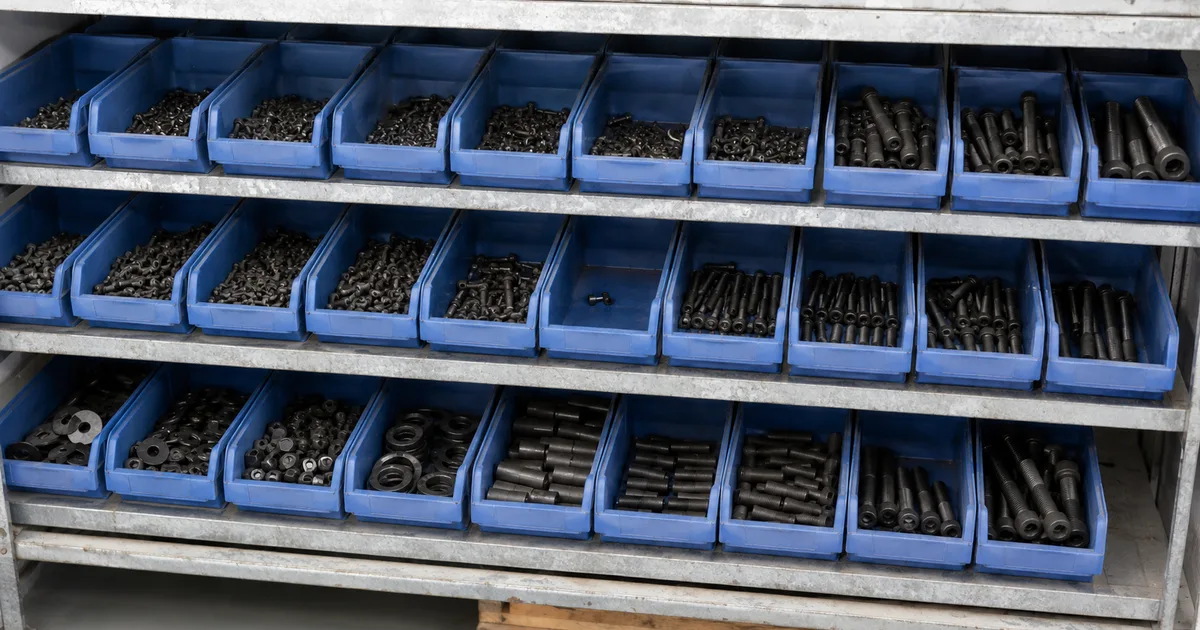
You know the feeling? You reach into the rack, and exactly the part you need right now is out. Or the opposite: a bin is overflowing with material you bought in bulk two years ago and nobody has touched since.
This is exactly where min-max inventory management comes in: It creates the balance between "always enough in stock" and "not letting money sit on the shelf."
The Problem: Traditional ordering methods are often based on gut feeling or the principle "We order when it's empty." This leads to:
- Unnecessarily high storage costs due to overstock
- Missing parts mid-job due to material shortages
- Time loss due to emergency orders and special trips to the wholesaler
What a single missing part really costs only adds up once you count the drive, the waiting time and the rescheduled job.
The Solution: The min-max principle automates ordering decisions based on clear metrics instead of intuition.
What Does Min-Max Inventory Management Mean Specifically?
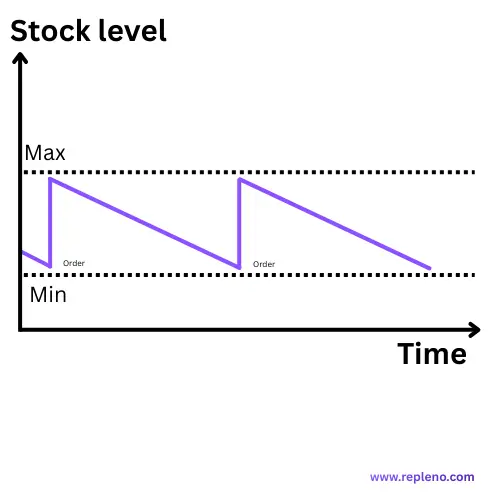
Min-max inventory management, also called a min-max system, is a rule-based system that sets two threshold values for every warehouse item: a reorder point (Min) that triggers the order, and an order-up-to level (Max) the stock is refilled to. Once stock drops to the Min, the system reorders up to the Max.
| Value | What it is | What it triggers |
|---|
| Reorder point (Min) | The order threshold | Stock reaches the Min, the order is triggered |
| Order-up-to level (Max) | The refill target | The order refills up to the Max |
Watch out, common mix-up: The "Min" is not the minimum stock in the sense of safety stock. It sits above it, by exactly the consumption expected during the lead time. The safety stock sits below it and is counted into the reorder point, but it is not the same thing.
The System Behind It
The min-max procedure belongs to the family of reorder point methods and has proven itself in materials management for decades, especially in industries with predictable consumption. It is one of the most practical implementations of what the Gabler Business Dictionary calls inventory management: stock levels smooth out fluctuations and bridge supply gaps.
In contrast to just-in-time approaches, it relies on defined safety buffers. This makes it well suited for businesses with consumables that don't want to rely on expensive emergency orders and special trips.
Practical Example: Electrical Installation Business
Item: NYM-J 3x1.5 mm² (100m rolls)
- Reorder point (Min): 2 rolls
- Order-up-to level (Max): 5 rolls
- Current Stock: 2 rolls → Order is triggered
- Order Quantity: 3 rolls (to get back to 5)
How Does the Min-Max Procedure Work in the Warehouse? The Two Stock Levels
Min-max steers every item through two stock levels: the reorder point (Min) says when you order, the order-up-to level (Max) says how much.
1. The Min: your reorder point
The Min marks the reorder point (ROP): the level at which you actually place the order. It covers consumption during the lead time and leaves the safety stock untouched.
The safety stock, the minimum stock in the narrow sense, sits below it: the reserve that should stay on the shelf.
2. The Max: your order-up-to level
The Max marks the order-up-to level: the quantity you refill to. It follows from the Min plus the quantity you want to put back on the shelf per replenishment.
You never quite reach that level, though. You keep consuming during the lead time, so the delivery lands on the safety stock rather than on the Min. The maximum stock actually attained is therefore safety stock + order quantity: lower than the Max by exactly the consumption during the lead time.
To stay with the example above: during the lead time you break into the second roll, so only one is left on the shelf. When the three ordered rolls arrive, you have 1 + 3 = 4 rolls, one below the Max of 5, exactly the consumption during the lead time.
How much you put back per replenishment, three rolls here, is a deliberate decision. That order quantity sets the Max and depends on:
- Storage capacity
- Capital commitment
- Shelf life/perishability
- Volume discounts from the supplier
- Order costs (shipping, effort)
What Are the Main Advantages of Running Your Stock on Min-Max?
- The order-up-to level caps overstock: less capital sits dead on the shelf, more space stays free for tools and project material, and the freed cash is available for investment instead of expensive inventory credit.
- The reorder point secures resupply before stock runs out. Missing parts mid-job become the exception, along with the emergency orders and special trips they otherwise trigger.
- And because order quantities become plannable, you gain a lever in price negotiations with your supplier: volume discounts, fixed delivery times and annual contracts that nobody grants for sporadic reordering.
What Material Is Min-Max Suited For?
Whether trades, workshop, production or retail: min-max works wherever material with steady consumption moves through the racks. Typical cases are fasteners and small parts (screws, anchors, clamps), operating supplies (glue, cleaners, lubricants), wear and spare parts (filters, gaskets, standard fittings) and packaging (boxes, film, labels), right down to the supply cabinet in the office.
What decides is the consumption pattern, not the price: wherever a reliable daily usage exists, min-max works. An expensive item with steady consumption belongs in min-max; a cheap one-off does not. Material that only comes up per project you plan individually.
How Do I Calculate Min-Max Values? Step by Step
In four steps: measure consumption, determine the lead time, set the safety stock, optimize the order quantity. The Min follows from consumption during the lead time plus safety stock, the Max from Min plus order quantity.
Step 1: Collect Consumption Data
Take at least three months of consumption history, better twelve. From it you read the average consumption per week, spot seasonal fluctuations and see whether demand for an item is rising or falling. A single month deceives: it shows a snapshot, not the pattern the Min and Max rest on.
Step 2: Determine Lead Times
What counts is the real lead time from order to goods receipt, not the promised one. Add buffer time for delays and note where your standard supplier takes longer than the backup you call in a pinch. That span determines how much stock the Min has to bridge.
Step 3: Set Safety Stock
Safety stock absorbs how far consumption and lead time scatter upward. For standard items one week of buffer is usually enough, critical items get two, and anything hard to procure calls for three weeks or more. The more reliable your data from steps 1 and 2, the tighter the buffer can be.
Step 4: Optimize Order Quantity
Between Min and Max sits the order quantity, and it is shaped by your supplier's terms: the minimum order quantity, the threshold where tiered pricing kicks in, plus your own storage capacity and, for perishable goods, the shelf life. The Max is in the end the Min plus the quantity that pays off under these conditions.
Complete Calculation Example for Min-Max Materials Management
Item: Shipping Boxes, Size M
Data Basis:
- Average Consumption: 50 pieces/week
- Lead Time: 1 week
- Desired Safety Buffer: 1 week
- Supplier offers tiered pricing from 500 pieces
Setting the Min: consumption during lead time plus the same again as safety stock
Min = 100 pieces
Setting the order-up-to level:
- Optimal order quantity due to tiered pricing: 500 pieces
- Max = 100 + 500
Max = 600 pieces
Result:
- At ≤ 100 pieces in stock → Trigger order of 500 pieces
- Order-up-to level: 600 pieces. Maximum stock actually attained after delivery: 50 safety stock + 500 = 550 pieces
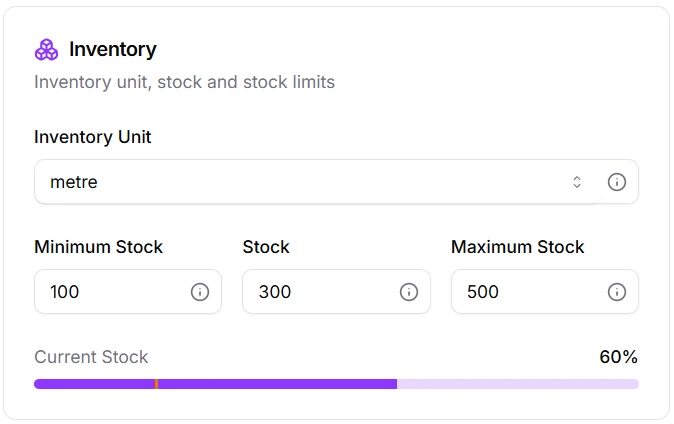
These four steps apply to each item on its own, and the values go stale the moment consumption or lead time shifts. Once Min and Max are set, an automatic reorder takes the ongoing work off your hands: it watches the stock and, when the Min is reached, computes the order quantity from the order-up-to level, current stock and consumption.
The 5 Most Common Mistakes in Min-Max Inventory Management
Most min-max mistakes have two roots: values nobody touches again after setup, and estimates instead of real consumption data. These five are the most common.
Mistake 1: Set Min-Max Values Once and Forget
Problem: Consumption patterns change, suppliers change lead times
Solution: Quarterly review + adjustment for major changes
Mistake 2: Too High Safety Stocks Out of Caution
Problem: Capital commitment increases unnecessarily
Solution: Start with realistic buffers, then refine
Mistake 3: Manage All Items with Min-Max
Problem: Project and special parts without regular consumption don't fit the min-max scheme
Solution: Use min-max for everything with a reliable daily consumption. The exclusion criterion is missing consumption history
Mistake 4: Estimate Consumption Data from Gut Feeling
Problem: Wrong basis = wrong values
Solution: Use at least 3 months of real consumption data
Mistake 5: No Consideration of Seasonality
Problem: Too much heating material in summer, too few climate components in winter
Solution: Create seasonal min-max profiles
How Do I Run Min-Max in Practice?
Min-max only holds if the values are maintained: start small, write down lead times, check against metrics and leave the routine to the software.
1. Start with a Pilot Group
Begin with your highest-consumption items, gather a few weeks of experience there and only then extend min-max to the rest. Because these items move the most, they show fastest whether your values hold or need adjusting.
For efficient inventory management, the REFA Federal Association recommends defining metrics such as safety, reorder and maximum stock clearly. These values form the basis for successful min-max systems, in manufacturing businesses as much as in the trades.
Write down what your supplier actually delivers: the real lead time, delivery reliability and recurring quality problems. From this history you later refine safety stock and Min, because a supplier who reliably delivers in three days needs less buffer than one whose dates swing.
3. Use Dashboards for Overview
Whether your min-max holds shows in the right inventory metrics: the service level, that is how often an item was available when needed, inventory turnover as the pace at which stock rotates, the number of items below the reorder point and the capital tied up in the warehouse. Together they tell you whether your values sit too tight or too generous.
4. Involve the Team
Min-max lives on the team knowing the rules and booking withdrawals reliably. A quick warehouse status in the meeting, a fixed channel for material problems and an induction for new staff keep the bookings clean, because a single mis-recorded withdrawal tips even the most precise calculation.
5. Automate Routine Tasks
The daily routine belongs with the software: check stock, generate order suggestions or send them directly, warn on critical levels and collect the figures for reporting. What runs automatically does not slip when the shop gets hectic.
Conclusion
You do not need a logistics degree to run your stock on min-max. The method is easy to grasp and proven in practice, and software can take the upkeep of the values off your hands. For a small business, min-max offers the perfect balance between automation and control.
With min-max, less capital sits on the shelf and material availability still goes up. Automation pays for itself once manual upkeep starts to slip; then software takes over the updating. You do not need the perfect initial setup either: start pragmatically and correct what consumption shows you.
Min-max only bites once every item has a fixed spot in the stockroom and your team books withdrawals, returns and deliveries. Until then you are managing estimates, and they drive your warehouse costs.