Best Inventory Management App for Trades 2026: 3 Apps Compared
Top 3 inventory management apps for trades in 2026 compared: repleno, Sortly and Lager im Griff. With criteria, pricing and a GDPR check. Written for a DACH audience.
The best inventory management app is the one your team actually uses in daily work.
This article is written for a DACH audience. Pricing, GDPR/DPA, German support and wholesaler interfaces like IDS or Open Masterdata matter here.
Stock visibility where everyone sees what is there and where it is, plus a heads-up before material runs out: repleno (free up to 25 items, from EUR 49/month above that, users included).
Inventory management with strong wholesaler interfaces (IDS, Open Masterdata): Lager im Griff (from EUR 289 net/year).
Visual inventory lists with photos: Sortly (from US$49).
Most important test: create a few items with stock levels. Then give the app to two people in the business and check whether withdrawal, search and replenishment work without training.
Many trades businesses are more digital than their stockroom suggests. According to the Bitkom study 2025, a representative survey of 504 trade businesses, 85 percent of businesses offer at least one digital service, yet rate their own digitalization at an average school grade of 3.0 (C equivalent). In inventory management and documentation, only 7 to 10 percent use AI or automation. At the same time, 56 percent expect noticeable time savings from digital processes. The same span between paper slips and AI is examined by IFH Goettingen in its status quo analysis.
In most small businesses, inventory still runs on Excel, scraps of paper or word of mouth. Often it all hangs on the owner, or it does not run at all and sinks into chaos. Others get by with supplier ordering portals. For a one or two-person shop, that can work. Once a real stockroom has to be managed and several people draw from it, missing parts, extra trips and stress are built in.
Many start with Excel. But Excel hits its limits fast: stock levels are hard to maintain in long lists, and in daily work nobody logs every withdrawal by hand. The Excel vs. app comparison shows why that rarely works.
Most inventory apps fail in practice. Because if your team does not book, stock levels are wrong. If stock levels are wrong, every software fails and the stockroom sinks back into chaos.
This comparison ranks three lean inventory management apps and stock programs by different core problems. There is no single winner for everyone; the right tool depends on your most expensive inventory problem.
One thing upfront: there is plenty of inventory software, but lean specialists are the exception in the German market, because most want to sell you an entire business system.
How do you start with inventory software in a trade business?
PROCESS AND STRUCTURE FIRST -> DIGITALIZATION -> AUTOMATION
Before you compare tools, you do not need a perfect stockroom. But you need a clear plan. An inventory app can remove searching, paper notes and forgotten orders. To make it work in daily operations, four things have to fit:
One stockroom champion. This person decides storage locations, labels, minimum stock levels and rules for withdrawals. They keep the team moving when daily work gets in the way.
Start with the most important area. Consumables that are constantly missing or constantly used come first. That is how your team quickly sees why the change is worth it.
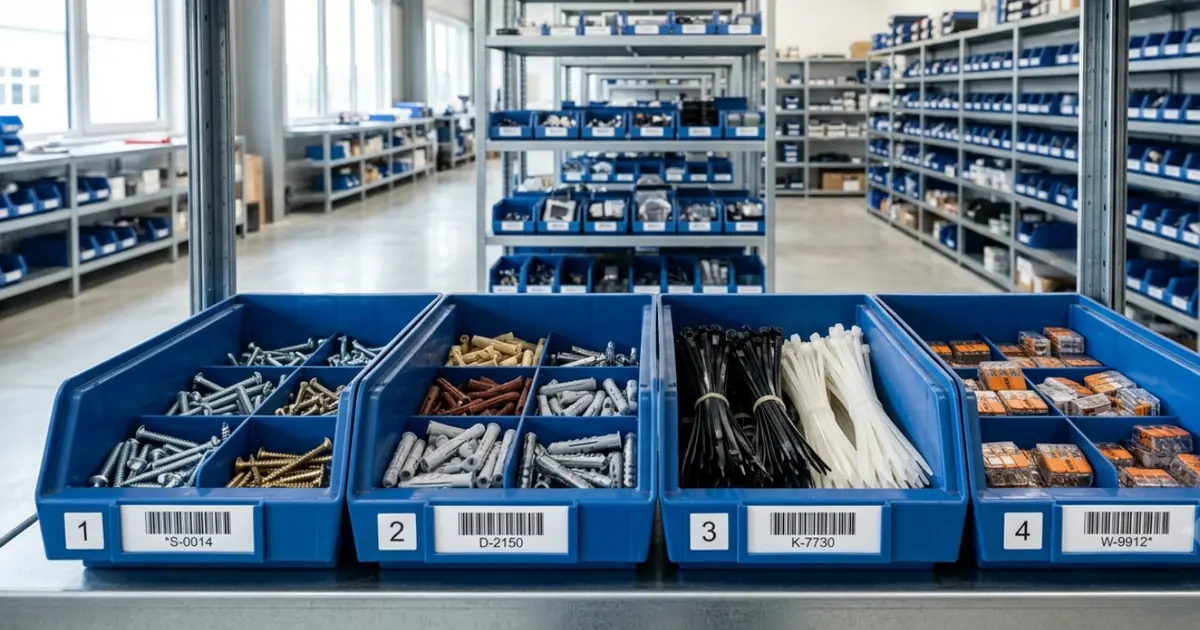
Storage locations and labels must be visible. It does not need to be perfect. But every item needs a place and a label so it can be found faster and booked when withdrawn. The guides on organizing your stockroom and labeling shelves show how to get there.
Withdrawals must be easy to book. If a technician first needs training to understand the app, it will not be used. And if it is not used, nothing gets booked. Because everyone has a smartphone in their pocket, simple apps matter more than rarely used special features.
Visible label = scan possible = booking happens = stock level is right.
You do not need to rebuild the whole business. Take real items, real locations and a clear workflow: scan, withdraw, update stock, trigger replenishment. That is what an inventory management app is worth using for.
Transparency note: repleno is our product. There are no paid placements in this article. The selection and evaluation of tools is based on clear criteria and publicly available information (e.g. feature overviews and list prices) as well as our practical experience in trades workflows. Prices and features can change; for your decision, verify the current terms and GDPR/DPA documentation of each vendor. This article is not legal advice.
How did we evaluate? (methodology)
We evaluated the tools against these criteria:
Simplicity and acceptance: Do even the people who dislike software get along with it?
Barcode scan and mobile workflows: withdrawal, goods receipt and stocktaking via smartphone, without additional hardware.
Barcode and labels: Can the tool create labels for items and locations, or does it only read existing codes?
Setup and stockroom structure: Does the vendor help with storage locations, labels, item import and minimum stock levels, and is consulting or training available, remote or on site?
Locations: main stockroom, secondary stock, vehicle stock, jobsites, transfers and traceability.
Automation: purchase suggestions, reorder point or min-max, and replenishment without manual lists.
Roles and permissions: who can withdraw, order, approve.
Data and integrations: export, API or CSV for clean hand-offs if other systems are connected later.
DACH check: language, support, invoicing, contract docs (e.g. DPA) and information about data location/sub-processors (based on vendor statements).
Pricing is indicative and depends on users, modules and billing (monthly vs. yearly). Taxes may apply; for USD pricing, exchange rates are not included.
Data basis used: publicly available vendor information (e.g. feature pages, pricing pages, help docs) and our practical experience with trades inventory workflows.
What we intentionally do not claim: we did not perform full legal/GDPR reviews or security audits and cannot guarantee that data location/DPA statements fit every case.
The practical test: does it get used?
We already covered the point: inventory software rarely fails on missing features. It fails because it does not get used in daily work. Stock levels are only right when everyone joins in and understands the system. You need broad acceptance in the business.
Give the tool to two people: one who likes software and apps, and one who does not. Both should run through a normal day: find an item, book a withdrawal, put goods back, correct a wrong booking.
If only the nerd manages it, the business will not keep using the tool, no matter how good the feature list looks or what the vendor sales team tells you.
Recommendation: which inventory app fits you?
You want the whole team on board without per-seat fees, with personal onboarding and process/inventory consulting to get started, remote or on site: repleno.
You need an IDS or Open Masterdata connection: Lager im Griff.
You want to document tools and equipment visually, especially with photos and QR codes: Sortly.
All three can manage inventory. Choose by the problem that costs you money and nerves every day.
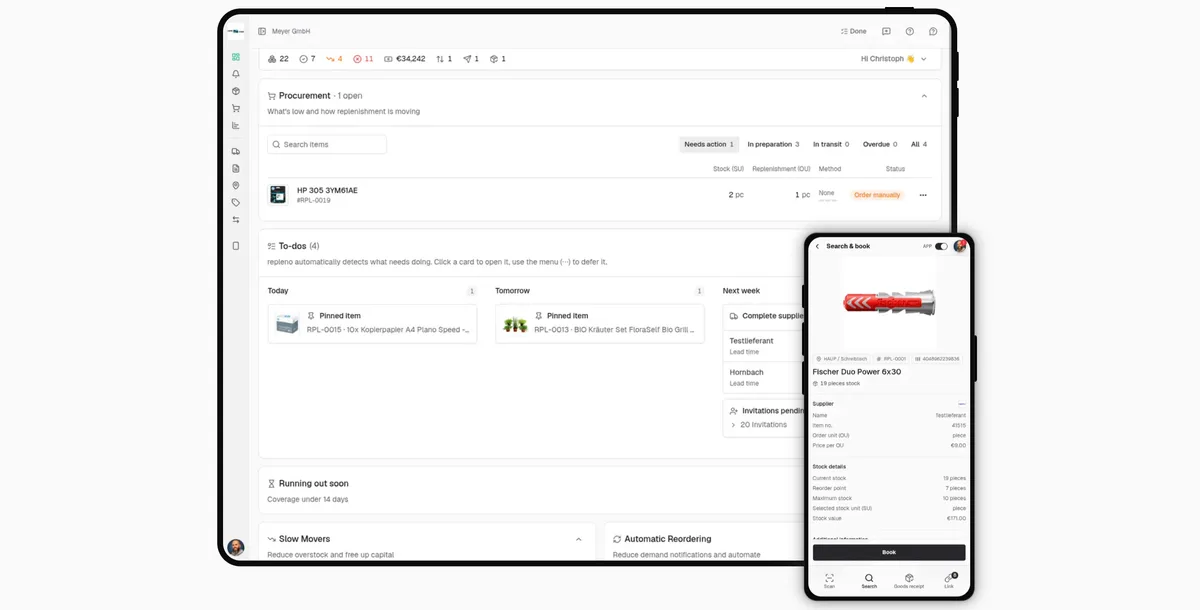
repleno
repleno is inventory software for small businesses from Bielefeld, Germany. What sets it apart from the others here: billing per business and item rather than per user. And if, before rolling out an app, you still need help with processes, structure and stockroom organization, you get personal service on site or remote.
Fits if: people in the business keep searching and asking where material is and whether any is left, and missing parts regularly trigger extra trips to the wholesaler or rushed orders.
Strengths:Barcode scan by smartphone for withdrawals at the shelf. Items are created by scan, AI or import, with description and product photo. Consumables and tools are tracked as items with a reorder point. The label designer creates QR and barcode labels from item and location data. Replenishment is configurable per item: notify only, or send an order by email to the supplier. Stock analysis and consumption reports report turnover and cost per item. Sets, bills of materials and project bookings are supported.
Multiple warehouses: Track the same item across several sites and storage locations, each with its own stock. Vehicles and jobsites can be set up as separate locations, and stock can be transferred between them.
Limitations: Bookings need an internet connection; offline, nothing works yet (sync planned). No wholesaler interface yet (planned).
Price: Free plan with no time limit, covering 25 items and one active storage location; sign-up is online, with no sales call. Above that, an item-based flat rate from EUR 49/month (Go plan, annual billing). Unlimited users are included in every plan (list price, as of 17 Jul 2026).
DACH check: High: DACH focus. For your decision, verify DPA/GDPR docs and data location case-by-case.
"For the roughly 120 tools we now run through repleno, we would otherwise spend two to four hours a week on coordination and searching. Now it is maybe 20 minutes, and falling. I pay per company, not per user. Everyone in the company can join in without costs exploding." Tapio R., managing director of a machinery business (Capterra review, July 2026)
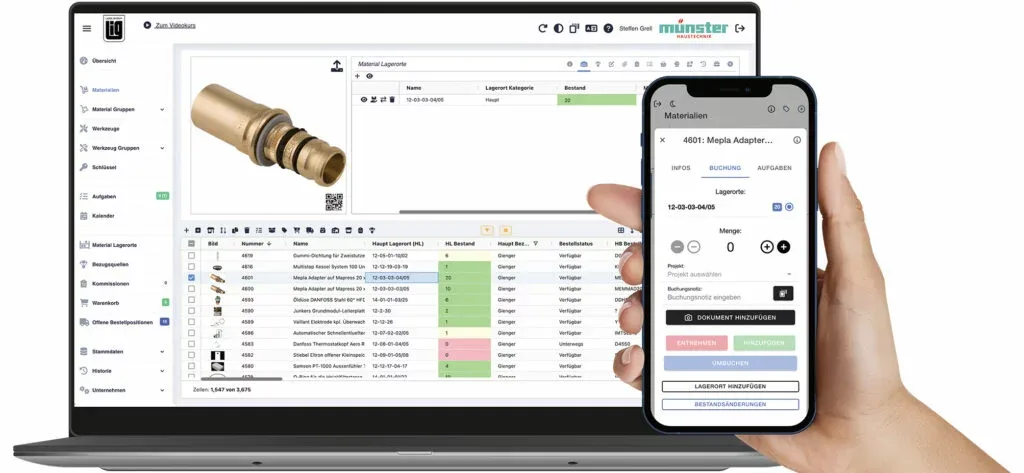
Lager im Griff
Lager im Griff is a German tool from Bonn. Its edge over the others here: wholesaler connectivity via IDS, Open Masterdata and Datanorm, plus device management that assigns tools to employees.
Fits if: you need a clear inventory overview, want to manage several locations, and depend on wholesaler links such as IDS or Open Masterdata.
Strengths: Quick setup, simple UX, Excel import/export for onboarding. Tools can be assigned to employees, so it is traceable who last had a device in use. Barcode and QR labels can be created in the software. Weekly office hour (Fri 11am) and video course for support. From Pro: Datanorm, IDS, Open Masterdata, OCI and an API with webhooks.
Multiple warehouses: management of several sites, centrally controlled across plants, warehouses and production locations according to the vendor.
Limitations: Focus on order and transparency. Orders are triggered manually, for example via cart and supplier price comparison. No on-site support.
Price: Starter from EUR 289 net/year (1-3 users), Pro from EUR 789 net/year (4-10 users, incl. interfaces). Enterprise on request. Limit: up to 8,000 items. 30-day free trial (as of 21 Jul 2026).
DACH check: High (per vendor): German provider. Verify DPA, data location and sub-processors in the vendor docs.
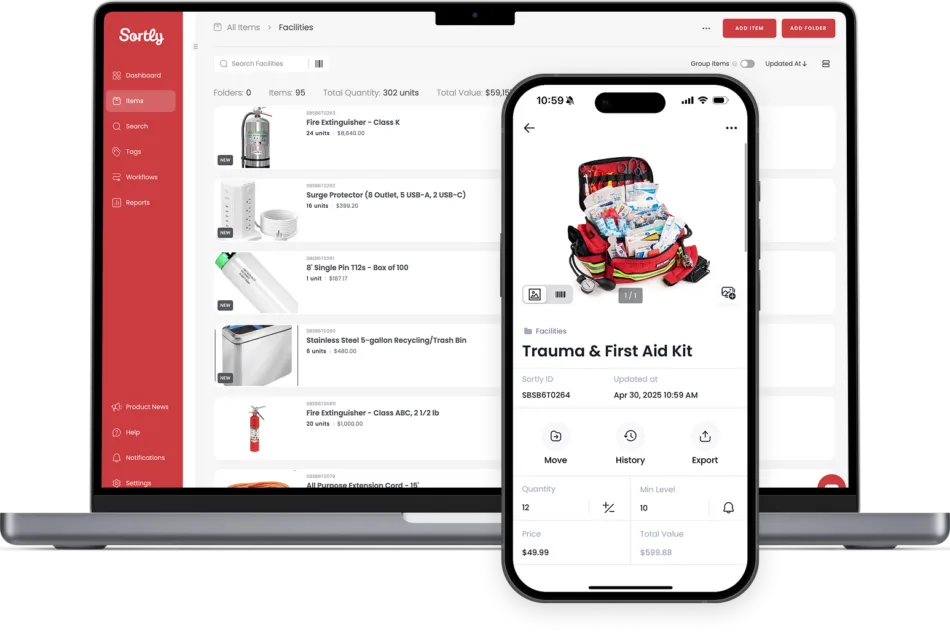
Sortly (visual inventory lists)
Sortly is an app for visual inventory management. It is strong when you mainly need a clear inventory list with many photos per item: tools, equipment, boxes, kits, accessories.
Fits if: you want to find and document things, but do not expect procurement or automatic replenishment.
Strengths: Many photos per item, QR code creation and an interface that is quick to understand.
Limitations: Focus is tracking and documentation, not procurement. Support only in English. No on-site support.
Price: Free plan with 100 items and one user. From about US$49/month (Advanced plan, 2 users), Ultra US$149 (5 users). Teams of 8+ users need the Enterprise plan, price on request only. List prices with monthly billing (as of 21 Jul 2026).
DACH check: Medium. US provider: verify GDPR/DPA and data location carefully. More in our Sortly vs. repleno comparison.
Comparison table: which app fits you?
Criterion
repleno
Lager im Griff
Sortly
Product category
Inventory management + procurement automation
Inventory + stockroom + wholesaler
Inventory / asset tracking
Scanning
Barcode + QR (app)
Barcode + QR (app)
Barcode + QR (app)
Barcode/QR labels
Yes, label designer
Yes, in the software
Yes, QR/barcode labels
Multiple storage locations (vehicle, jobsite)
Yes (from Go)
Yes
Yes
Ordering function
Manual, approval or automatic
Manual (reorder suggestion at minimum level)
Manual
Wholesaler interface
No (planned); orders by email to any supplier, no vendor lock-in
Yes (IDS, Open Masterdata)
No
Offline mode
No
Yes, according to the vendor
Yes (sync)
Setup help
Help center; consulting, setup and training bookable remote or on site
Video course + office hour
Help Center / English support
Free to use
Yes, permanently (25 items, 1 location, all staff)
30-day trial
Yes, permanently (100 items, 1 user)
Cost (12 users) / month
~EUR 49 (Go, flat)
on request (>10 users)
on request (>8 users)
Vendor / hosting
DE / DE
DE / DE
USA / USA
Typical fit
Consumables across several locations, incl. sets and project bookings
Consumables, keys, tools
Materials and inventory
Not suitable if
Offline bookings are mandatory today, or wholesaler integration is important
Automatic replenishment is required (ordering stays manual)
German provider is important
Table note: the "Cost (12 users) / month" line assumes a 12-person team with annual billing. "On request" means the vendor lists no public price for this team size. Actual costs depend on term, add-ons and conditions (as of 4 Jul 2026).
What do small trade businesses really need?
Most businesses do not want a new software landscape. They want to know what is in stock, where it is and when it needs to be reordered. Sounds banal. It is not. This is where businesses lose time every day: searching, asking around, double-ordering, driving back.
Warning signs:
Pricing only after a sales call.
Features locked behind high tiers.
Weeks of implementation and training before the first item is booked.
Opaque pricing.
For an inventory problem, speed matters: set up, import real items, let the team test. If you need a large software project first, you are solving the wrong problem. A compact overview for small businesses with two to 15 people is linked here.
Checklist: questions to ask the vendor
Usually the sales team asks you the questions. Turn it around and ask every vendor on your shortlist, us included.
How quickly can I start with my own items and test the full workflow?
Can I test the tool right away myself, or only after a demo or sales appointment?
How do I get existing item data into the system, and what happens if the import fails?
Is there a barcode scan workflow for withdrawals, goods receipt and stocktaking without an extra handheld scanner? Do I have to buy additional hardware?
Can I create multiple storage locations and track transfers?
Is there a complete booking history showing who changed what and when?
Are there roles and approvals so not everyone can do everything?
Who places the orders? Are there features that take ordering work off my hands?
Does the tool support reorder points or min-max so warnings and replenishment run reliably?
How fast does someone respond after my inquiry?
Is there support in my team's language and during our working hours?
Do I reach a human who can decide and help, or an AI bot and then a ticket queue anyway?
How does the vendor handle feature requests: who decides on them, and how long does it take from request to shipping?
Are DPA, data location and sub-processors documented transparently?
Is pricing per user, per warehouse or per module, and what happens if my employee count doubles?
On cancellation, can I export all master, stock and movement data in full?
Know a tool that is missing here? We keep this comparison up to date. Tell us via the contact page which inventory software you use and what it can do. We will take a look and add it if it fits small businesses.
Scope and category
Some vendors want to sell inventory as part of a full business software suite. That can fit if you are already rebuilding quoting, projects, purchasing, staff and accounting. But if only the stockroom and consumables are causing pain, that is usually too much for the problem: broad implementation, many modules, more coordination, and often unpredictable costs through per-user licensing. And once it is in place, your whole business hangs on a single vendor.
Stay with the original question: do you want to get storage locations, stock levels, withdrawals and replenishment under control? Then compare inventory management apps. The guide to inventory management without ERP shows how material stock can run without a large suite rollout.
Conclusion: which app fits you in 2026?
According to the Chamber of Crafts Region Stuttgart, many businesses are right in the middle of that switch, and the chamber wants to smooth the path for them. Three tools, three focuses: repleno bills per business rather than per user and supports the start in person with onboarding and inventory consulting. Lager im Griff plays to its strength in wholesaler interfaces (IDS, Open Masterdata) and can also manage keys. Sortly documents inventory visually. repleno is our product, so please weigh our recommendation accordingly; the criteria and prices above are open to check.
In the end, usage in the stockroom matters: if your team books withdrawals, stock levels are right. And if stock levels are right, missing parts go down. What the opposite costs is worked out in the article on missing material; what an app saves in your business is estimated by the ROI calculator.
Frequently Asked Questions about Inventory Management Apps
A simple inventory program is lean software focused on managing stock: adding items, tracking quantities and storage locations, booking withdrawals and triggering replenishment. It solves the stockroom problem without forcing you to rebuild the whole business software stack.
The kind where roles and day-to-day tasks can be cleanly separated: one person (the admin) handles system upkeep (item data, supplier data, goods receipt, material returns and so on). Everyone else only books when they withdraw. Booking a withdrawal, and updating an item's stock with it, takes seconds via a smartphone scan and needs almost no training. One person manages, everyone else just books.
With 3-5 employees and more than 50 different items, an app is almost always worth it. The time saved through less searching and automatic stock alerts often exceeds the cost within a few weeks.
Specialized inventory management apps typically land between EUR 24 and EUR 50 per month. Check the tariff carefully: users, locations, barcode scanning and replenishment drive the real cost.
Electrical businesses benefit particularly from apps with automatic replenishment or strong wholesaler integrations because they manage many small parts (terminals, cables, fuses).
In most cases, yes. Make sure you can model main stockroom, vehicle stock and jobsites as separate locations and track transfers.
Important. If you store employee or customer data in the app, you need to ensure it is processed lawfully. For providers outside the EU, review DPA/sub-processors and data locations carefully.