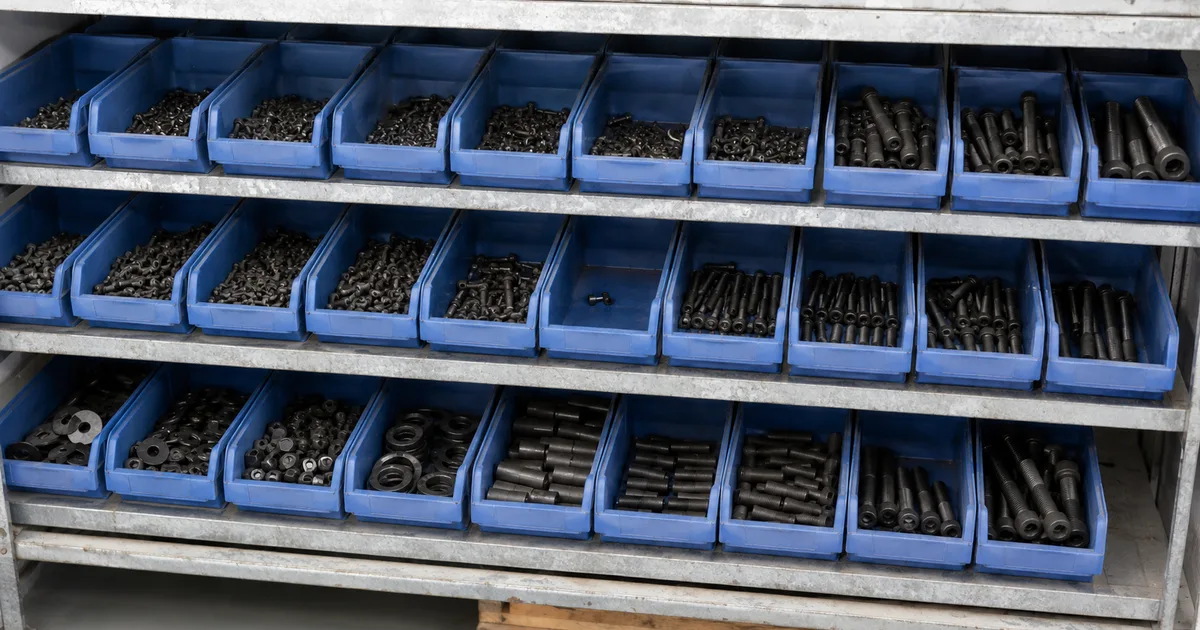
The stock level is the quantity and value of what sits in your warehouse. Once as goods on the shelf, once as a number in the system.
Stock level = opening stock + receipts - issues. One unrecorded withdrawal makes the formula quietly wrong.
Average stock level = (opening stock + closing stock) / 2 understates a stock that swings during the year; then the twelve month-end balances count.
Minimum stock is another name for the safety stock, not for the reorder point.
First step: count once and hold it against the book stock. If the two drift apart, no downstream figure adds up.
What is the stock level?
The stock level is a snapshot: it shows what sits in the warehouse on a given day, in units and the corresponding value in euros.
Almost every other inventory metric grows out of the stock level: inventory value, turnover rate and days in inventory. When the levels are wrong, these numbers tip over with them.
A correct stock level is the result of functioning inventory management, the ongoing recording of receipts and issues.
What counts as stock?
The stock covers the goods a business keeps on hand for sale, production, assembly or operations. A retailer counts mostly merchandise. A trade business counts material, spare parts and consumables. A manufacturer additionally counts raw materials, intermediate products and finished goods.
The balance sheet sorts these goods more finely, into raw materials, auxiliary materials, operating supplies, work in progress and finished goods. For reordering that changes nothing: whether a seal is booked as an auxiliary material or as a spare part changes nothing about when it has to be reordered. Three other things decide that: whether your team uses the item regularly, how fast the supplier replenishes, and how expensive a stockout becomes.
How do you work out the stock level?
You calculate the current stock level from opening stock, receipts and issues. The formula is:
Current stock
Stock level = opening stock + receipts - issues
The opening stock is the quantity at the start of the period in question. Receipts are deliveries, returns or transfers into the warehouse. Issues are sales, withdrawals, consumption, write-offs or transfers out of the warehouse.
Beispiel
An electrical contractor has 500 Wago 221-412 lever connectors in the warehouse at the start of the month. During the month 200 are added, 300 are used on sites.
=Stock level = 500 + 200 - 300 = 400 connectors
This calculation only works when every movement is recorded in the system. If someone takes material off the shelf without posting it, the book stock stays too high, and from there the formula keeps calculating with a quantity that never sat on the shelf.
What types of stock level are there?
The stock level breaks down into several stock types. Three of them steer your orders, the fourth is the basis of almost every inventory metric:
Stock type
Function
Question it answers
Safety stock
Buffer for delivery delays and demand peaks
What is left if the delivery is late?
Reorder point
Threshold that triggers replenishment when reached
When do I have to order?
Maximum stock
Upper limit that caps capital and storage space
How much is too much?
Average stock level
Mean stock over a period
How much sits in the warehouse on average?
Minimum stock and iron reserve are other names for the safety stock, the same level, not three different ones. The Gabler Business Dictionary lists "eiserner Bestand" (iron stock) as a synonym and has no entry for "Mindestbestand" at all; the term comes from practice, not from the literature.
The distinction that actually matters is between safety stock and reorder point. The safety stock is the buffer meant to stay on the shelf. The reorder point sits above it and triggers the order, by exactly the amount you consume during the lead time. Gabler draws the same line in its entry on the reorder point: the safety stock is a separate figure that has to be kept apart from it.
Alongside these are stock types that describe the status of an item:
Stock type
Meaning
Practical question
Available stock
Quantity still free to use or sell
What can I actually plan with?
Reserved stock
Quantity already blocked for an order, site or customer
What is there but no longer free?
In-transit stock
Goods ordered or on the way but not yet stored
What is arriving soon?
Of these, the only one you can plan with is the available stock. Reserved goods sit on the shelf but already belong to a job, and in-transit stock is no help to the fitter today. Anyone who looks at the total quantity for an ordering decision orders too late on a regular basis.
How do you calculate the average stock level?
The average stock level measures the mean stock over a period, usually a year. Turnover rate, days in inventory and storage costs all build on it. The simple variant uses only two values:
Simple variant
Avg stock = (opening stock + closing stock) / 2
This formula works as a starting point but has a weakness: it sees only the first and the last day of the year. If the stock fluctuates strongly in between, for example through a seasonal bulk order in spring, that distorts the mean. The calculation gets more precise with month-end balances. If you use the opening stock in addition to the twelve month-end balances, you divide by 13:
If only the twelve month-end balances are available, you calculate with those twelve values:
Monthly average without opening stock
Avg stock = sum of the 12 month-end balances / 12
With steady usage the two-value formula is enough; with seasonal or project business the monthly average is worth it:
Beispiel
Electrical contractor, opening stock 8,000 EUR, closing stock 4,000 EUR. In between, a bulk order in spring briefly lifts the stock to 16,000 EUR.
=Simple: (8,000 + 4,000) / 2 = 6,000 EUR
Beispiel
The same twelve month-end balances summed give 96,000 EUR, because the spring peak flows in.
=Monthly average: 96,000 / 12 = 8,000 EUR
The simple formula delivers 6,000 euros, the monthly average 8,000: a quarter less. Anyone calculating storage costs on that figure is costing themselves money.
Divide the annual cost of goods sold by the average stock level and you get the turnover rate. How that interacts and which benchmarks apply is covered in the article on inventory metrics.
The optimal stock level keeps an item available without wasting capital, space and storage costs. It is not a fixed value for the whole warehouse. An expensive spare part with a long lead time needs different control than a cheap consumable the supplier delivers daily.
Usage and lead time are obvious. Two others usually slip through: how strongly both fluctuate, and what a single order costs in effort, because that decides whether you order often and small or rarely and large.
For small businesses the reorder point usually matters most. It says from which quantity you order so that stock does not fall below the safety stock during the lead time, and combines daily usage, lead time, and safety stock.
What does the inventory value tell you?
The inventory value is the monetary value of the entire stock at a given date. It shows how much capital is tied up in the warehouse and forms the basis for valuation in the balance sheet. It is calculated from quantity on hand and cost price, summed across all positions:
Valuation
Inventory value = Σ (quantity on hand × cost price)
The cost price here is the purchase price plus procurement costs such as freight or duty, not the sales price. With fluctuating purchase prices, valuation methods come into play: weighted average, FIFO or LIFO decide which price a withdrawn item is booked at. For most small businesses the moving weighted average price is the practical choice.
The inventory value alone says little. Only in relation to revenue does it become meaningful. A high inventory value with low turnover means dead capital. This is exactly where the storage cost rate sets in: every euro of inventory value causes annual costs through tied-up capital, space, insurance and shrinkage. The actual warehouse cost calculation is a separate exercise.
Physical stock vs. book stock: where does the inventory discrepancy come from?
Stock level can be measured in two ways. Book stock is the quantity that should be in the warehouse according to the system. Physical stock is the quantity actually there when you count. The two figures almost always differ, and that deviation is called the inventory discrepancy.
Reconciliation
Inventory discrepancy = book stock − physical stock
The book stock arises by calculation: every posted receipt raises it, every posted issue lowers it. This chain breaks quickly in daily work:
Unrecorded withdrawal: a fitter quickly grabs ten terminals off the shelf without posting it. Book stock too high.
Shrinkage: material is damaged, spoils or goes missing. Physical stock falls without a posting.
Counting error: counted wrong during the stocktake. The difference then lies not in the warehouse but on the sheet.
Short delivery: less was delivered than on the delivery note, but the delivery-note quantity was posted.
You only detect the inventory discrepancy by counting. This is exactly why Germany's Commercial Code (HGB § 240) prescribes a stocktake at least once a year: the complete reconciliation of book stock against physical stock. The longer a discrepancy goes undetected, the harder its cause is to reconstruct.
How do you keep stock low without stockouts?
Too much stock ties up capital and causes storage costs, too little leads to stockouts and emergency runs. The balance is struck per item, aligned with actual usage. A blanket reduction across all items hits the ones needed daily first.
Three levers:
Identify slow movers. Items with long days in inventory and low turnover tie up capital without benefit. They are the first place to start.
Set reorder points correctly. A reorder point set too high triggers too early and permanently carries stock ahead of itself; one set too low triggers too late. Daily usage and lead time determine the point; how much then gets ordered is a second decision.
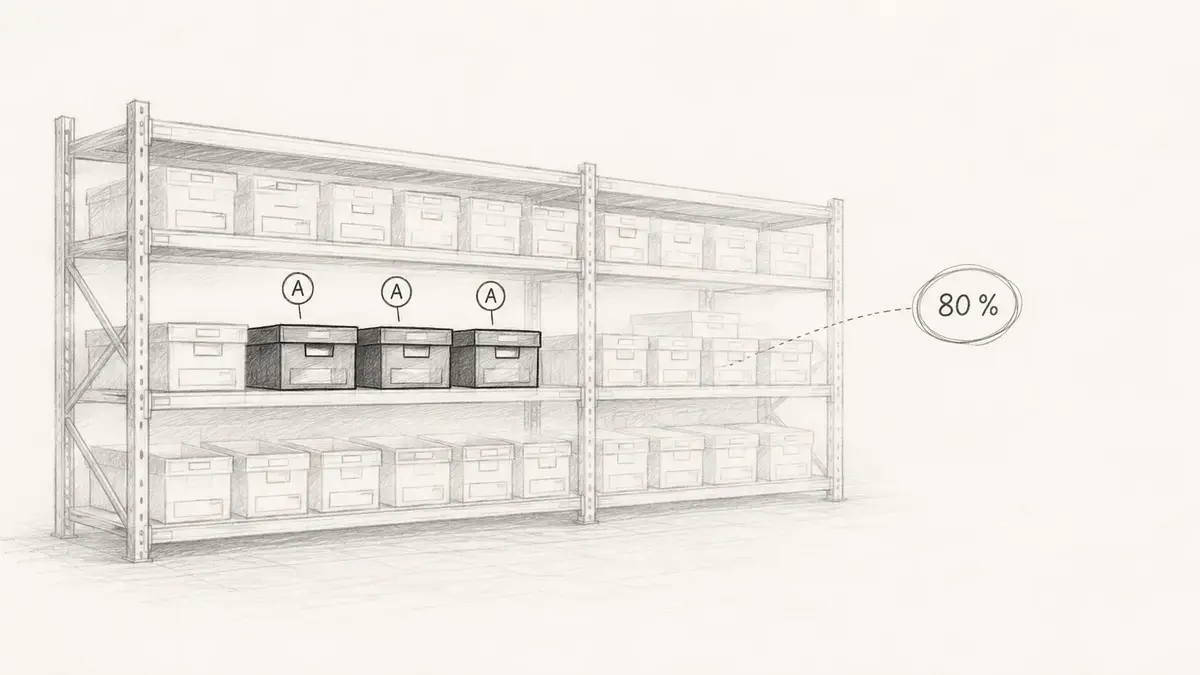
A-items first. The twenty percent of items with the highest consumption value deserve the most precise planning. For C-items a rough rule of thumb is enough.
Conclusion
Whoever keeps safety stock, reorder point and maximum stock apart makes ordering decisions with a system rather than by gut feeling. The average stock level provides the basis for turnover, days in inventory and inventory value, and the choice between the simple formula and the monthly average decides how accurate those downstream figures are.
What stays decisive is the reconciliation. A book stock is only as reliable as the postings that form it. As long as every movement is recorded and counted regularly, the stock picture holds. The moment the first gap appears, the book stock drifts from the physical stock, and the overview starts to crumble.
FAQs on stock level
The opening stock of a period is the closing stock of the one before it. When you start keeping stock records there is no predecessor, so it comes from a count: count the item once in full and post that quantity as the opening stock. Without that first counted figure, every later formula builds on an estimate.
Stock level is called "Lagerbestand" in German. "Bestand" refers to the quantity on hand, "Lager" to the warehouse, so "Lagerbestand" is the quantity held in stock. Related terms are "Lagerwert" (inventory value) and "Buchbestand" (book stock).